Coelho Lara E, Jenkins Cathy A, Shepherd Bryan E, Pape Jean W, Mejia Cordero Fernando, Padgett Denis, Crabtree Ramirez Brenda, Grinsztejn Beatriz, Althoff Keri N, Koethe John R, Marconi Vincent C, Tien Phyllis C, Willig Amanda L, Moore Richard D, Castilho Jessica L, Colasanti Jonathan, Crane Heidi M, Gill M John, Horberg Michael A, Mayor Angel, Silverberg Michael J, McGowan Catherine, Rebeiro Peter F
Instituto Nacional de Infectologia Evandro Chagas (INI), Fundação Oswaldo Cruz, Rio de Janeiro, Brazil.
Department of Biostatistics, Vanderbilt University Medical Center, Nashville, TN, USA.
Lancet Reg Health Am. 2022 Apr;8. doi: 10.1016/j.lana.2021.100173. Epub 2022 Jan 5.
An obesity epidemic has been documented among adult Latinos/as in Latin America and the United States (US); however, little is known about obesity among Latinos/as with HIV (PWH). Moreover, Latinos/as PWH in the US may have different weight trajectories than those in Latin America due to the cultural and environmental contexts. We assessed weight and body mass index (BMI) trajectories among PWH initiating antiretroviral therapy (ART) across 5 countries in Latin America and the Caribbean and the US.
ART-naÿve PWH ≥18 years old, enrolled in Brazil, Honduras, Mexico, Peru, and Haiti (sites within CCA-SAnet) and the US (NA-ACCORD) starting ART between 2000 and 2017, with at least one weight measured after ART initiation were included. Participants were classified according to site/ethnicity as: Latinos/as in US, non-Latinos/as in US, Haitians, and Latinos/as in Latin America. Generalized least squares models were used to assess trends in weight and BMI. Models estimating probabilities of becoming overweight/obese (BMI ≥25 kg/m) and of becoming obese (BMI ≥30 kg/m) post ART initiation for males and females were fit using generalized estimating equations with a logit link and an independence working correlation structure.
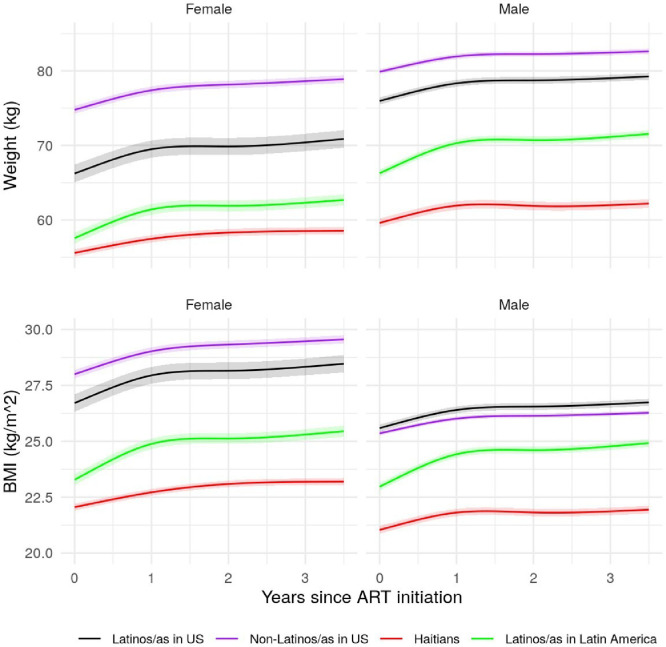
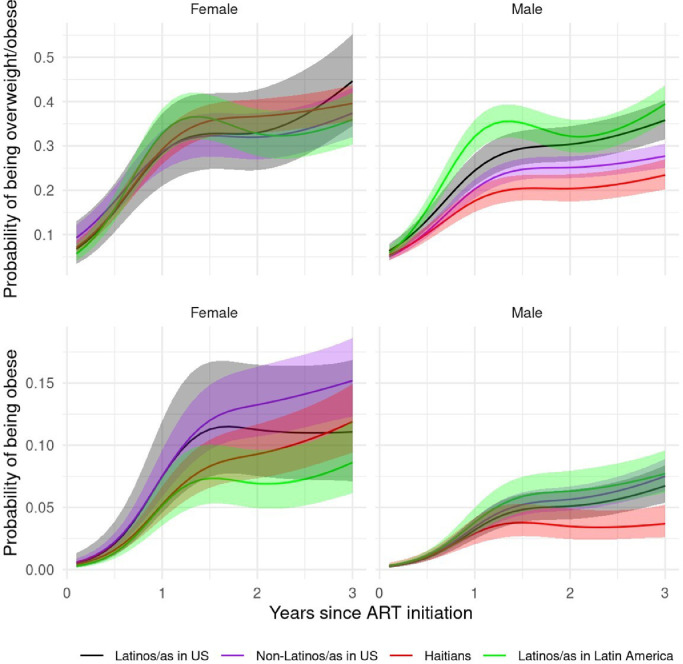
Among 59,207 PWH, 9% were Latinos/as from Latin America, 9% Latinos/as from the US, 68% non-Latinos/as from the US and 14% were Haitian. At ART initiation, 29% were overweight and 14% were obese. Post-ART weight and BMI increases were steeper for Latinos/as in Latin America compared with other sites/ethnicities; however, BMI at 3-years post ART remained lower compared to Latinos/as and non-Latinos/as in the US. Among females, at 3-years post ART initiation the greatest adjusted probability of obesity was found among non-Latinas in the US (15·2%) and lowest among Latinas in Latin America (8.6%). Among males, while starting with a lower BMI, Latinos in Latin America had the greatest adjusted probability of becoming overweight or obese 3-years post-ART initiation.
In the Americas, PWH gain substantial weight after ART initiation. Despite environmental and cultural differences, PWH in Latin America, Haiti and Latinos and non-Latinos in the US share similar BMI trajectories on ART and high probabilities of becoming overweight and obese over time. Multicohort studies are needed to better understand the burden of other metabolic syndrome components in PWH across different countries.
拉丁美洲和美国的成年拉丁裔人群中已出现肥胖流行情况;然而,对于感染艾滋病毒的拉丁裔人群(艾滋病毒感染者)的肥胖情况却知之甚少。此外,由于文化和环境背景的差异,美国的艾滋病毒感染拉丁裔人群的体重变化轨迹可能与拉丁美洲的不同。我们评估了拉丁美洲、加勒比地区和美国5个国家开始接受抗逆转录病毒治疗(ART)的艾滋病毒感染者的体重和体重指数(BMI)变化轨迹。
纳入2000年至2017年间在巴西、洪都拉斯、墨西哥、秘鲁和海地(CCA-SAnet项目点)以及美国(NA-ACCORD项目)开始接受ART治疗、年龄≥18岁且在开始ART治疗后至少测量过一次体重的初治艾滋病毒感染者。参与者根据地点/种族分类为:美国的拉丁裔、美国的非拉丁裔、海地人以及拉丁美洲的拉丁裔。使用广义最小二乘法模型评估体重和BMI的变化趋势。使用具有logit链接和独立工作相关结构的广义估计方程拟合模型,以估计男性和女性在开始ART治疗后超重/肥胖(BMI≥25 kg/m²)和肥胖(BMI≥30 kg/m²)的概率。
在59207名艾滋病毒感染者中,9%是来自拉丁美洲的拉丁裔,9%是来自美国的拉丁裔,68%是来自美国的非拉丁裔,14%是海地人。开始ART治疗时,29%的人超重,14%的人肥胖。与其他地点/种族相比,拉丁美洲的艾滋病毒感染拉丁裔人群在开始ART治疗后的体重和BMI增加更为明显;然而,开始ART治疗3年后的BMI仍低于美国的拉丁裔和非拉丁裔。在女性中,开始ART治疗3年后,肥胖调整后概率最高的是美国的非拉丁裔女性(15.2%),最低的是拉丁美洲的拉丁裔女性(8.6%)。在男性中,尽管开始时BMI较低,但拉丁美洲的拉丁裔男性在开始ART治疗3年后超重或肥胖的调整后概率最高。
在美洲,艾滋病毒感染者在开始ART治疗后体重显著增加。尽管存在环境和文化差异,但拉丁美洲、海地的艾滋病毒感染者以及美国的拉丁裔和非拉丁裔在接受ART治疗后的BMI变化轨迹相似,且随着时间推移超重和肥胖的概率较高。需要开展多队列研究,以更好地了解不同国家艾滋病毒感染者中其他代谢综合征成分的负担。