Edwards Katie A, Leete Jacqueline J, Smith Ethan G, Quick Alycia, Modica Claire M, Wassermann Eric M, Polejaeva Elena, Dell Kristine C, LoPresti Matthew, Walker Peter, O'Brien Meghan, Lai Chen, Qu Bao-Xi, Devoto Christina, Carr Walter, Stone James R, Ahlers Stephen T, Gill Jessica M
Biomarkers of Trauma, National Institute of Nursing Research, National Institutes of Health, Bethesda, MD, United States.
Henry M. Jackson Foundation for the Advancement of Military Medicine, Bethesda, MD, United States.
Front Neurol. 2022 Apr 21;13:723923. doi: 10.3389/fneur.2022.723923. eCollection 2022.
The purpose of this pilot study was to determine if military service members with histories of hundreds to thousands of low-level blast exposures (i. e., experienced breachers) had different levels of serum and neuronal-derived extracellular vesicle (EV) concentrations of interleukin (IL)-6, IL-10, and tumor necrosis factor alpha (TNFα), compared to matched controls, and if these biomarkers related to neurobehavioral symptoms.
Participants were experienced breachers ( = 20) and matched controls without blast exposures ( = 14). Neuronal-derived EVs were isolated from serum and identified with mouse anti-human CD171. Serum and neuronal-derived EVs were analyzed for IL-6, IL-10, and TNFα using an ultra-sensitive assay.
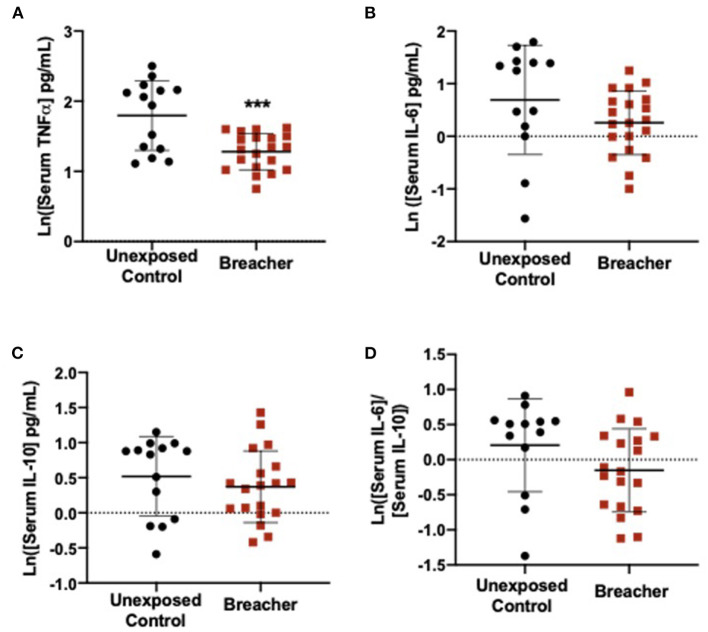
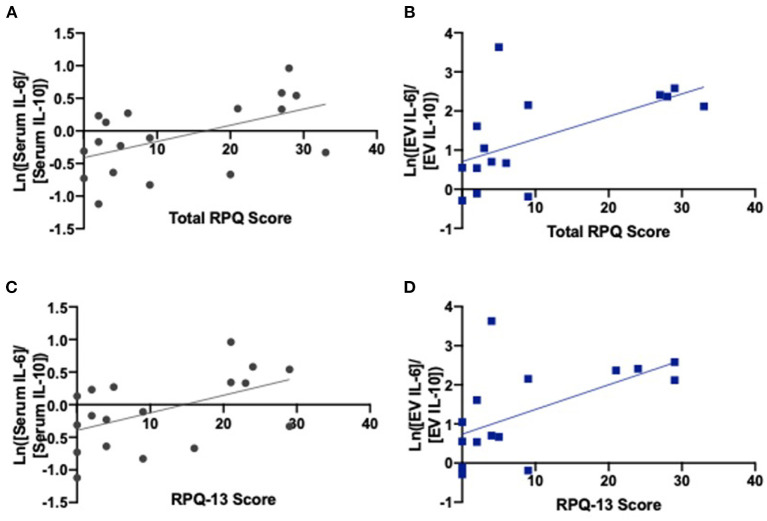
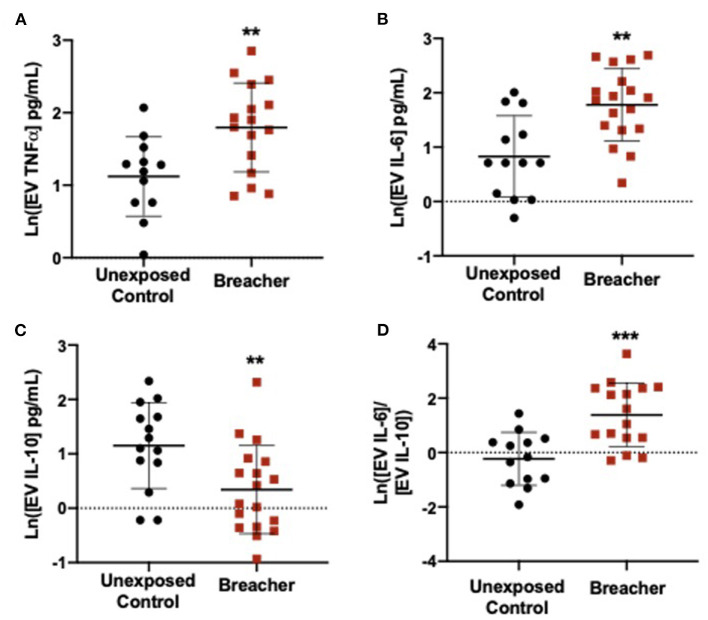
Serum TNFα concentrations were decreased in breachers when compared to control concentrations ( < 0.01). There were no differences in serum concentrations of IL-6, IL-10, or the IL-6/IL-10 ratio between breachers and controls ('s > 0.01). In neuronal-derived EVs, TNFα and IL-6 levels were increased in breachers compared to controls ('s < 0.01), and IL-10 levels were decreased in the breacher group compared to controls ( < 0.01). In breachers the IL-6/IL-10 ratio in neuronal-derived EVs was higher compared to controls, which correlated with higher total Rivermead Post-concussion Questionnaire (RPQ) scores ('s < 0.05).
These findings suggest that exposure of personnel to high numbers of low-level blast over a career may result in enduring central inflammation that is associated with chronic neurological symptoms. The data also suggest that peripheral markers of inflammation are not necessarily adequate surrogates for central neuroinflammation.
本初步研究的目的是确定有数百至数千次低强度爆炸暴露史的军人(即有经验的爆破人员)与匹配的对照组相比,其血清和神经元衍生的细胞外囊泡(EV)中白细胞介素(IL)-6、IL-10和肿瘤坏死因子α(TNFα)的浓度水平是否不同,以及这些生物标志物是否与神经行为症状相关。
参与者为有经验的爆破人员(n = 20)和无爆炸暴露史的匹配对照组(n = 14)。从血清中分离出神经元衍生的EV,并使用小鼠抗人CD171进行鉴定。使用超灵敏检测法分析血清和神经元衍生的EV中的IL-6、IL-10和TNFα。
与对照组浓度相比,爆破人员的血清TNFα浓度降低(P < 0.01)。爆破人员与对照组之间血清IL-6、IL-10浓度或IL-6/IL-10比值无差异(P值> 0.01)。在神经元衍生的EV中,与对照组相比,爆破人员中的TNFα和IL-6水平升高(P值< 0.01),与对照组相比,爆破人员组中的IL-10水平降低(P < 0.01)。在爆破人员中,神经元衍生的EV中的IL-6/IL-10比值高于对照组,这与较高的Rivermead脑震荡后问卷(RPQ)总分相关(P值< 0.05)。
这些发现表明,人员在职业生涯中暴露于大量低强度爆炸可能会导致持续的中枢炎症,这与慢性神经症状有关。数据还表明,炎症的外周标志物不一定是中枢神经炎症的充分替代指标。