Pandit Santosh, Gaska Karolina, Mokkapati V R S S, Forsberg Sven, Svensson Magnus, Kádár Roland, Mijakovic Ivan
Division of Systems Biology, Department of Biology and Biological Engineering, Chalmers University of Technology Kemivagen 10 Goteborg Sweden
Chalmers University of Technology, Industrial and Materials Science SE 412 96 Gothenburg Sweden
RSC Adv. 2019 Oct 17;9(57):33454-33459. doi: 10.1039/c9ra06773f. eCollection 2019 Oct 15.
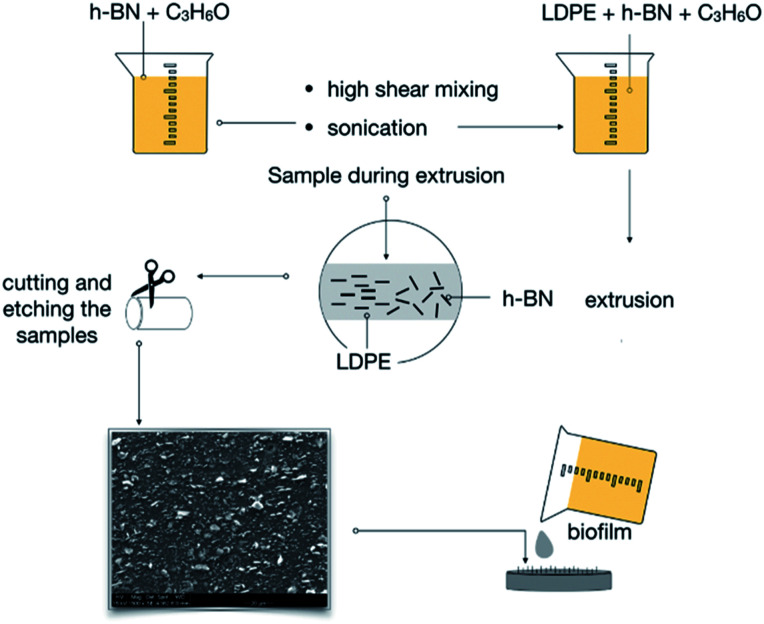
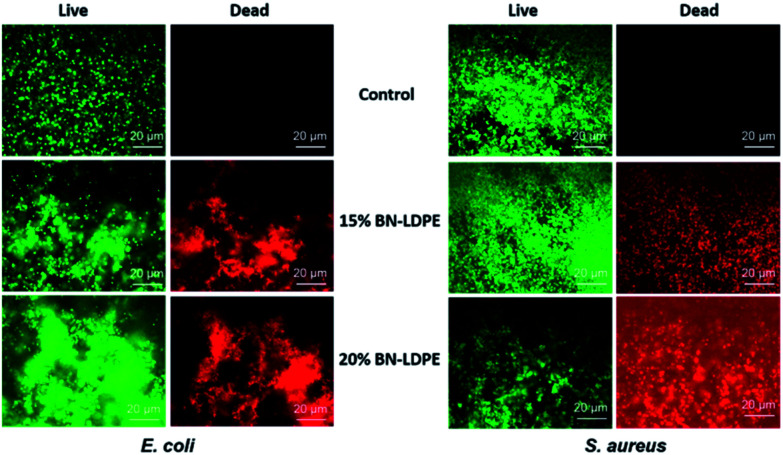
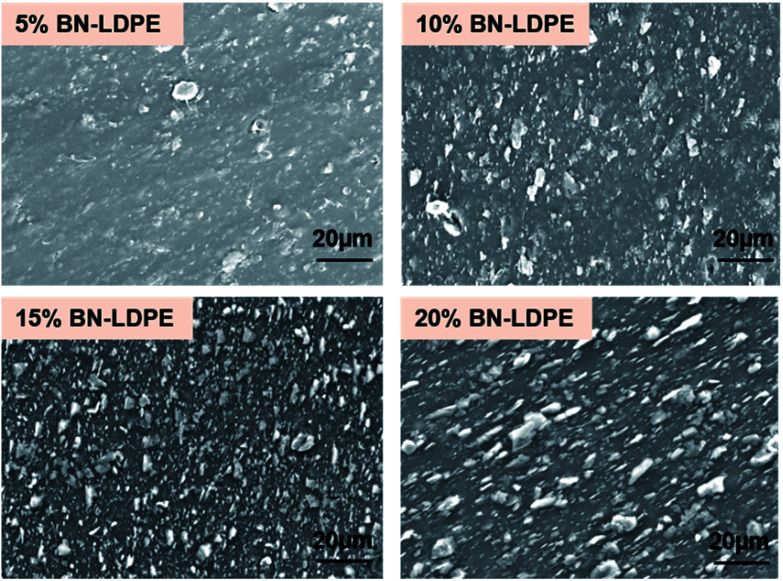
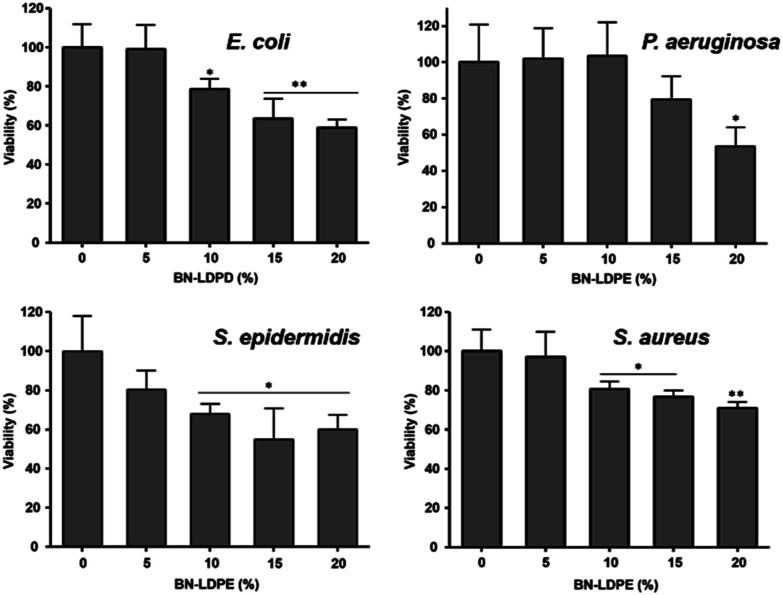
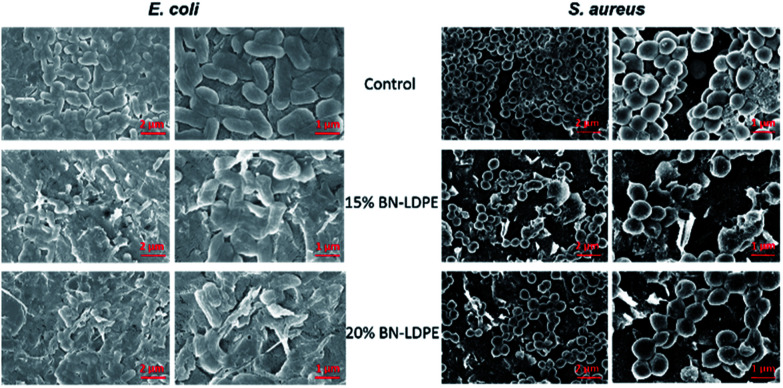
Boron nitride (BN) is a stable 2D material with physiochemical properties similar to graphene-based nanomaterials. We have recently demonstrated that vertically aligned coatings of graphene-based nanomaterials provide strong antibacterial effects on various surfaces. Here we investigated whether BN, a nanomaterial with extensive similarities to graphene, might exhibit similar antibacterial properties. To test this, we developed a novel composite material using BN and low density polyethylene (LDPE) polymer. The composite was extruded under controlled melt flow conditions leading to highly structured morphology, with BN oriented in the extrusion flow direction. Nanocomposite extruded surfaces perpendicular to the flow direction were etched, thus exposing BN nanoparticles embedded in the matrix. The antimicrobial activity of extruded samples was evaluated against , , and by the colony forming units (CFUs) counting method. Furthermore, the bactericidal effect of oriented BN against and was evaluated by scanning electron microscopy (SEM) and live/dead viability assay. Our results suggest that BN nanoflakes on the extruded BN/LDPE composite physically interact with the bacterial cellular envelope, leading to irreparable physical damage. Therefore, we propose that BN-polymer composites might be useful to develop polymer based biomedical devices protected against bacterial adhesion, and thus minimize device associated infections.
氮化硼(BN)是一种稳定的二维材料,其理化性质与石墨烯基纳米材料相似。我们最近证明,石墨烯基纳米材料的垂直排列涂层对各种表面具有强大的抗菌作用。在此,我们研究了与石墨烯有诸多相似之处的纳米材料BN是否可能表现出类似的抗菌特性。为了验证这一点,我们使用BN和低密度聚乙烯(LDPE)聚合物开发了一种新型复合材料。该复合材料在可控的熔体流动条件下挤出,形成高度结构化的形态,BN沿挤出流动方向排列。垂直于流动方向的纳米复合材料挤出表面经过蚀刻,从而暴露出嵌入基质中的BN纳米颗粒。通过菌落形成单位(CFU)计数法评估挤出样品对金黄色葡萄球菌、大肠杆菌、铜绿假单胞菌和白色念珠菌的抗菌活性。此外,通过扫描电子显微镜(SEM)和活/死细胞活力测定法评估定向BN对金黄色葡萄球菌和大肠杆菌的杀菌效果。我们的结果表明,挤出的BN/LDPE复合材料上的BN纳米片与细菌细胞膜发生物理相互作用,导致无法修复的物理损伤。因此,我们认为BN-聚合物复合材料可能有助于开发基于聚合物的生物医学设备,防止细菌粘附,从而将与设备相关的感染降至最低。