Zeng Peng, Su Hong-Fei, Ye Chao-Yuan, Qiu Shuo-Wen, Shi Anbing, Wang Jian-Zhi, Zhou Xin-Wen, Tian Qing
Department of Pathology and Pathophysiology, School of Basic Medicine, Tongji Medical College, Key Laboratory of Neurological Disease of National Education Ministry, Huazhong University of Science and Technology, Wuhan, China.
Department of Biochemistry and Molecular Biology, School of Basic Medicine, Tongji Medical College, Cell Architecture Research Institute, Huazhong University of Science and Technology, Wuhan, China.
Front Pharmacol. 2022 Apr 21;13:877806. doi: 10.3389/fphar.2022.877806. eCollection 2022.
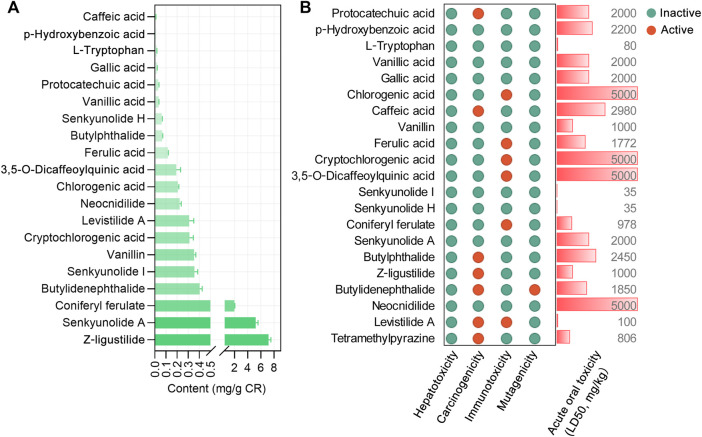
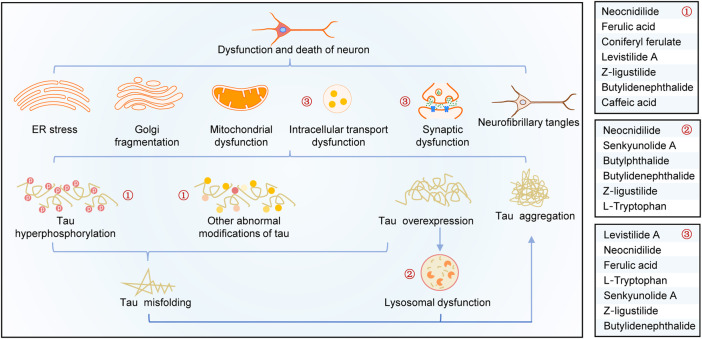
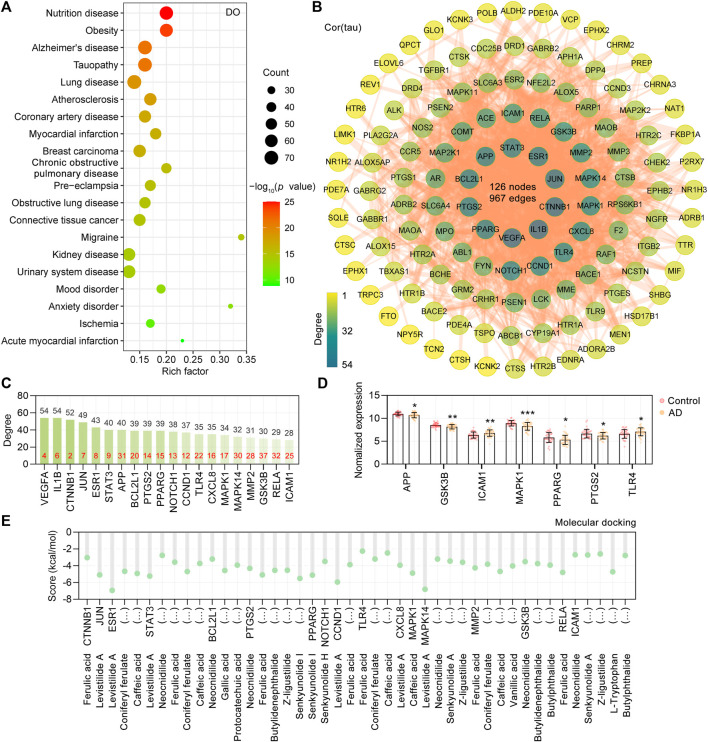
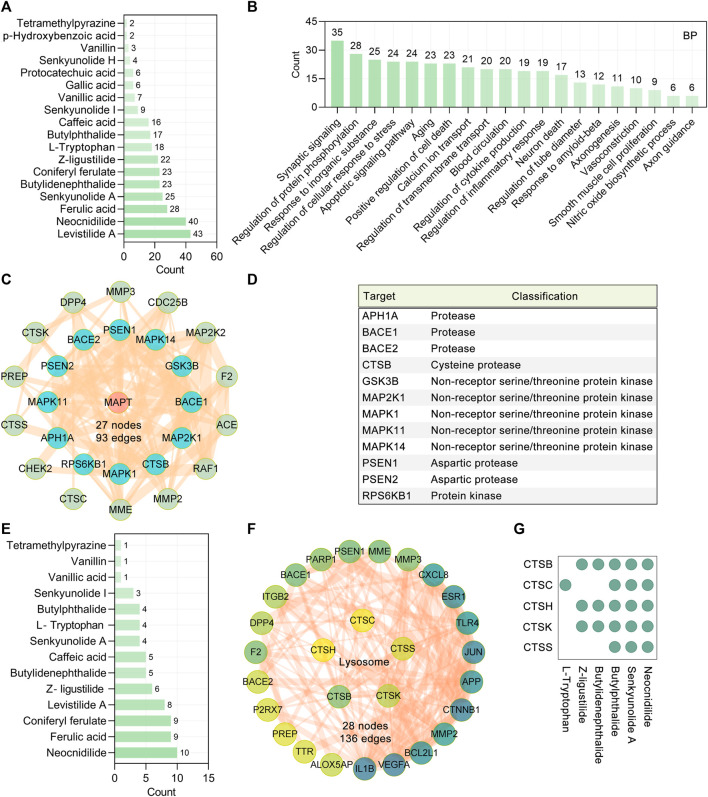
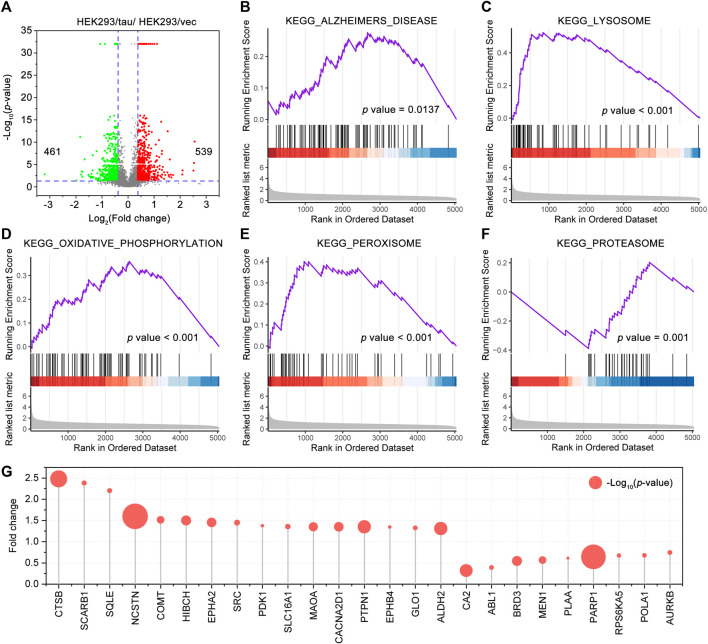
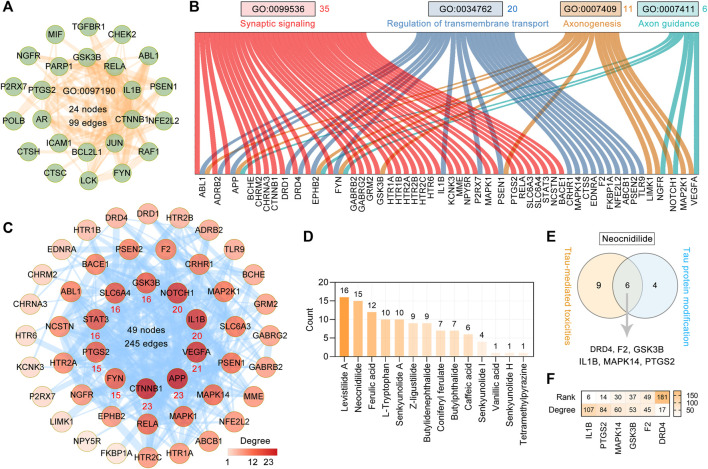
Alzheimer's disease (AD) is the most common cause of neurodegenerative dementia and one of the top medical concerns worldwide. Currently, the approved drugs to treat AD are effective only in treating the symptoms, but do not cure or prevent AD. Although the exact causes of AD are not understood, it is recognized that tau aggregation in neurons plays a key role. (CR) has been widely reported as effective for brain diseases such as dementia. Thus, we explored the protections of CR in AD by a tau pathogenesis-based network pharmacology approach. According to ultra-HPLC with triple quadrupole mass spectrometry data and Lipinski's rule of five, 18 bioactive phytochemicals of CR were screened out. They were shown corresponding to 127 tau pathogenesis-related targets, among which VEGFA, IL1B, CTNNB1, JUN, ESR1, STAT3, APP, BCL2L1, PTGS2, and PPARG were identified as the core ones. We further analyzed the specific actions of CR-active phytochemicals on tau pathogenesis from the aspects of tau aggregation and tau-mediated toxicities. It was shown that neocnidilide, ferulic acid, coniferyl ferulate, levistilide A, Z-ligustilide, butylidenephthalide, and caffeic acid can be effective in reversing tau hyperphosphorylation. Neocnidilide, senkyunolide A, butylphthalide, butylidenephthalide, Z-ligustilide, and L-tryptophan may be effective in promoting lysosome-associated degradation of tau, and levistilide A, neocnidilide, ferulic acid, L-tryptophan, senkyunolide A, Z-ligustilide, and butylidenephthalide may antagonize tau-mediated impairments of intracellular transport, axon and synaptic damages, and neuron death (especially apoptosis). The present study suggests that acting on tau aggregation and tau-mediated toxicities is part of the therapeutic mechanism of CR against AD.
阿尔茨海默病(AD)是神经退行性痴呆最常见的病因,也是全球主要的医学关注问题之一。目前,获批用于治疗AD的药物仅能有效缓解症状,无法治愈或预防AD。尽管AD的确切病因尚不清楚,但人们认识到神经元中的tau蛋白聚集起关键作用。据报道,白藜芦醇(CR)对痴呆等脑部疾病有效。因此,我们采用基于tau蛋白致病机制的网络药理学方法,探索CR对AD的保护作用。根据超高效液相色谱-三重四极杆质谱数据和Lipinski五规则,筛选出CR的18种具有生物活性的植物化学物质。它们对应127个与tau蛋白致病机制相关的靶点,其中血管内皮生长因子A(VEGFA)、白细胞介素1β(IL1B)、β-连环蛋白(CTNNB1)、Jun原癌基因(JUN)、雌激素受体1(ESR1)、信号转导和转录激活因子3(STAT3)、淀粉样前体蛋白(APP)、B细胞淋巴瘤-2样蛋白1(BCL2L1)、前列腺素内过氧化物合酶2(PTGS2)和过氧化物酶体增殖物激活受体γ(PPARG)被确定为核心靶点。我们从tau蛋白聚集和tau蛋白介导的毒性方面,进一步分析了CR活性植物化学物质对tau蛋白致病机制的具体作用。结果表明,新蛇床内酯、阿魏酸、阿魏酸松柏酯、藁本内酯A、Z-藁本内酯、丁烯基苯酞和咖啡酸可有效逆转tau蛋白过度磷酸化。新蛇床内酯、蛇床子素A、丁苯酞、丁烯基苯酞、Z-藁本内酯和L-色氨酸可能有效促进tau蛋白与溶酶体相关的降解,而藁本内酯A、新蛇床内酯、阿魏酸、L-色氨酸、蛇床子素A、Z-藁本内酯和丁烯基苯酞可能拮抗tau蛋白介导的细胞内运输损伤、轴突和突触损伤以及神经元死亡(尤其是细胞凋亡)。本研究表明,作用于tau蛋白聚集和tau蛋白介导的毒性是CR治疗AD的部分作用机制。