Bañuelos Gimeno J, Blanco A, Díaz J, Linares C, López J A, Navas M A, Sánchez-Martínez G, Luna Y, Hervella B, Belda F, Culqui D R
Reference Unit on Climate Change, Health and Urban Environment, National School of Health, Carlos III Health Institute, Monforte de Lemos, 5, 28029 Madrid, Spain.
Department of Preventive Medicine and Public Health and Microbiology, Autonomous University of Madrid, Arzobispo Morcillo, 4, 28029 Madrid, Spain.
Int J Environ Sci Technol (Tehran). 2023;20(3):2869-2882. doi: 10.1007/s13762-022-04190-z. Epub 2022 May 4.
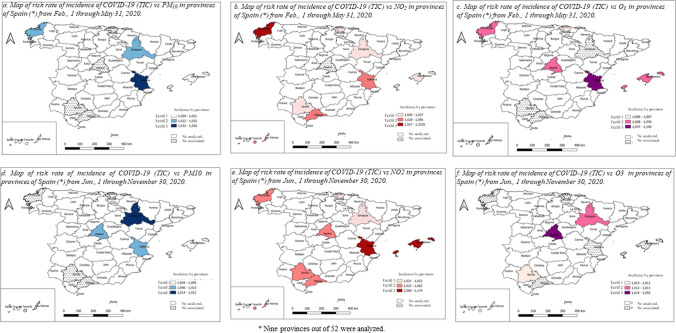
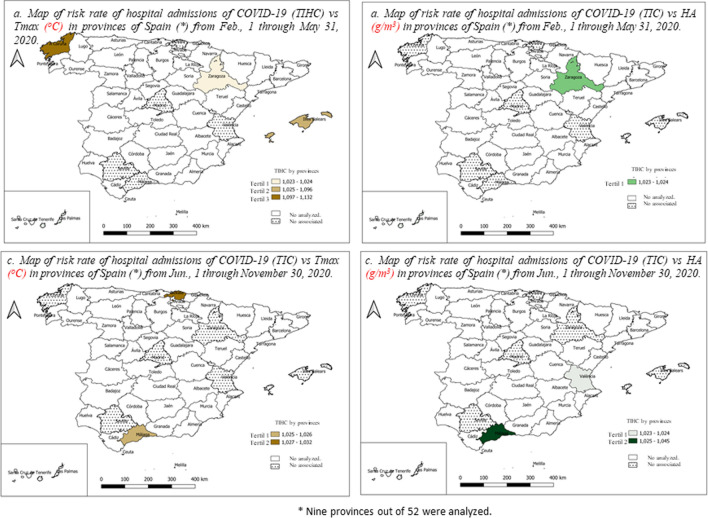
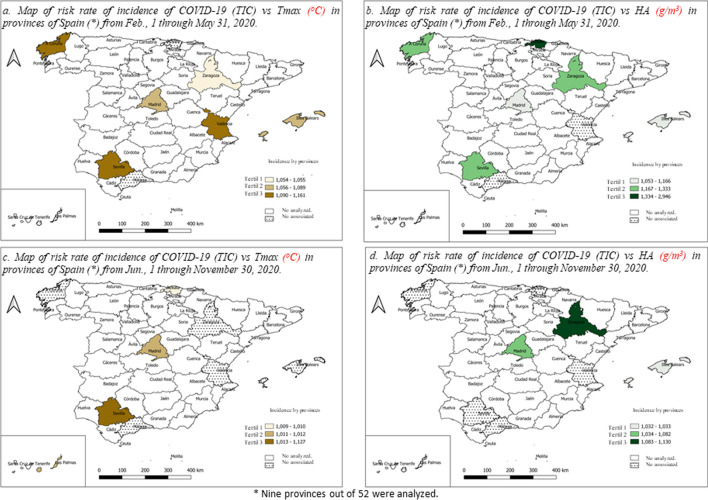
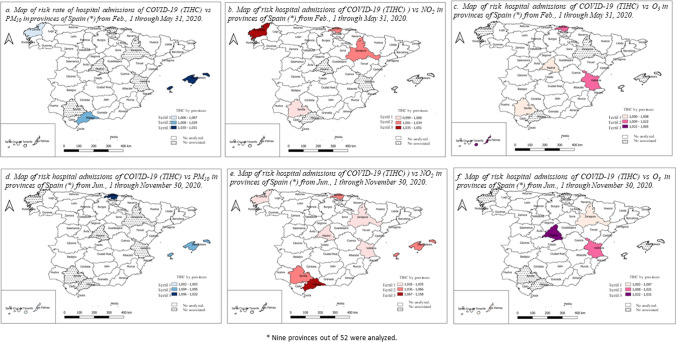
The aim of this research is to study the influence of atmospheric pollutants and meteorological variables on the incidence rate of COVID-19 and the rate of hospital admissions due to COVID-19 during the first and second waves in nine Spanish provinces. Numerous studies analyze the effect of environmental and pollution variables separately, but few that include them in the same analysis together, and even fewer that compare their effects between the first and second waves of the virus. This study was conducted in nine of 52 Spanish provinces, using generalized linear models with Poisson link between levels of PM, NO and O (independent variables) and maximum temperature and absolute humidity and the rates of incidence and hospital admissions of COVID-19 (dependent variables), establishing a series of significant lags. Using the estimators obtained from the significant multivariate models, the relative risks associated with these variables were calculated for increases of 10 µg/m for pollutants, 1 °C for temperature and 1 g/m for humidity. The results suggest that NO has a greater association than the other air pollution variables and the meteorological variables. There was a greater association with O in the first wave and with NO in the second. Pollutants showed a homogeneous distribution across the country. We conclude that, compared to other air pollutants and meteorological variables, NO is a protagonist that may modulate the incidence and severity of COVID-19, though preventive public health measures such as masking and hand washing are still very important.
The online version contains supplementary material available at 10.1007/s13762-022-04190-z.
本研究旨在探讨大气污染物和气象变量对西班牙九个省份第一波和第二波新冠疫情期间新冠病毒感染发病率及因新冠病毒感染住院率的影响。众多研究分别分析环境和污染变量的影响,但很少有研究将它们纳入同一分析,更少的研究比较病毒第一波和第二波期间它们的影响。本研究在西班牙52个省份中的9个省份开展,使用广义线性模型,以泊松链接表示细颗粒物(PM)、氮氧化物(NO)和臭氧(O)水平(自变量)与最高温度、绝对湿度以及新冠病毒感染发病率和住院率(因变量)之间的关系,并建立了一系列显著滞后关系。利用从显著多元模型中获得的估计值,计算污染物每增加10微克/立方米、温度每升高1摄氏度、湿度每增加1克/立方米时与这些变量相关的相对风险。结果表明,氮氧化物比其他空气污染变量和气象变量的关联性更强。第一波疫情中臭氧的关联性更强,第二波疫情中氮氧化物的关联性更强。污染物在全国分布均匀。我们得出结论,与其他空气污染物和气象变量相比,氮氧化物可能是调节新冠病毒感染发病率和严重程度的关键因素,尽管诸如戴口罩和洗手等预防性公共卫生措施仍然非常重要。
网络版包含可在10.1007/s13762-022-04190-z获取的补充材料。