National School of Public Health, Carlos III Institute of Health (ISCIII), Avda Monforte de Lemos 5, 28029, Madrid, Spain.
State Meteorological Agency (AEMET), Madrid, Spain.
Environ Sci Pollut Res Int. 2021 Oct;28(37):51948-51960. doi: 10.1007/s11356-021-14228-3. Epub 2021 May 16.
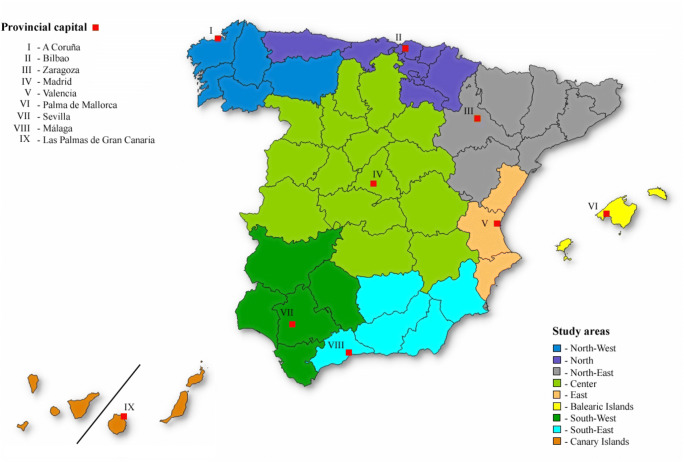
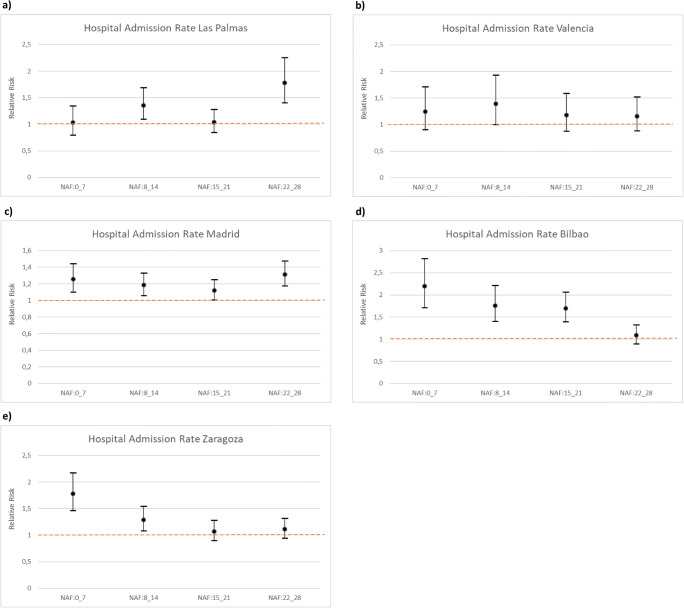
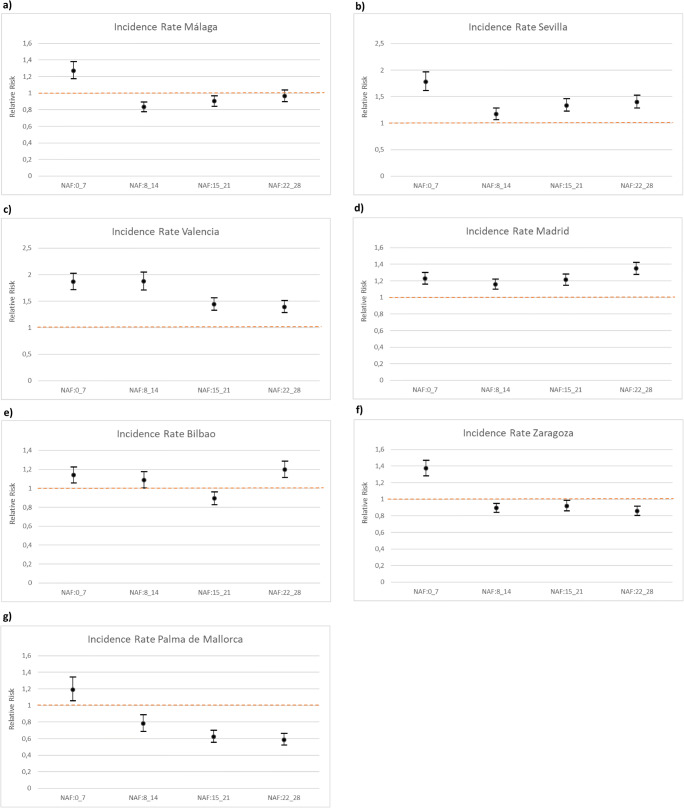
Scientific evidence suggests that Saharan dust intrusions in Southern Europe contribute to the worsening of multiple pathologies and increase the concentrations of particulate matter (PM) and other pollutants. However, few studies have examined whether Saharan dust intrusions influence the incidence and severity of COVID-19 cases. To address this question, in this study we carried out generalized linear models with Poisson link between incidence rates and daily hospital admissions and average daily concentrations of PM, NO, and O in nine Spanish regions for the period from February 1, 2020 to December 31, 2020. The models were adjusted by maximum daily temperature and average daily absolute humidity. Furthermore, we controlled for trend, seasonality, and the autoregressive nature of the series. The variable relating to Saharan dust intrusions was introduced using a dichotomous variable, NAF, averaged across daily lags in ranges of 0-7 days, 8-14 days, 14-21 days, and 22-28 days. The results obtained in this study suggest that chemical air pollutants, and especially NO, are related to the incidence and severity of COVID-19 in Spain. Furthermore, Saharan dust intrusions have an additional effect beyond what is attributable to the variation in air pollution; they are related, in different lags, to both the incidence and hospital admissions rates for COVID-19. These results serve to support public health measures that minimize population exposure on days with particulate matter advection from the Sahara.
科学证据表明,撒哈拉尘埃侵入对欧洲南部的多种病理状况的恶化起到推波助澜的作用,并增加了颗粒物(PM)和其他污染物的浓度。然而,很少有研究探讨撒哈拉尘埃侵入是否会影响 COVID-19 病例的发病率和严重程度。为了解决这个问题,在这项研究中,我们在西班牙九个地区进行了广义线性模型分析,其中发病率和每日住院人数与 PM、NO 和 O 的日平均浓度之间存在泊松关系。模型通过每日最高温度和日平均绝对湿度进行调整。此外,我们还控制了趋势、季节性和序列的自回归性质。撒哈拉尘埃侵入的相关变量使用二分类变量 NAF 表示,该变量在 0-7 天、8-14 天、14-21 天和 22-28 天的每日滞后范围内进行平均。本研究结果表明,化学空气污染物,特别是 NO,与西班牙 COVID-19 的发病率和严重程度有关。此外,撒哈拉尘埃侵入的影响超出了空气污染变化的归因,它们在不同的滞后时间与 COVID-19 的发病率和住院率都有关系。这些结果为支持旨在减少撒哈拉尘埃输送日对人群暴露的公共卫生措施提供了依据。