Cao Junmei, Meng Fanning, Gao Liguo, Yang Shuzhang, Yan Yeling, Wang Ning, Liu Anmin, Li Yanqiang, Ma Tingli
State Key Laboratory of Fine Chemicals, School of Petroleum and Chemical Engineering, Dalian University of Technology Panjin 124221 P. R. China
Graduate School of Life Science and Systems Engineering, Kyushu Institute of Technology Kitakyushu Fukuoka 808-0196 Japan
RSC Adv. 2019 Oct 23;9(59):34152-34157. doi: 10.1039/c9ra06091j.
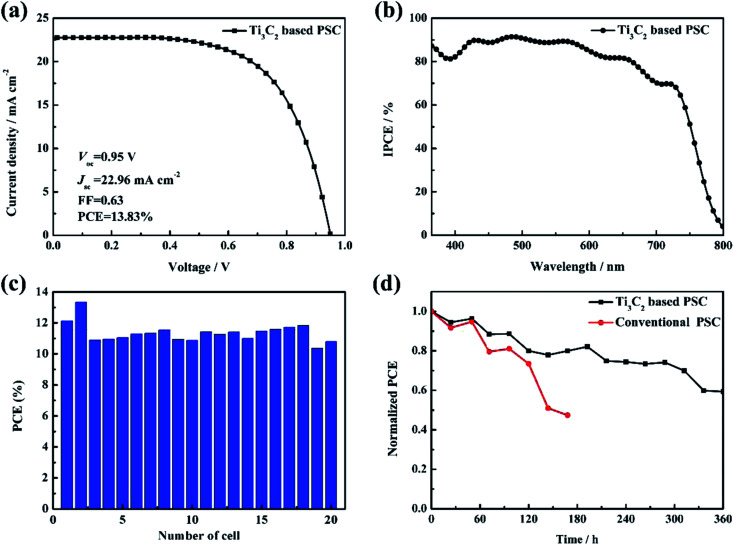
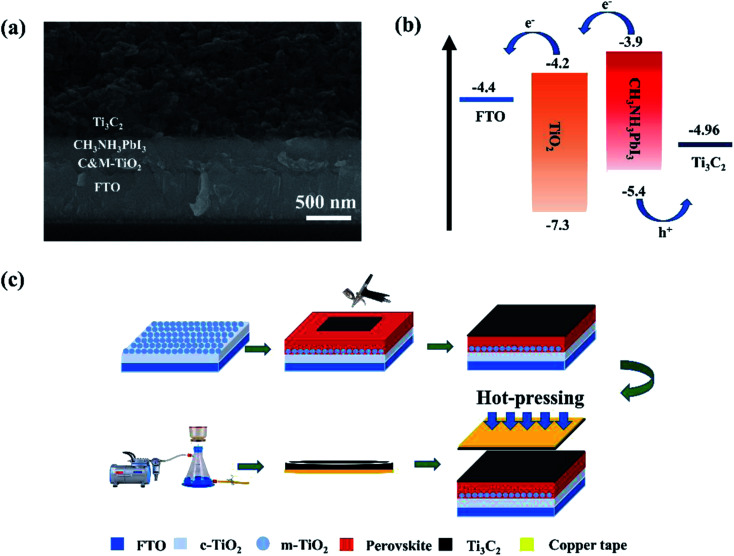
The high cost of hole transporting materials (HTMs) and noble metal electrodes limits the application of perovskite solar cells (PSCs). Carbon materials have been commonly utilized for HTMs and noble-metal-free PSCs. In this paper, a more conductive 2D MXene material (TiC), showing a similar energy level to carbon materials, has been used as a back electrode in HTMs and noble-metal-free PSCs for the first time. Seamless interfacial contact between the perovskite layer and TiC material was obtained using a simple hot-pressing method. After the adjustment of key parameters, the PSCs based on the TiC electrode show more stability and higher power conversion efficiencies (PCE) (13.83%, 27% higher than that (10.87%) of the PSCs based on carbon electrodes) due to the higher conductivity and seamless interfacial contact of the MXene electrode. Our work proposes a promising future application for MXene and also a good electrode candidate for HTM and the noble-metal-free PSCs.
空穴传输材料(HTMs)和贵金属电极的高成本限制了钙钛矿太阳能电池(PSCs)的应用。碳材料已被广泛用于HTMs和无贵金属的PSCs。在本文中,首次将一种导电性更强的二维MXene材料(TiC)用作HTMs和无贵金属PSCs的背电极,其能级与碳材料相似。通过简单的热压方法实现了钙钛矿层与TiC材料之间的无缝界面接触。在调整关键参数后,基于TiC电极的PSCs表现出更高的稳定性和功率转换效率(PCE)(13.83%,比基于碳电极的PSCs的10.87%高出27%),这归因于MXene电极具有更高的导电性和无缝界面接触。我们的工作为MXene提出了一个有前景的未来应用方向,同时也为HTM和无贵金属PSCs提供了一种优良的电极候选材料。