Xi Yuzhen, Ge Xiuhong, Ji Haiming, Wang Luoyu, Duan Shaofeng, Chen Haonan, Wang Mengze, Hu Hongjie, Jiang Feng, Ding Zhongxiang
Department of Radiology, Key Laboratory of Clinical Cancer Pharmacology and Toxicology Research of Zhejiang Province, Affiliated Hangzhou First People's Hospital, Cancer Center, Zhejiang University School of Medicine, Hangzhou, China.
Department of Radiology, 903rd Hospital of PLA, Hangzhou, China.
Front Oncol. 2022 Apr 22;12:824509. doi: 10.3389/fonc.2022.824509. eCollection 2022.
We aimed to establish an MRI radiomics model and a Delta radiomics model to predict tumor retraction after induction chemotherapy (IC) combined with concurrent chemoradiotherapy (CCRT) for primary nasopharyngeal carcinoma (NPC) in non-endemic areas and to validate its efficacy.
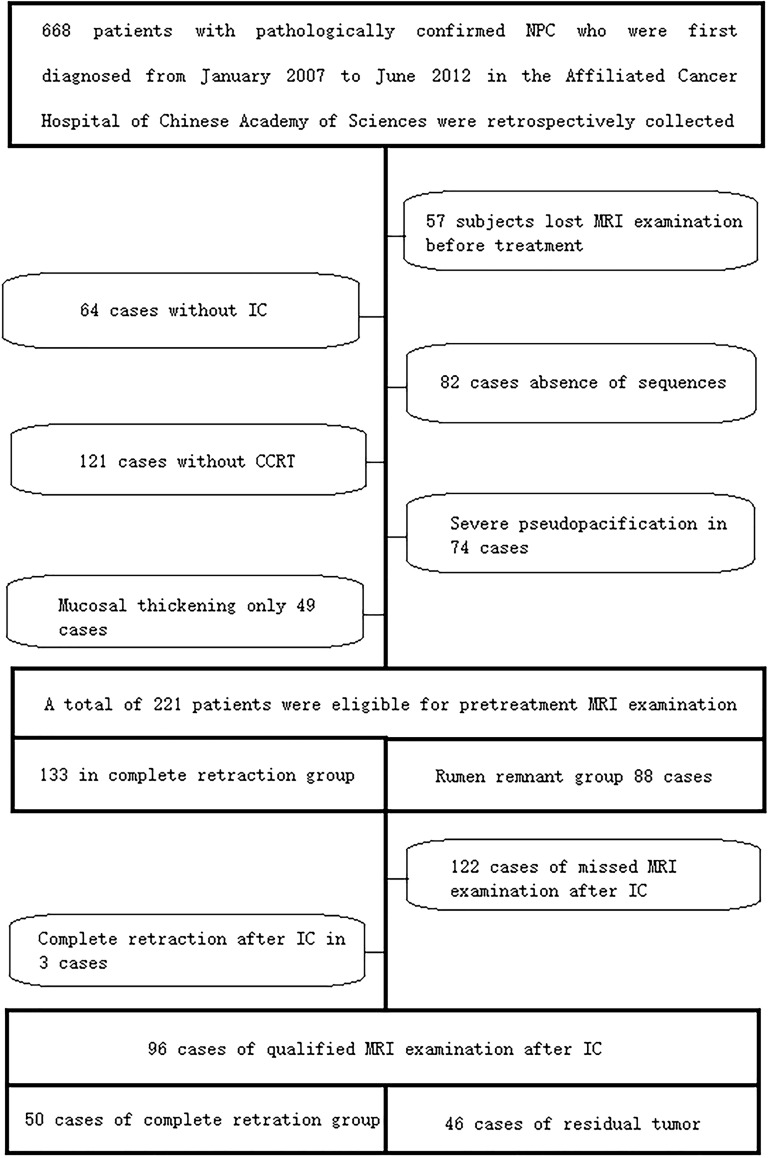
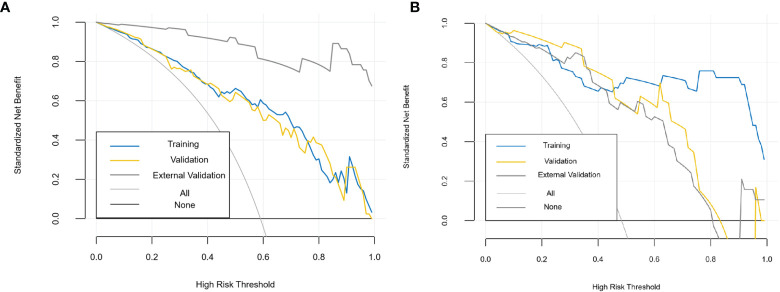
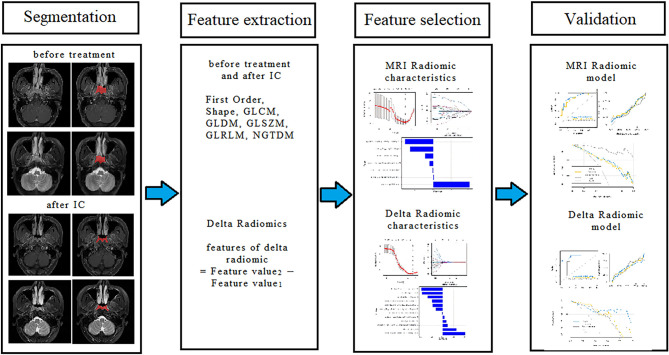
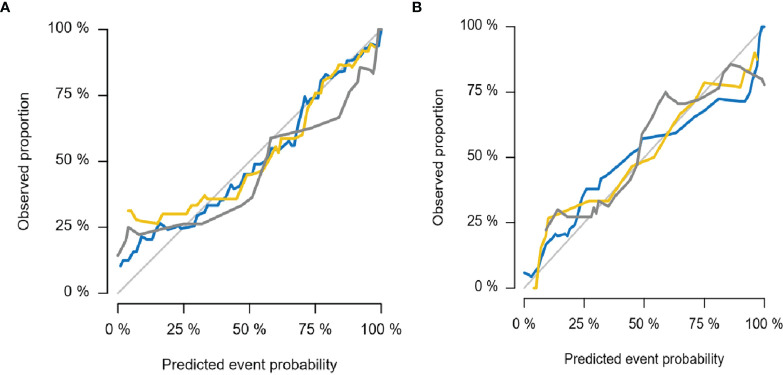
A total of 272 patients (155 in the training set, 66 in the internal validation set, and 51 in the external validation set) with biopsy pathologically confirmed primary NPC who were screened for pretreatment MRI were retrospectively collected. The NPC tumor was delineated as a region of interest in the two sequenced images of MRI before treatment and after IC, followed by radiomics feature extraction. With the use of maximum relevance minimum redundancy (mRMR) and least absolute shrinkage and selection operator (LASSO) algorithms, logistic regression was performed to establish pretreatment MRI radiomics and pre- and post-IC Delta radiomics models. The optimal Youden's index was taken; the receiver operating characteristic (ROC) curve, calibration curve, and decision curve were drawn to evaluate the predictive efficacy of different models.
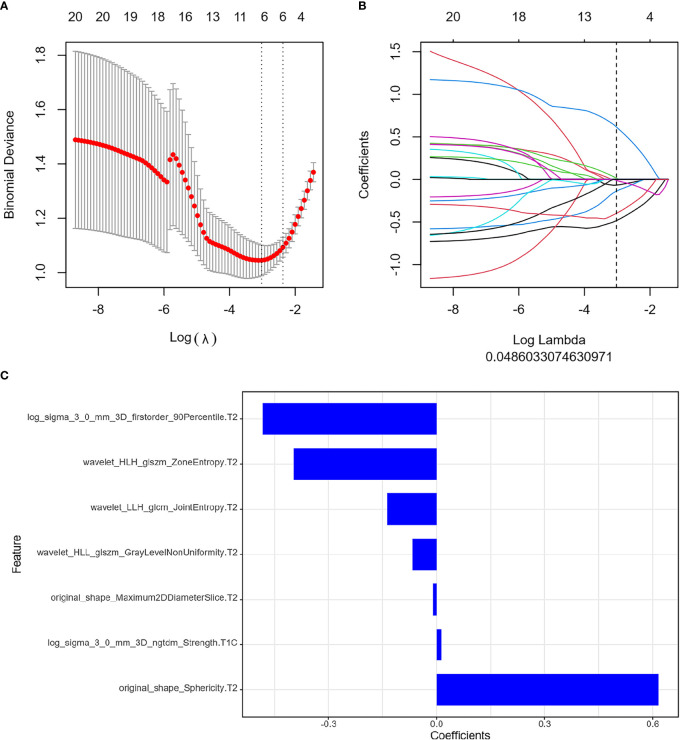
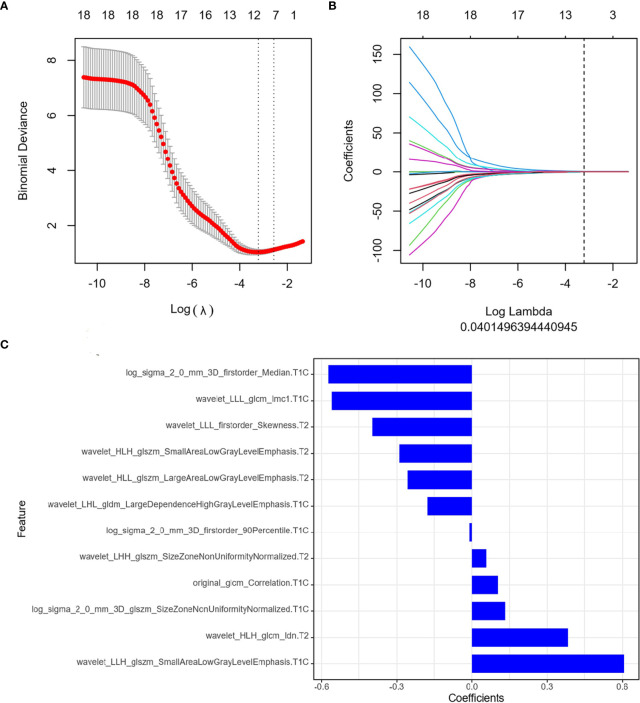
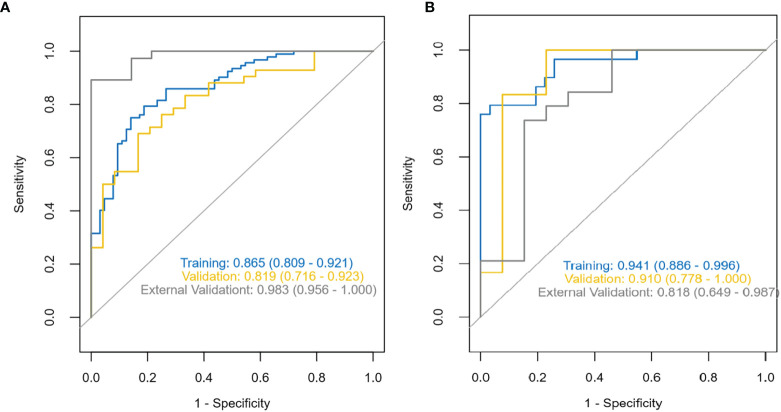
Seven optimal feature subsets were selected from the pretreatment MRI radiomics model, and twelve optimal subsets were selected from the Delta radiomics model. The area under the ROC curve, accuracy, sensitivity, specificity, negative predictive value (NPV), and positive predictive value (PPV) of the MRI radiomics model were 0.865, 0.827, 0.837, 0.813, 0.776, and 0.865, respectively; the corresponding indicators of the Delta radiomics model were 0.941, 0.883, 0.793, 0.968, 0.833, and 0.958, respectively.
The pretreatment MRI radiomics model and pre- and post-IC Delta radiomics models could predict the IC-CCRT response of NPC in non-epidemic areas.
我们旨在建立一个MRI放射组学模型和一个Delta放射组学模型,以预测非流行地区原发性鼻咽癌(NPC)诱导化疗(IC)联合同步放化疗(CCRT)后的肿瘤退缩情况,并验证其有效性。
回顾性收集了272例经活检病理确诊为原发性NPC且接受过治疗前MRI筛查的患者(训练集155例,内部验证集66例,外部验证集51例)。在治疗前和IC后的MRI序列图像中,将NPC肿瘤划定为感兴趣区域,随后进行放射组学特征提取。使用最大相关最小冗余(mRMR)和最小绝对收缩和选择算子(LASSO)算法,进行逻辑回归以建立治疗前MRI放射组学模型以及IC前后的Delta放射组学模型。取最佳约登指数;绘制受试者工作特征(ROC)曲线、校准曲线和决策曲线,以评估不同模型的预测效果。
从治疗前MRI放射组学模型中选择了7个最佳特征子集,从Delta放射组学模型中选择了12个最佳子集。MRI放射组学模型的ROC曲线下面积、准确性、敏感性、特异性、阴性预测值(NPV)和阳性预测值(PPV)分别为0.865、0.827、0.837、0.813、0.776和0.865;Delta放射组学模型的相应指标分别为0.941、0.883、0.793、0.968、0.833和0.958。
治疗前MRI放射组学模型以及IC前后的Delta放射组学模型可以预测非流行地区NPC的IC-CCRT反应。