Alghamdi Ali, Mazraani Nadia, Alghamdi Yara, Albugami Sarah M
Internal Medicine, King Saud Bin Abdulaziz University for Health Sciences, College of Medicine - Western Region, Ministry of National Guard Health Affairs. King Abdullah International Medical Research Center, Jeddah, SAU.
Family Medicine, King Abdulaziz Medical City, Ministry of National Guard Health Affairs, Jeddah, SAU.
Cureus. 2022 Apr 4;14(4):e23832. doi: 10.7759/cureus.23832. eCollection 2022 Apr.
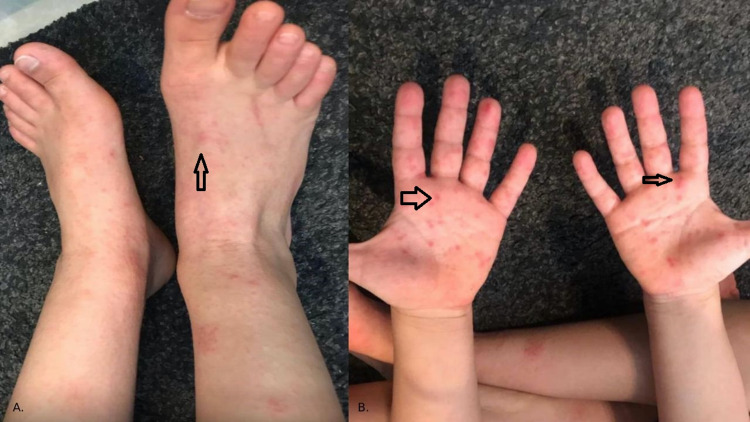
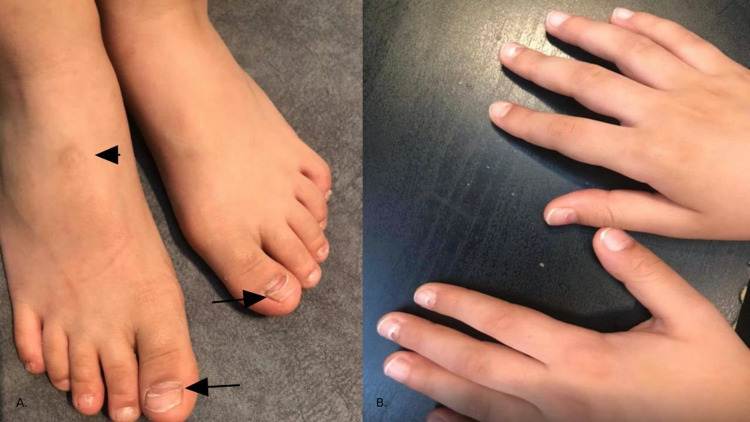
Hand-foot-and-mouth disease (HFMD) is a viral infection frequently encountered in the pediatric age group. Common culprits in such manifestations are coxsackievirus A16 and human enterovirus 71. The patient presents febrile with erythematous papulovesicular exanthems in the mouth, palms, and soles. HFMD is self-limiting in nature with a rare-complication rate. Onychomadesis is proximal nail separation while Beau's lines are whitish transverse lines and considered a rare complication of HFMD. Both allude to halted nail-matrix proliferation, and the pathophysiology behind such manifestations is still not yet understood. It is hypothesized that the virus elicits an inflammatory process, inhibiting nail-matrix proliferation or immune-complexes depositing on nails creating an embolism. Onychomadesis and Beau's lines appear after four to eight weeks of HFMD disease resolution and persist for approximately 35 days. There are no serious sequelae of those manifestations, as the nail basement is still intact. We present a case of a seven-year-old Saudi male presenting with nail changes, mainly onychomadesis and Beau's lines, after 35 days of HFMD disease resolution. All causes of nail changes have been ruled out and diagnosis of onychomycosis and Beau's lines secondary to HFDM has been established.
手足口病(HFMD)是儿科年龄组中常见的病毒感染。此类表现的常见病原体是柯萨奇病毒A16和人肠道病毒71型。患者发热,口腔、手掌和足底出现红斑性丘疹水疱疹。手足口病本质上是自限性的,并发症发生率很低。甲脱离是指甲近端分离,而博氏线是白色横线,被认为是手足口病的罕见并发症。两者均提示甲母质增殖停止,此类表现背后的病理生理学仍未明确。据推测,病毒引发炎症过程,抑制甲母质增殖或免疫复合物沉积在指甲上形成栓塞。甲脱离和博氏线在手足口病病情消退4至8周后出现,并持续约35天。这些表现没有严重后遗症,因为指甲基底仍然完好。我们报告一例7岁沙特男性病例,在手足口病病情消退35天后出现指甲改变,主要是甲脱离和博氏线。已排除所有导致指甲改变的原因,并确诊为手足口病继发的甲真菌病和博氏线。