Department of Biomedical Sciences, Humanitas University, Milan, Italy.
Department of Urology, Humanitas Mater Domini Hospital, Varese, Italy.
Int J Urol. 2022 Aug;29(8):890-896. doi: 10.1111/iju.14912. Epub 2022 May 9.
To evaluate the accuracy of a new electronic nose to recognize prostate cancer in urine samples.
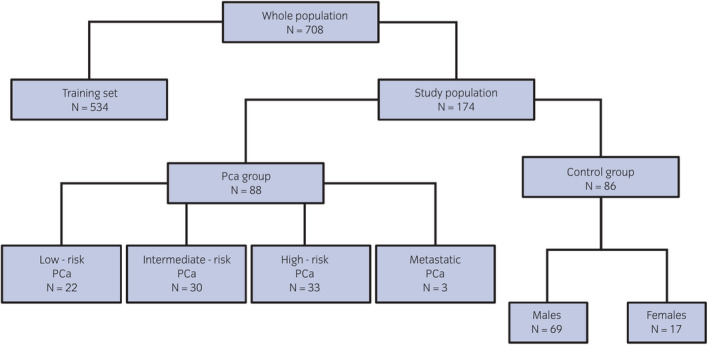
A blind, prospective study on consecutive patients was designed. Overall, 174 subjects were included in the study: 88 (50.6%) in prostate cancer group, and 86 (49.4%) in control group. Electronic nose performance for prostate cancer was assessed using sensitivity and specificity. The diagnostic accuracy of electronic nose was reported as area under the receiver operating characteristic curve.
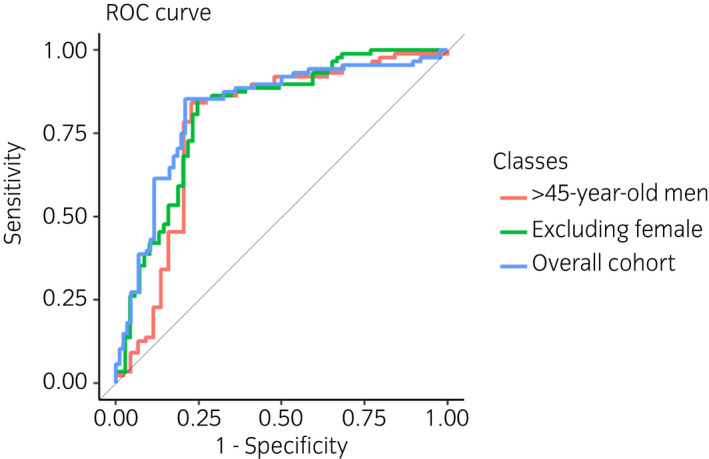
The electronic nose in the study population reached a sensitivity 85.2% (95% confidence interval 76.1-91.9; 13 false negatives out of 88), a specificity 79.1% (95% confidence interval 69.0-87.1; 18 false positives out of 86). The accuracy of the electronic nose represented as area under the receiver operating characteristic curve 0.821 (95% confidence interval 0.764-0.879).
The diagnostic accuracy of electronic nose for recognizing prostate cancer in urine samples is high, promising and susceptible to supplemental improvement. Additionally, further studies will be necessary to design a clinical trial to validate electronic nose application in diagnostic prostate cancer nomograms.
评估一种新型电子鼻识别尿液样本中前列腺癌的准确性。
设计了一项针对连续患者的盲法、前瞻性研究。共纳入 174 例受试者:前列腺癌组 88 例(50.6%),对照组 86 例(49.4%)。使用灵敏度和特异性评估电子鼻识别前列腺癌的性能。电子鼻的诊断准确性以受试者工作特征曲线下面积报告。
在研究人群中,电子鼻的灵敏度为 85.2%(95%置信区间 76.1-91.9;88 例中有 13 例假阴性),特异性为 79.1%(95%置信区间 69.0-87.1;86 例中有 18 例假阳性)。电子鼻的准确性表示为受试者工作特征曲线下面积 0.821(95%置信区间 0.764-0.879)。
电子鼻识别尿液样本中前列腺癌的诊断准确性较高,具有很高的应用潜力,有望进一步提高。此外,还需要进一步的研究来设计临床试验,以验证电子鼻在前列腺癌诊断列线图中的应用。