Department of Chemistry and Biochemistry, University of California San Diego, La Jolla, CA, 92093, USA.
Division of Biological Sciences, Section of Cell and Developmental Biology, University of California San Diego, La Jolla, CA, 92093, USA.
Nat Commun. 2022 May 9;13(1):2351. doi: 10.1038/s41467-022-29989-9.
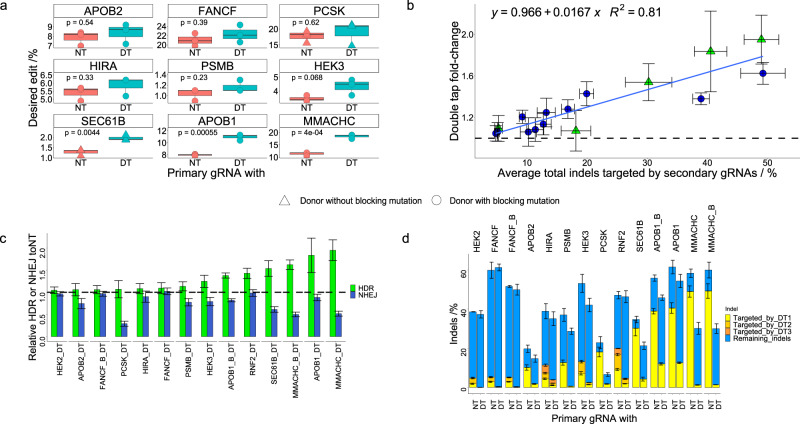
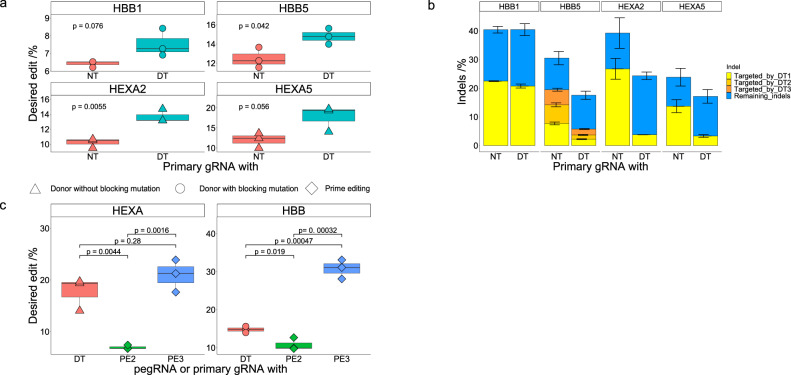
Programmable double-strand DNA breaks (DSBs) can be harnessed for precision genome editing through manipulation of the homology-directed repair (HDR) pathway. However, end-joining repair pathways often outcompete HDR and introduce insertions and deletions of bases (indels) at the DSB site, decreasing precision outcomes. It has been shown that indel sequences for a given DSB site are reproducible and can even be predicted. Here, we report a general strategy (the "double tap" method) to improve HDR-mediated precision genome editing efficiencies that takes advantage of the reproducible nature of indel sequences. The method simply involves the use of multiple gRNAs: a primary gRNA that targets the wild-type genomic sequence, and one or more secondary gRNAs that target the most common indel sequence(s), which in effect provides a "second chance" at HDR-mediated editing. This proof-of-principle study presents the double tap method as a simple yet effective option for enhancing precision editing in mammalian cells.
可编程双链 DNA 断裂 (DSB) 可通过同源定向修复 (HDR) 途径的操纵用于精确基因组编辑。然而,末端连接修复途径经常与 HDR 竞争,并在 DSB 位点引入碱基的插入和缺失 (indels),降低了精确性。已经表明,给定 DSB 位点的 indel 序列是可重复的,甚至可以预测。在这里,我们报告了一种通用策略(“双敲”方法),利用 indel 序列的可重复性来提高 HDR 介导的精确基因组编辑效率。该方法简单地涉及使用多个 gRNA:一个靶向野生型基因组序列的主要 gRNA,和一个或多个靶向最常见的 indel 序列的次要 gRNA,这实际上为 HDR 介导的编辑提供了“第二次机会”。这项原理验证研究提出了双敲方法,作为增强哺乳动物细胞精确编辑的简单而有效的选择。