Universitätsklinikum Jena, Institut für Physiologie II, Jena, Germany.
John von Neumann-Institut für Computing (NIC), Jülich Supercomputing Centre (JSC), and Institut für Biologische Informationsprozesse (IBI-7: Strukturbiochemie), Forschungszentrum Jülich GmbH, Jülich, Germany.
Commun Biol. 2022 May 9;5(1):430. doi: 10.1038/s42003-022-03360-6.
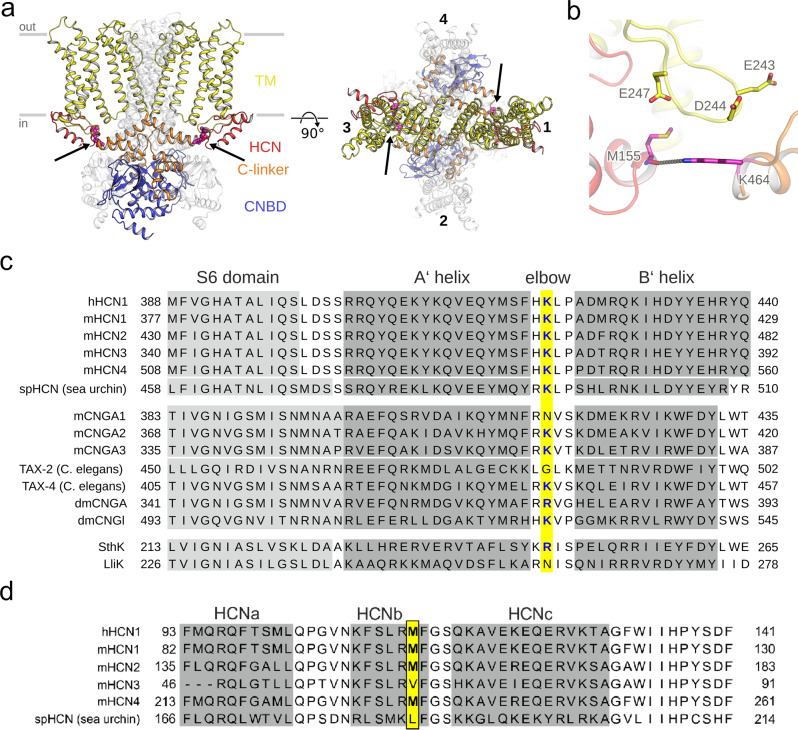
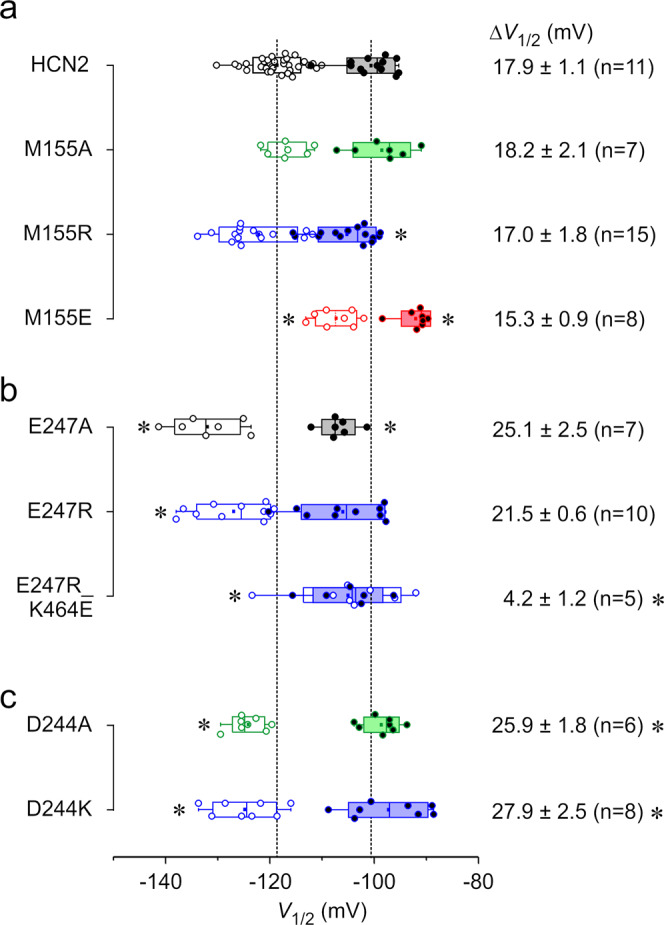
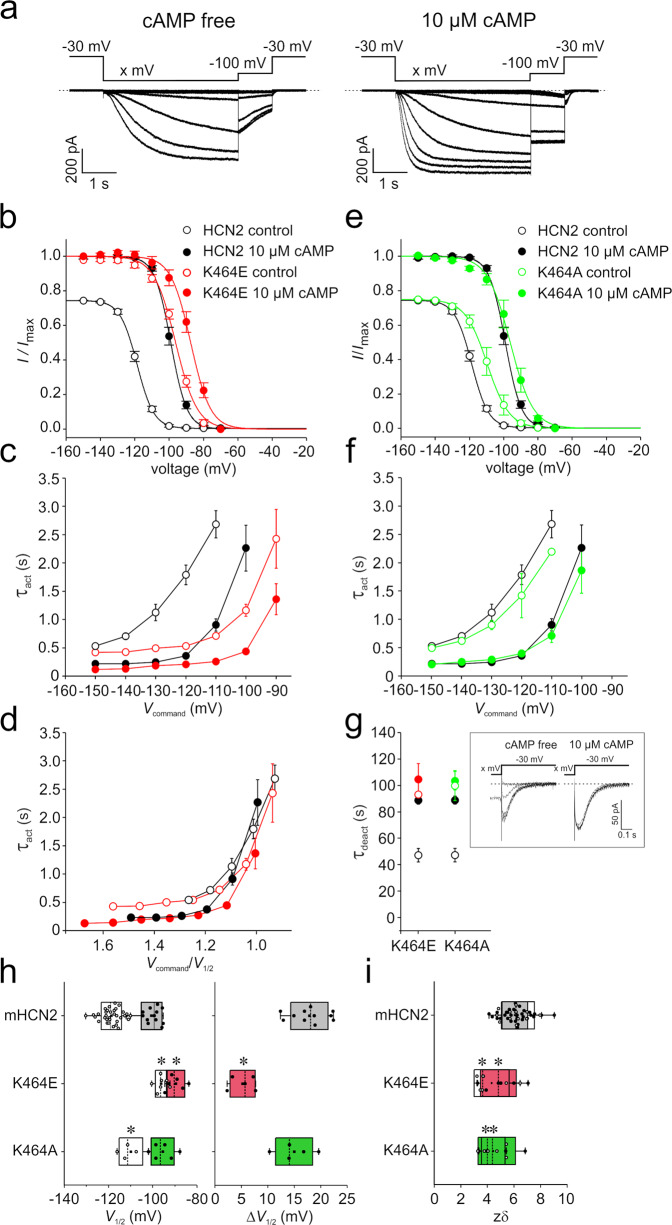
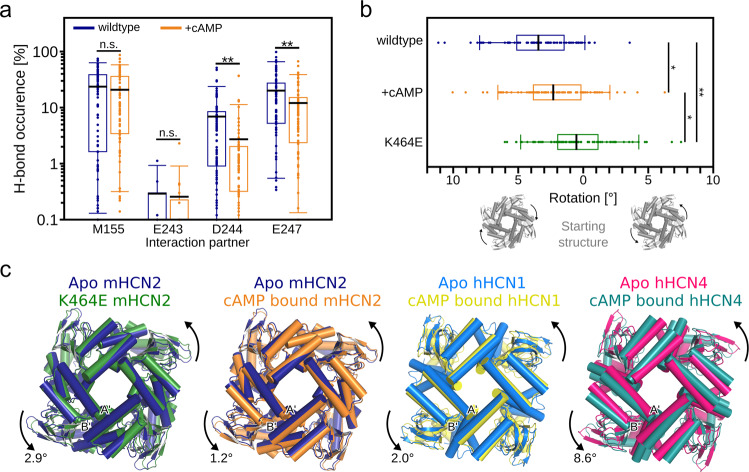
Hyperpolarization-activated and cyclic nucleotide (HCN) modulated channels are tetrameric cation channels. In each of the four subunits, the intracellular cyclic nucleotide-binding domain (CNBD) is coupled to the transmembrane domain via a helical structure, the C-linker. High-resolution channel structures suggest that the C-linker enables functionally relevant interactions with the opposite subunit, which might be critical for coupling the conformational changes in the CNBD to the channel pore. We combined mutagenesis, patch-clamp technique, confocal patch-clamp fluorometry, and molecular dynamics (MD) simulations to show that residue K464 of the C-linker is relevant for stabilizing the closed state of the mHCN2 channel by forming interactions with the opposite subunit. MD simulations revealed that in the K464E channel, a rotation of the intracellular domain relative to the channel pore is induced, which is similar to the cAMP-induced rotation, weakening the autoinhibitory effect of the unoccupied CL-CNBD region. We suggest that this CL-CNBD rotation is considerably involved in activation-induced affinity increase but only indirectly involved in gate modulation. The adopted poses shown herein are in excellent agreement with previous structural results.
超极化激活和环核苷酸 (HCN) 调节通道是四聚体阳离子通道。在每个亚基中,细胞内环核苷酸结合域 (CNBD) 通过螺旋结构 C 链接器与跨膜域相连。高分辨率通道结构表明,C 链接器允许与相反亚基进行功能相关的相互作用,这对于将 CNBD 中的构象变化与通道孔耦联可能至关重要。我们结合了突变、膜片钳技术、共聚焦膜片钳荧光法和分子动力学 (MD) 模拟,结果表明 C 链接器的残基 K464 通过与相反亚基形成相互作用,对 mHCN2 通道的关闭状态具有稳定作用。MD 模拟表明,在 K464E 通道中,胞内结构域相对于通道孔发生旋转,类似于 cAMP 诱导的旋转,从而削弱了未占据的 CL-CNBD 区域的自动抑制效应。我们认为,这种 CL-CNBD 旋转在激活诱导的亲和力增加中起重要作用,但仅在间接在门调制中起作用。本文中采用的构象与之前的结构结果非常吻合。