Neuromuscular Unit, Department of Neurology, Hospital del Mar, Barcelona, Spain.
Department of Cell Biology, Physiology and Immunology, Institute of Neurosciences and CIBERNED, Universitat Autònoma de Barcelona, Bellaterra, Spain.
Sci Rep. 2022 May 9;12(1):7600. doi: 10.1038/s41598-022-11767-8.
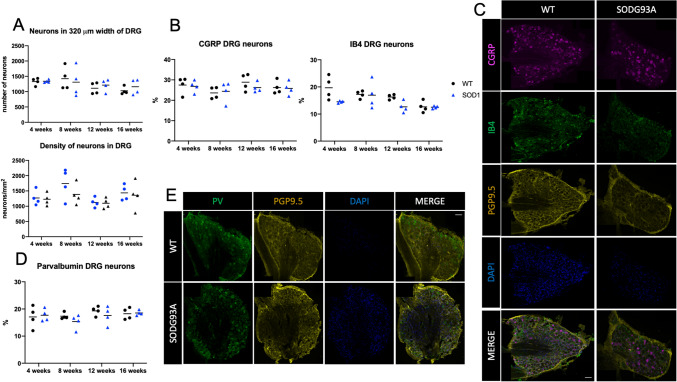
SOD1 mice show loss of cutaneous small fibers, as in ALS patients. Our objective is to characterize the involvement of different somatosensory neuron populations and its temporal progression in the SOD1 mice. We aim to further define peripheral sensory involvement, analyzing at the same time points the neuronal bodies located in the dorsal root ganglia (DRG) and the distal part of their axons in the skin, in order to shed light in the mechanisms of sensory involvement in ALS. We performed immunohistochemical analysis of peptidergic (CGRP), non-peptidergic (IB4) fibers in epidermis, as well as sympathetic sudomotor fibers (VIP) in the footpads of SOD1 mice and wild type littermates at 4, 8, 12 and 16 weeks of age. We also immunolabeled and quantified neuronal bodies of IB4, CGRP and parvalbumin (PV) positive sensory neurons in lumbar DRG. We detected a reduction of intraepidermal nerve fiber density in the SOD1 mice of both peptidergic and non-peptidergic axons, compared with the WT, being the non-peptidergic the fewest. Sweat gland innervation was similarly affected in the SOD1 mouse at 12 weeks. Nonetheless, the number of DRG neurons from different sensory populations remained unchanged during all stages. Cutaneous sensory axons are affected in the SOD1 mouse, with non-peptidergic being slightly more vulnerable than peptidergic axons. Loss or lack of growth of the distal portion of sensory axons with preservation of the corresponding neuronal bodies suggest a distal axonopathy.
SOD1 小鼠表现出皮肤小纤维丧失,类似于 ALS 患者。我们的目标是描述不同感觉神经元群体的受累情况及其在 SOD1 小鼠中的时间进程。我们旨在进一步定义周围感觉受累情况,同时分析位于背根神经节 (DRG) 的神经元体及其在皮肤中的轴突远端部分,以阐明 ALS 中感觉受累的机制。我们对 SOD1 小鼠和野生型同窝仔鼠的 4、8、12 和 16 周龄时的表皮肽能 (CGRP) 和非肽能 (IB4) 纤维以及足底交感舒血管纤维 (VIP) 进行了免疫组织化学分析。我们还对 IB4、CGRP 和钙结合蛋白 (PV) 阳性感觉神经元的腰椎 DRG 神经元体进行了免疫标记和定量。与 WT 相比,我们在 SOD1 小鼠中检测到两种肽能和非肽能轴突的表皮内神经纤维密度均降低,而非肽能纤维密度降低更为明显。在 12 周时,SOD1 小鼠的汗腺神经支配也受到类似影响。然而,在所有阶段,不同感觉群体的 DRG 神经元数量保持不变。皮肤感觉轴突在 SOD1 小鼠中受到影响,非肽能轴突比肽能轴突稍脆弱。感觉轴突的远端部分丧失或缺乏生长而保留相应的神经元体提示远端轴突变性。