Department of orthopedics, General Hospital of Ningxia Medical University, 804 Shengli street, Xingqing district, Yinchuan, Ningxia 750004, China
Ningxia Medical University, 1160 Shengli street, Xingqing district, Yinchuan, Ningxia 750004, China
Clin Appl Thromb Hemost. 2022 Jan-Dec;28:10760296221097383. doi: 10.1177/10760296221097383.
To investigate the diagnostic values of D-dimer, plasminogen activator inhibitor-1 (PAI-1), thrombin-antithrombin (TAT), and prothrombin fragment F1 + 2 (F1 + 2) for predicting venous thromboembolism (VTE) after total knee arthroplasty (TKA).
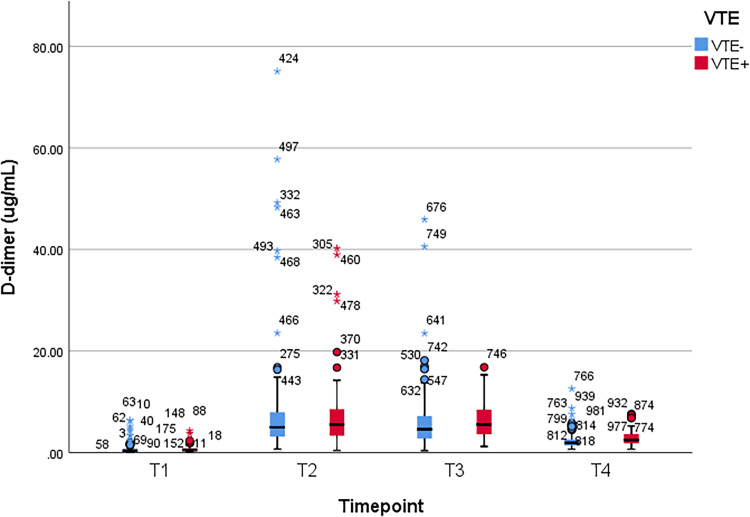
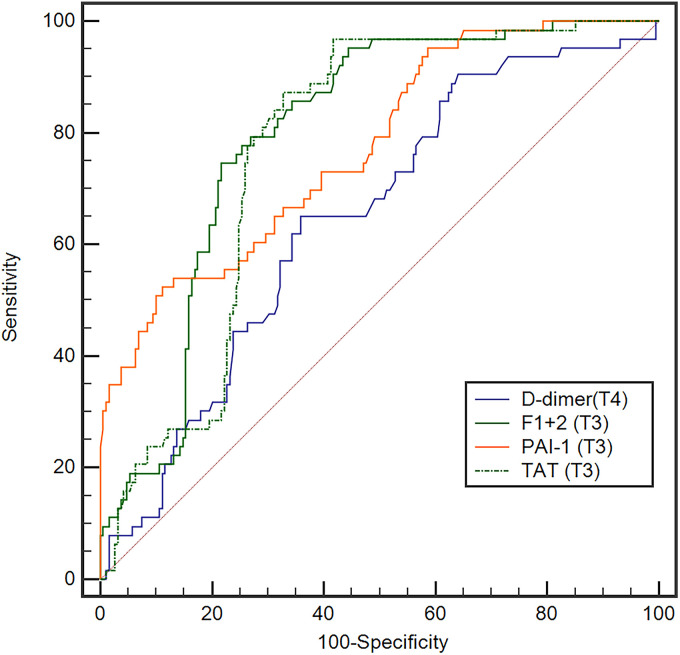
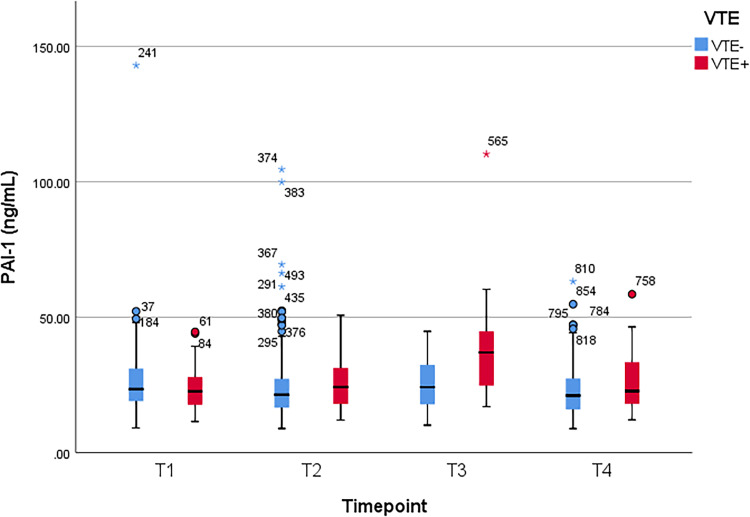
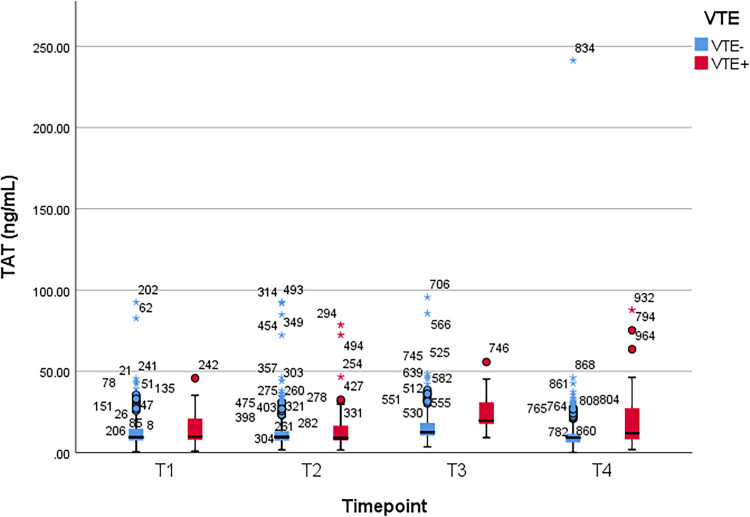
Ultrasonography and CTPA were performed to diagnose VTE in 252 patients who underwent TKAs. Plasma D-dimer, PAI-1, TAT, and F1 + 2 levels were assessed 1-3 days prior to operation (T1), second hour (T2), first (T3), and third day (T4) after the operation. Receiver-operating characteristic curves (ROC) analysis was conducted and pairwise compared to evaluate the diagnostic value of those biomarkers.
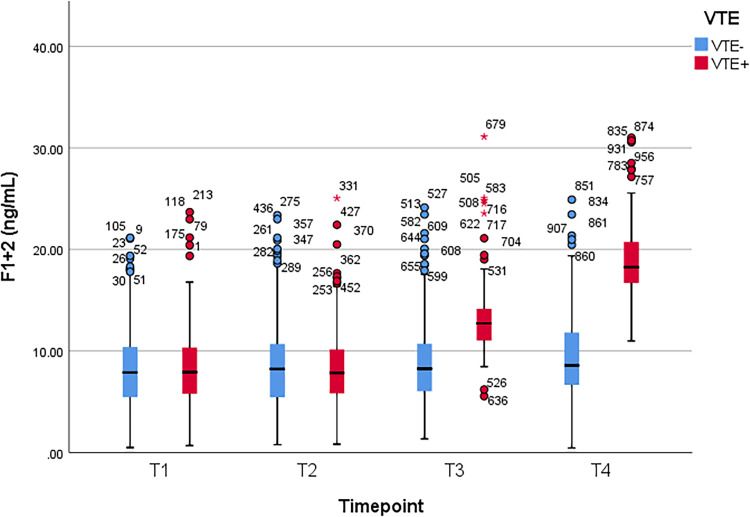
Plasma D-dimer levels differed between patients with and without VTE significantly on T4, PAI-1, TAT, and F1 + 2 levels differed on T3 and T4. The areas under ROC of D-dimer, PAI-1, TAT and F1 + 2 levels were 0.645, 0.773, 0.771 and 0.797, respectively. The most feasible cutoff values of D-dimer, PAI-1, TAT and F1 + 2 in predicting VTE after TKA were 2.24 ug/ml, 35.96 ng/ml, 13.36 ng/mg and 11.1 ng/ml, respectively. Pairwise comparison of ROC curves revealed that D-dimer level had the lowest diagnostic accuracy, whereas PAI-1, TAT and F1 + 2 level had similar diagnostic accuracy. There were significant differences in duration of tourniquet time and duration of anesthesia between patients with and without VTE.
After TKA, using 2.24ug/mL as the threshold value of D-dimer is more accurate than using 0.5ug/mL in the monitoring of VTE, PAI-1, TAT and F1 + 2 are more valuable than D-dimer in predicting VTE. Duration of tourniquet and duration of anesthesia are risk factors for the development of VTE.
探讨 D-二聚体、纤溶酶原激活物抑制剂-1(PAI-1)、凝血酶-抗凝血酶(TAT)和凝血酶原片段 F1+2(F1+2)对预测全膝关节置换术后静脉血栓栓塞症(VTE)的诊断价值。
对 252 例行 TKA 的患者进行超声和 CTPA 诊断 VTE。在术前 1-3 天(T1)、术后第 2 小时(T2)、第 1 天(T3)和第 3 天(T4)评估血浆 D-二聚体、PAI-1、TAT 和 F1+2 水平。通过接受者操作特征曲线(ROC)分析并进行两两比较,评估这些生物标志物的诊断价值。
T4 时 VTE 患者与无 VTE 患者的血浆 D-二聚体水平有显著差异,PAI-1、TAT 和 F1+2 水平在 T3 和 T4 时也有显著差异。D-二聚体、PAI-1、TAT 和 F1+2 水平的 ROC 曲线下面积分别为 0.645、0.773、0.771 和 0.797。D-二聚体、PAI-1、TAT 和 F1+2 预测 TKA 后 VTE 的最佳截断值分别为 2.24μg/ml、35.96ng/ml、13.36ng/mg 和 11.1ng/ml。ROC 曲线的两两比较显示,D-二聚体水平的诊断准确性最低,而 PAI-1、TAT 和 F1+2 水平的诊断准确性相似。有 VTE 和无 VTE 患者的止血带时间和麻醉时间存在显著差异。
TKA 后,使用 2.24μg/ml 作为 D-二聚体的阈值比使用 0.5μg/ml 监测 VTE 更准确,PAI-1、TAT 和 F1+2 比 D-二聚体更能预测 VTE。止血带时间和麻醉时间是 VTE 发生的危险因素。