Waśkiel-Burnat Anna, Rakowska Adriana, Zaremba Michał, Maciejewska Magdalena, Blicharz Leszek, Starace Michela, Iorizzo Matilde, Piraccini Bianca Maria, Olszewska Małgorzata, Rudnicka Lidia
Department of Dermatology, Medical University of Warsaw, Warsaw, Poland.
Dermatology Unit, IRCCS Azienda Ospedaliero-Universitaria di Bologna, Policlinico S. Orsola Malpighi, Bologna, Italy.
Dermatol Ther (Heidelb). 2023 Aug;13(8):1847-1855. doi: 10.1007/s13555-023-00971-7. Epub 2023 Jul 9.
Numerous studies have indicated that alopecia areata is associated with a chronic systemic inflammation, which is considered as a risk factor for venous thromboembolism. The aim of the study was to evaluate the following markers of venous thromboembolism risk: soluble fibrin monomer complex (SFMC), thrombin-antithrombin complex (TATC), and prothrombin fragment 1 + 2 (F1 + 2) in patients with alopecia areata and compare them with healthy controls.
In total, 51 patients with alopecia areata [35 women and 16 men; mean age: 38 (19-54) years] and 26 controls [18 women and 8 men; mean age: 37 (29-51) years] were enrolled in the study. The serum concentrations of thromboembolism markers were measured using an enzyme-linked immunosorbent assay (ELISA) kit.
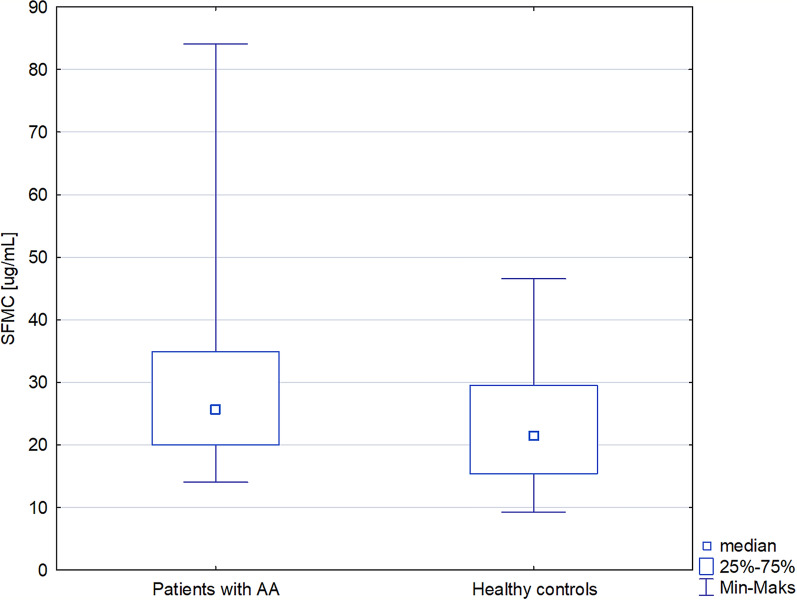
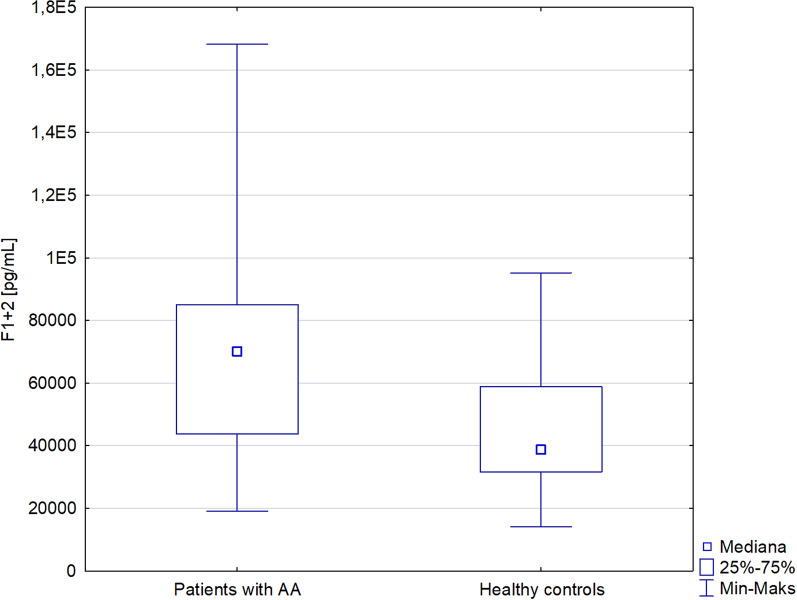
An increased level of SFMC was detected in patients with alopecia areata compared with the controls [25.66 (20-34.86) versus 21.46 (15.38-29.48) µg/ml; p < 0.05)]. In addition, a higher level of F1 + 2 was observed in patients with alopecia areata in comparison with the control group [70150 (43720-86070) versus 38620 (31550-58840) pg/ml; p < 0.001]. No significant correlation was detected among SFMC or F1 + 2 and the Severity of Alopecia Tool (SALT) score, disease duration, or the number of the hair loss episodes.
Alopecia areata may be associated with an increased risk of venous thromboembolism. Regular screening and preventive management of venous thromboembolism may be beneficial in patients with alopecia areata, especially before and during systemic Janus kinase (JAK) inhibitors or glucocorticoid therapy.
大量研究表明斑秃与慢性全身性炎症相关,而慢性全身性炎症被认为是静脉血栓栓塞的一个风险因素。本研究的目的是评估斑秃患者静脉血栓栓塞风险的以下标志物:可溶性纤维蛋白单体复合物(SFMC)、凝血酶 - 抗凝血酶复合物(TATC)和凝血酶原片段1 + 2(F1 + 2),并将其与健康对照者进行比较。
本研究共纳入51例斑秃患者[35例女性和16例男性;平均年龄:38(19 - 54)岁]和26例对照者[18例女性和8例男性;平均年龄:37(29 - 51)岁]。使用酶联免疫吸附测定(ELISA)试剂盒测量血栓栓塞标志物的血清浓度。
与对照组相比,斑秃患者中检测到SFMC水平升高[25.66(20 - 34.86)对21.46(15.38 - 29.48)μg/ml;p < 0.05]。此外,与对照组相比,斑秃患者中观察到更高水平的F1 + 2[70150(43720 - 86070)对38620(31550 - 58840)pg/ml;p < 0.001]。在SFMC或F1 + 2与脱发严重程度工具(SALT)评分、疾病持续时间或脱发发作次数之间未检测到显著相关性。
斑秃可能与静脉血栓栓塞风险增加有关。对斑秃患者进行定期的静脉血栓栓塞筛查和预防性管理可能有益,尤其是在全身使用Janus激酶(JAK)抑制剂或糖皮质激素治疗之前和期间。