Department of Neurology Seoul National University Bundang Hospital Seongnam Korea.
Department of Neurology Korea University Guro Hospital Seoul Korea.
J Am Heart Assoc. 2022 May 17;11(10):e025861. doi: 10.1161/JAHA.122.025861. Epub 2022 May 10.
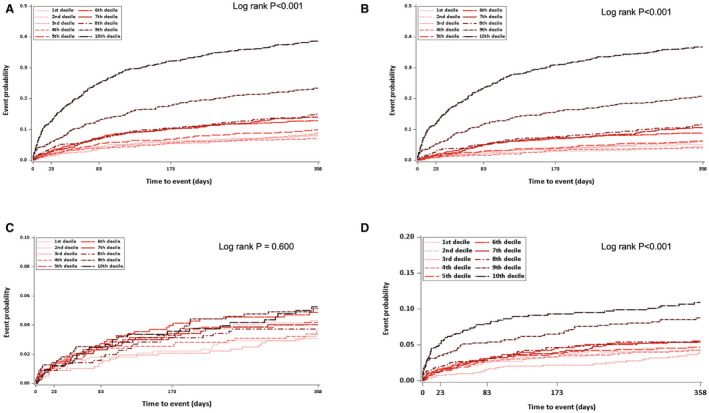
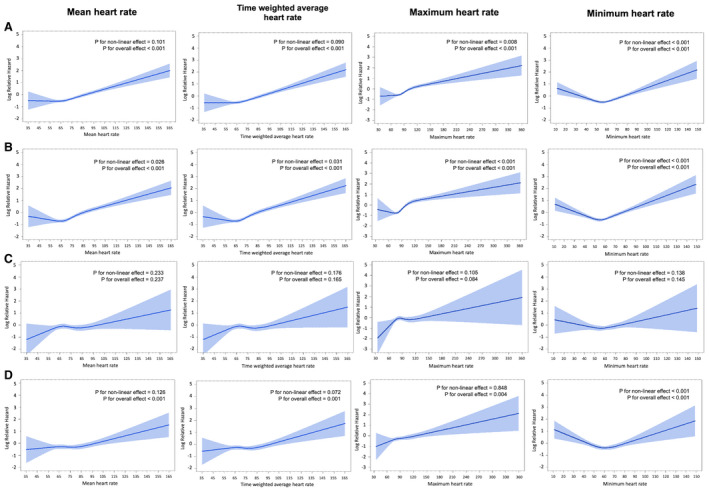
Background Previous literature about the effect of heart rate on poststroke outcomes is limited. We attempted to elucidate (1) whether heart rate during the acute period of ischemic stroke predicts subsequent major clinical events, (2) which heart rate parameter is best for prediction, and (3) what is the estimated heart rate cutoff point for the primary outcome. Methods and Results Eight thousand thirty-one patients with acute ischemic stroke who were hospitalized within 48 hours of onset were analyzed retrospectively. Heart rates between the 4th and 7th day after onset were collected and heart rate parameters including mean, time-weighted average, maximum, and minimum heart rate were evaluated. The primary outcome was the composite of recurrent stroke, myocardial infarction, and mortality up to 1 year after stroke onset. All heart rate parameters were associated with the primary outcome ('s<0.001). Maximum heart rate had the highest predictive power. The estimated cutoff point for the primary outcome was 81 beats per minute for mean heart rate and 100 beats per minute for maximum heart rate. Patients with heart rates above these cutoff points had a higher risk of the primary outcome (adjusted hazard ratio, 1.80 [95% CI, 1.57-2.06] for maximum heart rate and 1.65 [95% CI, 1.45-1.89] for mean heart rate). The associations were replicated in a separate validation dataset (N=10 000). Conclusions These findings suggest that heart rate during the acute period of ischemic stroke is a predictor of major clinical events, and optimal heart rate control might be a target for preventing subsequent cardiovascular events.
关于心率对脑卒中后结局影响的既往文献有限。我们试图阐明:(1)急性缺血性脑卒中期间的心率是否预测随后的主要临床事件;(2)哪种心率参数最适合预测;(3)主要结局的估计心率截断点是多少。
回顾性分析了 8031 例发病后 48 小时内住院的急性缺血性脑卒中患者。收集发病后第 4-7 天的心率,并评估心率参数,包括平均心率、时间加权平均心率、最大心率和最小心率。主要结局是卒中后 1 年内复发性卒中、心肌梗死和死亡率的复合结局。所有心率参数均与主要结局相关(P<0.001)。最大心率具有最高的预测能力。主要结局的估计截断点为平均心率 81 次/分,最大心率 100 次/分。心率高于这些截断点的患者主要结局风险更高(最大心率校正后的危险比为 1.80[95%CI,1.57-2.06],平均心率为 1.65[95%CI,1.45-1.89])。这些关联在另一个独立的验证数据集(N=10000)中得到了复制。
这些发现表明,急性缺血性脑卒中期间的心率是主要临床事件的预测因素,优化心率控制可能是预防随后心血管事件的目标。