Li Ci, Liu Song-Yang, Zhou Li-Ping, Min Tian-Tian, Zhang Meng, Pi Wei, Wen Yong-Qiang, Zhang Pei-Xun
Department of Orthopedics and Trauma, Peking University People's Hospital; Key Laboratory of Trauma and Neural Regeneration, Ministry of Education; National Center for Trauma Medicine, Beijing, China.
Beijing Key Laboratory for Bioengineering and Sensing Technology, School of Chemistry and Biological Engineering, University of Science and Technology Beijing, Beijing, China.
Neural Regen Res. 2022 Nov;17(11):2544-2550. doi: 10.4103/1673-5374.339006.
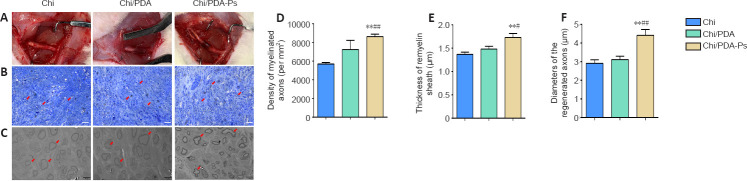
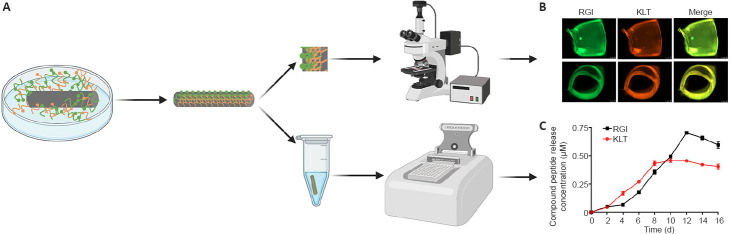
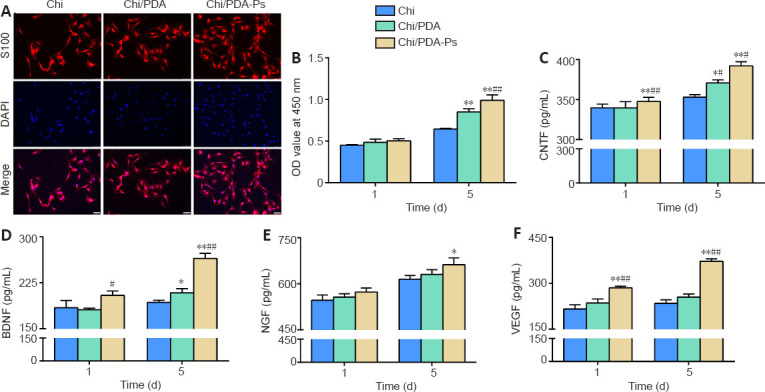
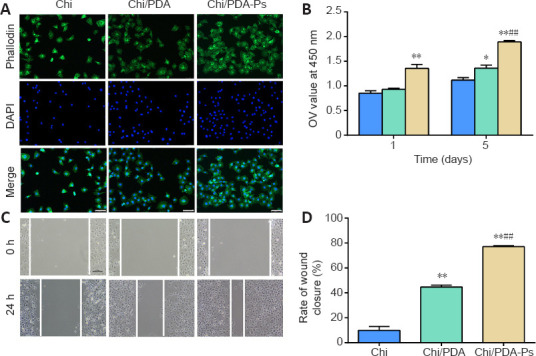
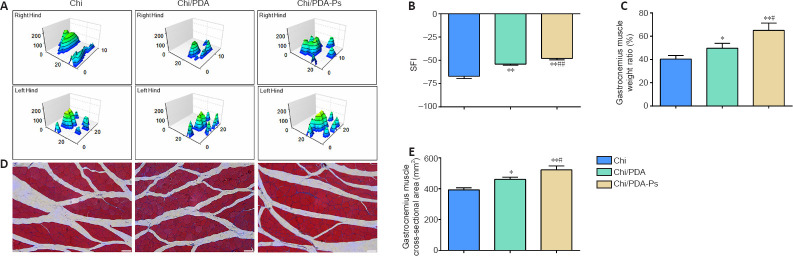
The introduction of neurotrophic factors into injured peripheral nerve sites is beneficial to peripheral nerve regeneration. However, neurotrophic factors are rapidly degraded in vivo and obstruct axonal regeneration when used at a supraphysiological dose, which limits their clinical benefits. Bioactive mimetic peptides have been developed to be used in place of neurotrophic factors because they have a similar mode of action to the original growth factors and can activate the equivalent receptors but have simplified sequences and structures. In this study, we created polydopamine-modified chitin conduits loaded with brain-derived neurotrophic factor mimetic peptides and vascular endothelial growth factor mimetic peptides (Chi/PDA-Ps). We found that the Chi/PDA-Ps conduits were less cytotoxic in vitro than chitin conduits alone and provided sustained release of functional peptides. In this study, we evaluated the biocompatibility of the Chi/PDA-Ps conduits. Brain-derived neurotrophic factor mimetic peptide and vascular endothelial growth factor mimetic peptide synergistically promoted proliferation of Schwann cells and secretion of neurotrophic factors by Schwann cells and attachment and migration of endothelial cells in vitro. The Chi/PDA-Ps conduits were used to bridge a 2 mm gap between the nerve stumps in rat models of sciatic nerve injury. We found that the application of Chi/PDA-Ps conduits could improve the motor function of rats and reduce gastrocnemius atrophy. The electrophysiological results and the microstructure of regenerative nerves showed that the nerve conduction function and remyelination was further restored. These findings suggest that the Chi/PDA-Ps conduits have great potential in peripheral nerve injury repair.
将神经营养因子引入受损的周围神经部位有利于周围神经再生。然而,神经营养因子在体内会迅速降解,并且在以超生理剂量使用时会阻碍轴突再生,这限制了它们的临床益处。生物活性模拟肽已被开发出来用于替代神经营养因子,因为它们具有与原始生长因子相似的作用模式,能够激活等效的受体,但序列和结构更为简化。在本研究中,我们制备了负载脑源性神经营养因子模拟肽和血管内皮生长因子模拟肽的聚多巴胺修饰几丁质导管(Chi/PDA-Ps)。我们发现,与单独的几丁质导管相比,Chi/PDA-Ps导管在体外的细胞毒性更小,并能实现功能性肽的持续释放。在本研究中,我们评估了Chi/PDA-Ps导管的生物相容性。脑源性神经营养因子模拟肽和血管内皮生长因子模拟肽在体外协同促进雪旺细胞的增殖以及雪旺细胞神经营养因子的分泌,还促进了内皮细胞的黏附和迁移。在坐骨神经损伤大鼠模型中,使用Chi/PDA-Ps导管桥接神经断端之间2毫米的间隙。我们发现,应用Chi/PDA-Ps导管可以改善大鼠的运动功能并减轻腓肠肌萎缩。电生理结果和再生神经的微观结构表明,神经传导功能和髓鞘再生得到了进一步恢复。这些发现表明,Chi/PDA-Ps导管在周围神经损伤修复方面具有巨大潜力。