Hergert Melinda, Le Roux Kevin, Nel Louis H
Department of Paraclinical Sciences, Faculty of Veterinary Science, University of Pretoria, Onderstepoort, 0110, South Africa.
KwaZulu-Natal Department of Environment, Agriculture and Rural Development, Government Veterinary Services, 458 Townbush Road, Pietermaritzburg, 3202, South Africa.
BMC Vet Res. 2018 Sep 10;14(1):278. doi: 10.1186/s12917-018-1604-z.
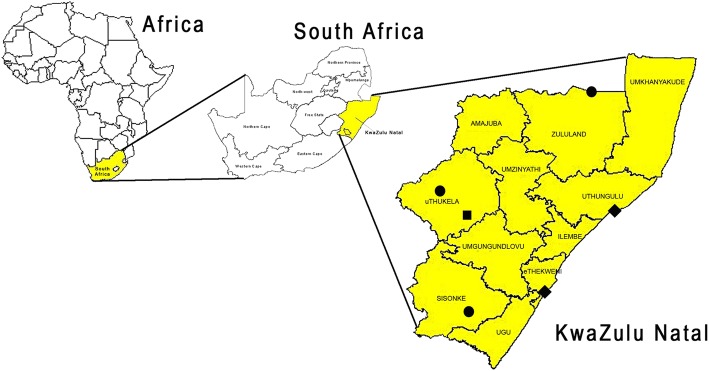
Canine rabies has been enzootic in the dog population of the KwaZulu-Natal province of South Africa since the mid-1970s and has been associated with high rates of human exposures and frequent transmissions to other domestic animal species. Several decades of control efforts, consisting primarily of mass vaccination programs, have previously failed to sufficiently curb rabies in the province. Despite this history of canine rabies, the target canine population has never been extensively studied or quantified. For efficient and effective vaccination campaign planning, the target population must be evaluated and understood. This study reports evaluated observations from survey records captured through a cross sectional observational study regarding canine populations and dog owners in rabies enzootic KwaZulu-Natal province, South Africa. The objective of this study was to aid government veterinary services in their current and ongoing efforts to eliminate canine rabies in the province by gaining information about the size and distribution of the owned dog population.
Thirty-eight percent of the households owned one or more dogs, with rural areas surveyed containing a significantly higher number of owned dogs than urban areas. The mean dog/person ratio for this study was 1:7.7 (range 1:5.4-1:31). The provincial sex ratio was 1.5:1 male to female, with the percentages for male dogs across the communities ranging from 53 to 61.5%. The age structure of this dog population indicates a high turnover rate. Dogs were kept mostly for guarding homes or livestock. Eighty-four percent of dogs had received a rabies vaccine at some point in their lifetime, almost all during a rabies campaign.
The study indicates the majority of owned dogs can be handled by at least one member of the household, thus can be made readily accessible for rabies vaccination during a campaign. Characteristics of owned dogs in the province were similar to those studied in other African countries; however, there were remarkable differences in age, sex and husbandry practices compared to dogs in eastern or northern Africa. These geographical differences lend credence to the theory that canine populations are heterogeneous; therefore, target populations should be evaluated prior to intervention planning.
自20世纪70年代中期以来,犬狂犬病在南非夸祖鲁-纳塔尔省的犬类种群中呈地方流行状态,与人类高暴露率以及频繁传播至其他家畜物种有关。此前,主要由大规模疫苗接种计划组成的数十年防控努力未能充分遏制该省的狂犬病。尽管有犬狂犬病的这段历史,但目标犬类种群从未得到过广泛研究或量化。为了进行高效且有效的疫苗接种活动规划,必须对目标种群进行评估和了解。本研究报告了通过横断面观察性研究获取的关于南非夸祖鲁-纳塔尔省狂犬病地方流行区犬类种群和犬主的调查记录评估观察结果。本研究的目的是通过获取有关家养犬类种群规模和分布的信息,协助政府兽医服务部门当前及正在进行的在该省消除犬狂犬病的努力。
38%的家庭拥有一只或多只狗,被调查的农村地区家养犬数量明显高于城市地区。本研究的平均犬与人的比例为1:7.7(范围为1:5.4 - 1:31)。该省的性别比例为雄性与雌性之比为1.5:1,各社区雄性犬的百分比在53%至61.5%之间。该犬类种群的年龄结构表明更替率很高。养狗主要是为了看家护院或守护牲畜。84%的狗在其一生中的某个时候接种过狂犬病疫苗,几乎都是在狂犬病防治运动期间接种的。
该研究表明,大多数家养犬至少可以由家庭中的一名成员照料,因此在狂犬病防治运动期间可以很容易地进行狂犬病疫苗接种。该省家养犬的特征与其他非洲国家研究的特征相似;然而,与东非或北非的犬相比,在年龄、性别和饲养方式上存在显著差异。这些地理差异支持了犬类种群具有异质性的理论;因此,在干预规划之前应对目标种群进行评估。