Department of Environmental Health and Engineering, Johns Hopkins Bloomberg School of Public Health, Baltimore, Maryland 21218, United States.
Department of Public Health Sciences, University of California Davis, Davis, California 95616, United States.
Environ Sci Technol. 2022 May 17;56(10):6560-6573. doi: 10.1021/acs.est.1c08942. Epub 2022 May 10.
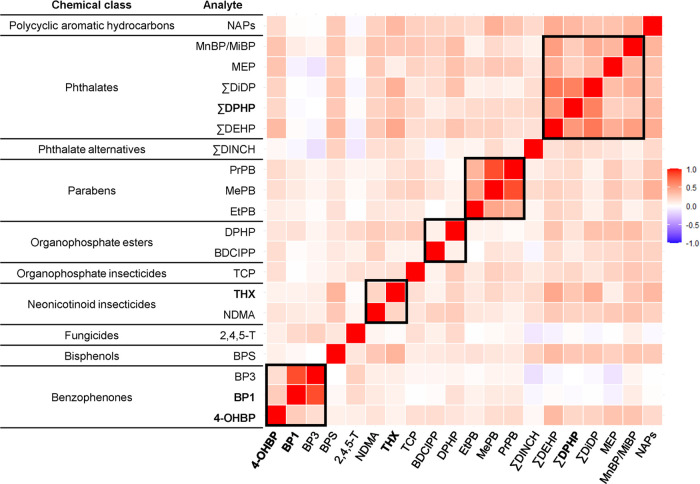
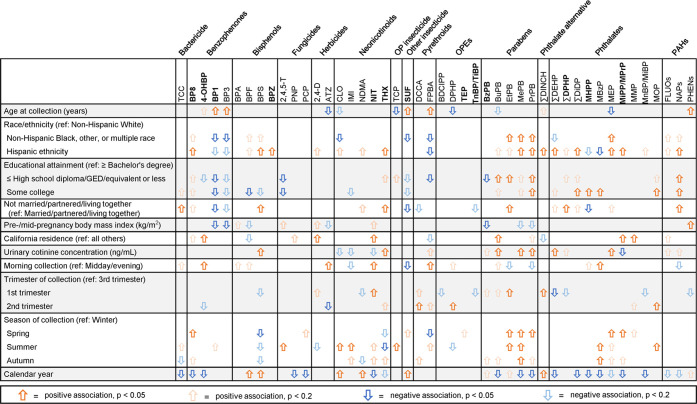
Prenatal chemical exposures can influence maternal and child health; however, few industrial chemicals are routinely biomonitored. We assessed an extensive panel of contemporary and emerging chemicals in 171 pregnant women across the United States (U.S.) and Puerto Rico in the Environmental influences on Child Health Outcomes (ECHO) Program. We simultaneously measured urinary concentrations of 89 analytes (103 total chemicals representing 73 parent compounds) in nine chemical groups: bactericides, benzophenones, bisphenols, fungicides and herbicides, insecticides, organophosphate esters (OPEs), parabens, phthalates/alternative plasticizers, and polycyclic aromatic hydrocarbons (PAHs). We estimated associations of creatinine-adjusted concentrations with sociodemographic and specimen characteristics. Among our diverse prenatal population (60% non-Hispanic Black or Hispanic), we detected 73 of 89 analytes in ≥1 participant and 36 in >50% of participants. Five analytes not currently included in the U.S. biomonitoring were detected in ≥90% of samples: benzophenone-1, thiamethoxam, mono-2-(propyl-6-carboxy-hexyl) phthalate, monocarboxy isooctyl phthalate, and monohydroxy-iso-decyl phthalate. Many analyte concentrations were higher among women of Hispanic ethnicity compared to those of non-Hispanic White women. Concentrations of certain chemicals decreased with the calendar year, whereas concentrations of their replacements increased. Our largest study to date identified widespread exposures to prevalent and understudied chemicals in a diverse sample of pregnant women in the U.S.
产前化学暴露会影响母婴健康;然而,很少有工业化学品被常规生物监测。我们在环境对儿童健康影响(ECHO)计划中,对美国和波多黎各的 171 名孕妇进行了广泛的当代和新兴化学物质评估。我们同时测量了 9 种化学物质组中 89 种分析物(代表 73 种母体化合物的 103 种总化学物质)的尿液浓度:杀菌剂、二苯甲酮、双酚、杀真菌剂和除草剂、杀虫剂、有机磷酸酯(OPEs)、对羟基苯甲酸酯、邻苯二甲酸酯/替代增塑剂和多环芳烃(PAHs)。我们估计了肌酐调整后的浓度与社会人口统计学和样本特征的关联。在我们多样化的产前人群(60%是非西班牙裔黑人或西班牙裔)中,我们在≥1 名参与者中检测到 89 种分析物中的 73 种,在>50%的参与者中检测到 36 种。在≥90%的样本中检测到 5 种目前未包含在美国生物监测中的分析物:二苯甲酮-1、噻虫嗪、单-2-(丙基-6-羧基-己基)邻苯二甲酸酯、单羧酸异辛基邻苯二甲酸酯和单羟基-异-癸基邻苯二甲酸酯。与非西班牙裔白人女性相比,具有西班牙裔血统的女性的许多分析物浓度更高。某些化学物质的浓度随日历年度而降低,而其替代品的浓度则增加。迄今为止,我们的最大研究在美国多样化的孕妇样本中发现了普遍存在的、受研究较少的化学物质暴露。