Turner Institute for Brain and Mental Health, School of Psychological Sciences, Monash University, Clayton, Victoria, Australia
Turner Institute for Brain and Mental Health, School of Psychological Sciences, Monash University, Clayton, Victoria, Australia.
BMJ Open. 2022 May 10;12(5):e055716. doi: 10.1136/bmjopen-2021-055716.
During adolescence, sleep and circadian timing shift later, contributing to restricted sleep duration and irregular sleep-wake patterns. The association of these developmental changes in sleep and circadian timing with cognitive functioning, and consequently academic outcomes, has not been examined prospectively. The role of ambient light exposure in these developmental changes is also not well understood. Here, we describe the protocol for the Circadian Light in Adolescence, Sleep and School (CLASS) Study that will use a longitudinal design to examine the associations of sleep-wake timing, circadian timing and light exposure with academic performance and sleepiness during a critical stage of development. We also describe protocol adaptations to enable remote data collection when required during the COVID-19 pandemic.
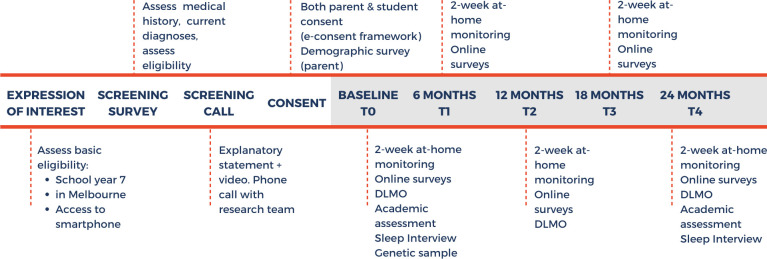
Approximately 220 healthy adolescents aged 12-13 years (school Year 7) will be recruited from the general community in Melbourne, Australia. Participants will be monitored at five 6 monthly time points over 2 years. Sleep and light exposure will be assessed for 2 weeks during the school term, every 6 months, along with self-report questionnaires of daytime sleepiness. Circadian phase will be measured via dim light melatonin onset once each year. Academic performance will be measured via national standardised testing (National Assessment Program-Literacy and Numeracy) and the Wechsler Individual Achievement Test-Australian and New Zealand Standardised Third Edition in school Years 7 and 9. Secondary outcomes, including symptoms of depression, anxiety and sleep disorders, will be measured via questionnaires.
The CLASS Study will enable a comprehensive longitudinal assessment of changes in sleep-wake timing, circadian phase, light exposure and academic performance across a key developmental stage in adolescence. Findings may inform policies and intervention strategies for secondary school-aged adolescents.
Ethical approval was obtained by the Monash University Human Research Ethics Committee and the Victorian Department of Education. Dissemination plans include scientific publications, scientific conferences, via stakeholders including schools and media.
Recruitment occurred between October 2019 and September 2021, data collection from 2019 to 2023.
在青少年时期,睡眠和昼夜节律时间会推迟,导致睡眠时间缩短和睡眠-觉醒模式不规律。这些睡眠和昼夜节律时间的发育变化与认知功能的关系,以及由此产生的学业成绩,尚未得到前瞻性研究。周围光照暴露在这些发育变化中的作用也知之甚少。在这里,我们描述了“青少年睡眠与生物钟、光照研究”(Circadian Light in Adolescence, Sleep and School,CLASS)研究的方案,该研究将采用纵向设计,在青少年发育的关键阶段,研究睡眠-觉醒时间、昼夜节律和光照暴露与学业成绩和嗜睡之间的关系。我们还描述了方案的调整,以便在 COVID-19 大流行期间需要时进行远程数据收集。
大约 220 名年龄在 12-13 岁(7 年级)的健康青少年将从澳大利亚墨尔本的普通社区招募。参与者将在 2 年内每 6 个月监测 5 次。在学期期间,每 6 个月监测 2 周的睡眠和光照暴露情况,并通过日间嗜睡自我报告问卷进行评估。每年通过暗光褪黑素起始测量一次昼夜节律相位。学业成绩将通过国家标准化测试(国家评估计划-读写和计算能力)和韦氏个体成就测验-澳大利亚和新西兰标准化第三版在 7 年级和 9 年级进行测量。次要结果,包括抑郁、焦虑和睡眠障碍的症状,将通过问卷进行测量。
CLASS 研究将能够全面纵向评估青少年关键发育阶段睡眠-觉醒时间、昼夜节律相位、光照暴露和学业成绩的变化。研究结果可能为中学年龄段青少年的政策和干预策略提供信息。
伦理批准由莫纳什大学人类研究伦理委员会和维多利亚州教育部获得。传播计划包括科学出版物、科学会议,通过包括学校和媒体在内的利益相关者进行。
招募时间为 2019 年 10 月至 2021 年 9 月,数据收集时间为 2019 年至 2023 年。