Liu Zhao, Li Ying-Hua, Cui Zi-Yang, Li Li, Nie Xue-Qiong, Yu Cheng-Dong, Shan Guang-Liang, Zhou Xin-Mei, Qin Rui, Cheng An-Qi, Chung Kian Fan, Chen Zheng-Ming, Xiao Dan, Wang Chen
Department of Tobacco Control and Prevention of Respiratory Disease, Center of Respiratory Medicine, China-Japan Friendship Hospital, Beijing, China.
WHO Collaborating Center for Tobacco Cessation and Respiratory Diseases Prevention, Beijing, China.
Lancet Reg Health West Pac. 2022 May 4;24:100464. doi: 10.1016/j.lanwpc.2022.100464. eCollection 2022 Jul.
Tobacco dependence is the key barrier to successful smoking cessation. However, little is known about its prevalence, sociodemographic characteristics and determinants. We aimed to estimate the prevalence, associated factors and burden of tobacco dependence in China.
During 2018-2019, the nationally representative 2018 China Health Literacy Survey (2018 CHLS) invited 87,708 participants to participate using a multistage stratified sampling method from 31 provinces (or equivalent) in mainland China, and 84,839 participants aged 20-69 with valid data were included in the analysis. We diagnosed tobacco dependence based on international criteria (ICD-10, DSM-4) and tailored to Chinese population according to China Clinical Guideline for Tobacco Cessation (2015 version). The prevalence of tobacco dependence was estimated overall and by sociodemographic factors. The Logistic regression was conducted to estimate odds ratios (OR) and 95% confidence intervals (CIs) for tobacco dependence and success of smoking cessation (being ex-smokers), with different levels of adjustment. These were used to estimate the total number of adults who were tobacco dependent in China.
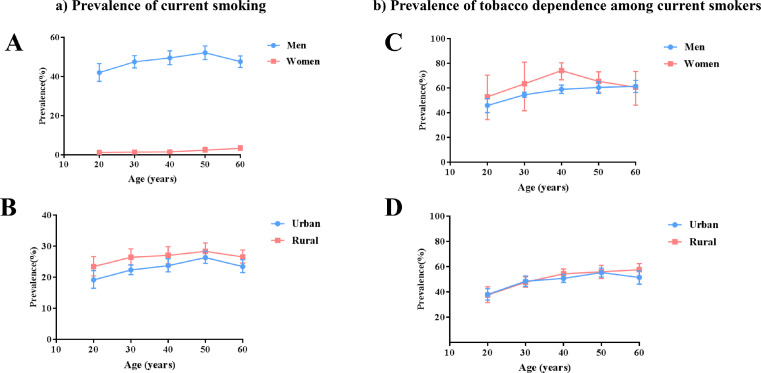
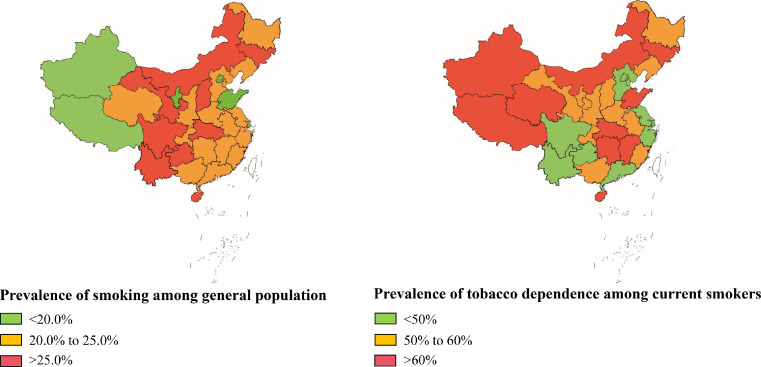
In China, the estimated prevalence of current smoking was 25.1%, significantly higher in men than in women (47.6% vs 1.9%). The prevalence of current smoking varied approximately 3-fold (12.9% to 37.9%) across 31 provinces of China. Among general population aged 20-69 years, the prevalence of tobacco dependence was 13.1% (95% CI:12.2-14.1). Among current smokers, the prevalence of tobacco dependence was 49.7% (46.5-52.9%), with no difference between men and women (49.7% vs 50.8%). The prevalence of tobacco dependence was associated significantly with smoking intensity, defined by pack-years (1.62 [1.54-1.70] per 10 pack-years), cigarettes smoked per day (2.01 [1.78, 2.27] per 10 cigarettes), and smoking starting age (0.93 [0.90, 0.97] per 5 years). Given smoking intensity, the prevalence of tobacco dependence also varied by age, gender, certain socioeconomic status and regions. Compared with those without tobacco dependence, ever smokers with tobacco dependence were less likely to be ex-smokers (2.88, 2.59-3.21). In China, 183.5 (170.4-197.4) million adults (177.5 million were men) were tobacco dependent in 2018.
In China, tobacco dependence is highly prevalent, with approximately half of current smokers being addictive, highlighting the need for coordinated effort to improve awareness, diagnosis and treatment of tobacco dependence.
Chinese Academy of Medical Sciences (CAMS) Initiative for Innovative Medicine (CAMS 2021-I2M-1-010), National Key R&D Program of China (grant no 2017YFC1309400), and National Natural Science Foundation of China (grant no 81720108001).
Chinese translation of abstract is available in appendix section.
烟草依赖是成功戒烟的关键障碍。然而,对其患病率、社会人口学特征及决定因素却知之甚少。我们旨在估算中国烟草依赖的患病率、相关因素及负担。
在2018 - 2019年期间,具有全国代表性的2018年中国健康素养调查(2018 CHLS)采用多阶段分层抽样方法,邀请了中国大陆31个省(或相当于省的行政区)的87708名参与者参与,纳入分析的是84839名年龄在20 - 69岁且有有效数据的参与者。我们依据国际标准(ICD - 10、DSM - 4)诊断烟草依赖,并根据《中国临床戒烟指南(2015年版)》针对中国人群进行了调整。总体及按社会人口学因素估算烟草依赖的患病率。进行逻辑回归以估算不同调整水平下烟草依赖及戒烟成功(成为戒烟者)的比值比(OR)和95%置信区间(CI)。这些用于估算中国烟草依赖的成年人数。
在中国,当前吸烟的估计患病率为25.1%,男性显著高于女性(47.6%对1.9%)。中国31个省当前吸烟的患病率相差约3倍(12.9%至37.9%)。在20 - 69岁的普通人群中,烟草依赖的患病率为13.1%(95%CI:12.2 - 14.1)。在当前吸烟者中,烟草依赖的患病率为49.7%(46.5 - 52.9%),男性和女性之间无差异(49.7%对50.8%)。烟草依赖的患病率与吸烟强度显著相关,吸烟强度由吸烟包年数定义(每10个吸烟包年为1.62 [1.54 - 1.70])、每日吸烟支数(每10支烟为2.01 [1.78, 2.27])以及开始吸烟年龄(每5年为0.93 [0.90, 0.97])。考虑吸烟强度后,烟草依赖的患病率也因年龄、性别、某些社会经济状况和地区而异。与无烟草依赖者相比,有烟草依赖的曾经吸烟者成为戒烟者的可能性较小(2.88,2.59 - 3.21)。2018年,中国有1.835亿(1.704 - 1.974亿)成年人存在烟草依赖(其中1.775亿为男性)。
在中国,烟草依赖非常普遍,约一半当前吸烟者成瘾,这凸显了需要共同努力提高对烟草依赖的认识、诊断和治疗。
中国医学科学院(CAMS)创新医学倡议(CAMS 2021 - I2M - 1 - 010)、国家重点研发计划(项目编号2017YFC1309400)以及中国国家自然科学基金(项目编号81720108001)。
摘要的中文翻译见附录部分。