Raevskaya Alexandra, Rozovik Oksana, Novikova Anastasiya, Selyshchev Oleksandr, Stroyuk Oleksandr, Dzhagan Volodymyr, Goryacheva Irina, Gaponik Nikolai, Zahn Dietrich R T, Eychmüller Alexander
L. V. Pysarzhevsky Institute of Physical Chemistry, National Academy of Sciences of Ukraine Kyiv 03028 Ukraine
Physical Chemistry, TU Dresden 01062 Dresden Germany
RSC Adv. 2018 Feb 16;8(14):7550-7557. doi: 10.1039/c8ra00257f. eCollection 2018 Feb 14.
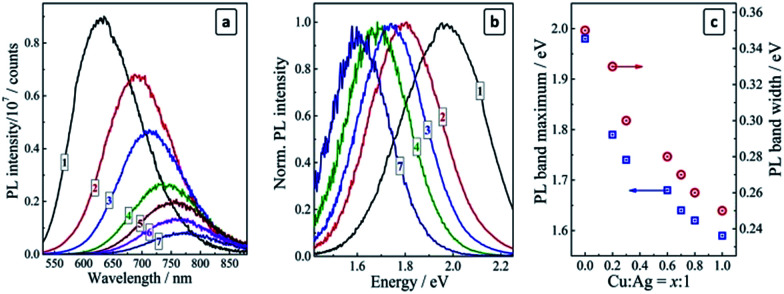
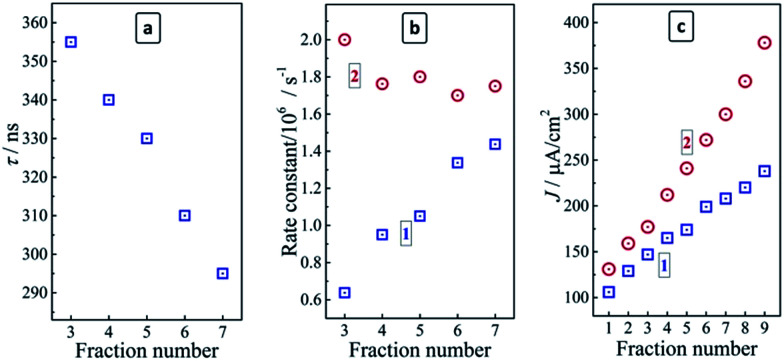
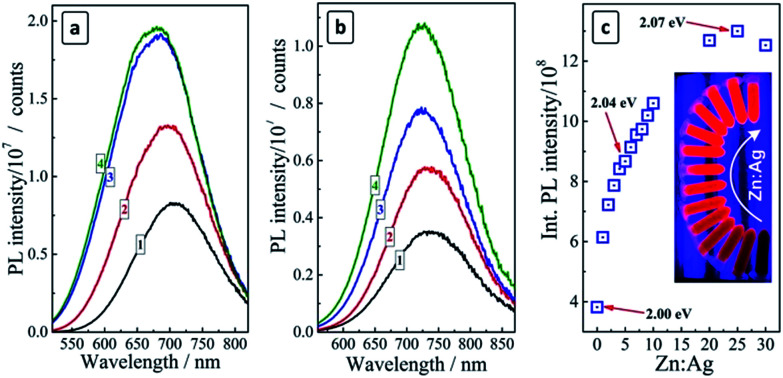
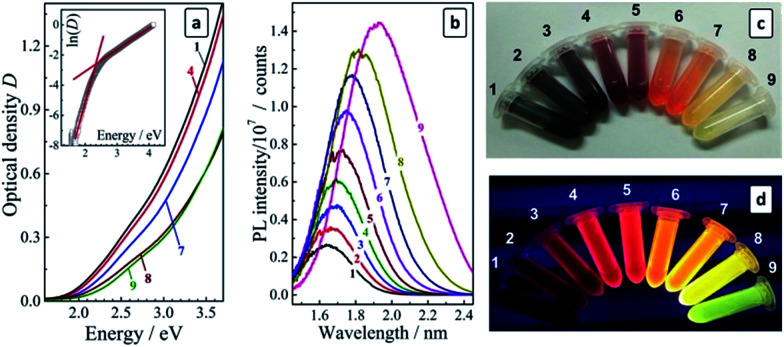
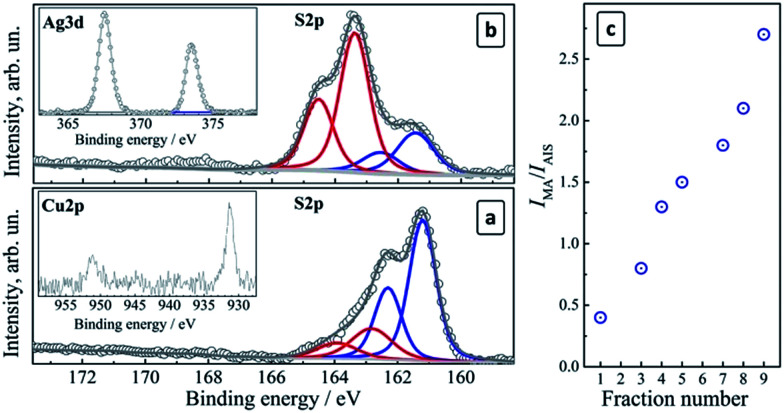
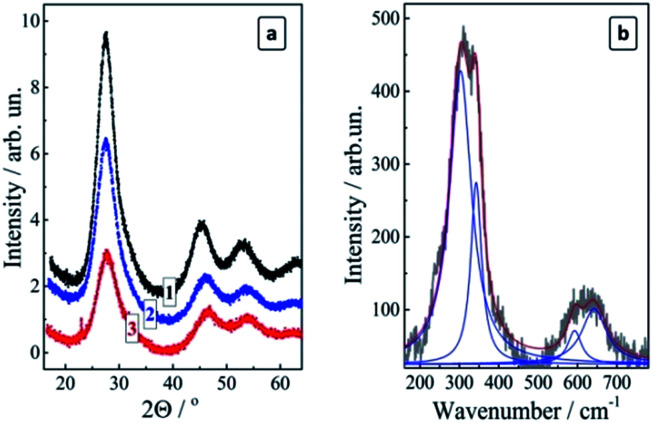
Ternary luminescent copper and silver indium sulfide quantum dots (QDs) can be an attractive alternative to cadmium and lead chalcogenide QDs. The optical properties of Cu-In-S and Ag-In-S (AIS) QDs vary over a broad range depending on the QD composition and size. The implementation of ternary QDs as emitters in bio-sensing applications can be boosted by the development of mild and reproducible syntheses directly in aqueous solutions as well as the methods of shifting the photoluminescence (PL) bands of such QDs as far as possible into the near IR spectral range. In the present work, the copper-doping of aqueous non-stoichiometric AIS QDs was found to result in a red shift of the PL band maximum from around 630 nm to ∼780 nm and PL quenching. The deposition of a ZnS shell results in PL intensity recovery with the highest quantum yield of 15%, with almost not change in the PL band position, opposite to the undoped AIS QDs. Size-selective precipitation using 2-propanol as a non-solvent allows discrimination of up to 9 fractions of Cu-doped AIS/ZnS QDs with the average sizes in the fractions varying from around 3 to 2 nm and smaller and with reasonably the same composition irrespective of the QD size. The decrease of the average QD size results in a blue PL shift yielding a series of bright luminophors with the emission color varies from deep-red to bluish-green and the PL efficiency increases from 11% for the first fraction to up to 58% for the smallest Cu-doped AIS/ZnS QDs. The rate constant of the radiative recombination of the size-selected Cu-doped AIS/ZnS QDs revealed a steady growth with the QD size decrease as a result of the size-dependent enhancement of the spatial exciton confinement. The copper doping was found to result in an enhancement of the photoelectrochemical activity of CAIS/ZnS QDs introduced as spectral sensitizers of mesoporous titania photoanodes of liquid-junction solar cells.
三元发光铜铟硫化物和银铟硫化物量子点(QDs)可能是镉和铅硫族化物量子点的一个有吸引力的替代品。铜铟硫(Cu-In-S)和银铟硫(AIS)量子点的光学性质会根据量子点的组成和尺寸在很宽的范围内变化。通过直接在水溶液中开发温和且可重复的合成方法以及将此类量子点的光致发光(PL)带尽可能移至近红外光谱范围的方法,可以推动三元量子点在生物传感应用中作为发光体的应用。在本工作中,发现非化学计量的水性AIS量子点进行铜掺杂会导致PL带最大值从约630nm红移至约780nm并发生PL猝灭。沉积ZnS壳层会导致PL强度恢复,最高量子产率为15%,PL带位置几乎不变,这与未掺杂的AIS量子点相反。使用2-丙醇作为非溶剂进行尺寸选择性沉淀,可以区分多达9个级分的铜掺杂AIS/ZnS量子点,这些级分的平均尺寸从约3nm到2nm及更小,并且无论量子点尺寸如何,其组成基本相同。平均量子点尺寸的减小会导致PL蓝移,产生一系列明亮的发光体,发射颜色从深红色到蓝绿色变化,PL效率从第一级分的11%增加到最小的铜掺杂AIS/ZnS量子点的高达58%。尺寸选择的铜掺杂AIS/ZnS量子点的辐射复合速率常数显示随着量子点尺寸减小而稳定增长,这是由于空间激子限制的尺寸依赖性增强。发现铜掺杂会增强作为液结太阳能电池中多孔二氧化钛光阳极的光谱敏化剂引入的CAIS/ZnS量子点的光电化学活性。