Warren Christopher M, Agrawal Avni, Gandhi Divya, Gupta Ruchi S
Center for Food Allergy and Asthma Research, Northwestern University Feinberg School of Medicine, 750 N Lake Shore Drive, 6 Floor, Chicago, IL, 60611, USA.
College of Osteopathic Medicine -LECOM Bradenton, 5000 Lakewood Ranch Blvd, Bradenton, FL, 34211, USA.
World Allergy Organ J. 2022 Apr 21;15(4):100644. doi: 10.1016/j.waojou.2022.100644. eCollection 2022 Apr.
Cow's milk is a food allergen of public health importance both in the United States and globally. Its natural history and epidemiology have been most studied among infants and young children, but the public health burden it places on adults and older pediatric populations remains unclear. This study comprehensively characterizes the US population-level burden of cow's milk allergy (CMA), including its prevalence, severity, health care utilization, psychosocial impact, natural history, and other associated factors-including ability to tolerate extensively heated milk products-within a large, nationally-representative survey sample of US households.
A cross-sectional survey was administered via web and telephone. Population level inference was based on data collected from participants recruited from National Opinion Research Center (NORC) at the University of Chicago's probability-based panel. Established dual-sample complex survey calibration methods were used to augment this sample with additional participants recruited through Survey Sampling International to increase the precision of the resulting estimates. In total, surveys were administered to a nationally representative sample of 51 819 US households from October 1, 2015, through September 31, 2016. Self-report responses from 40 453 adults and parent-proxy report for 38 408 children were analyzed.
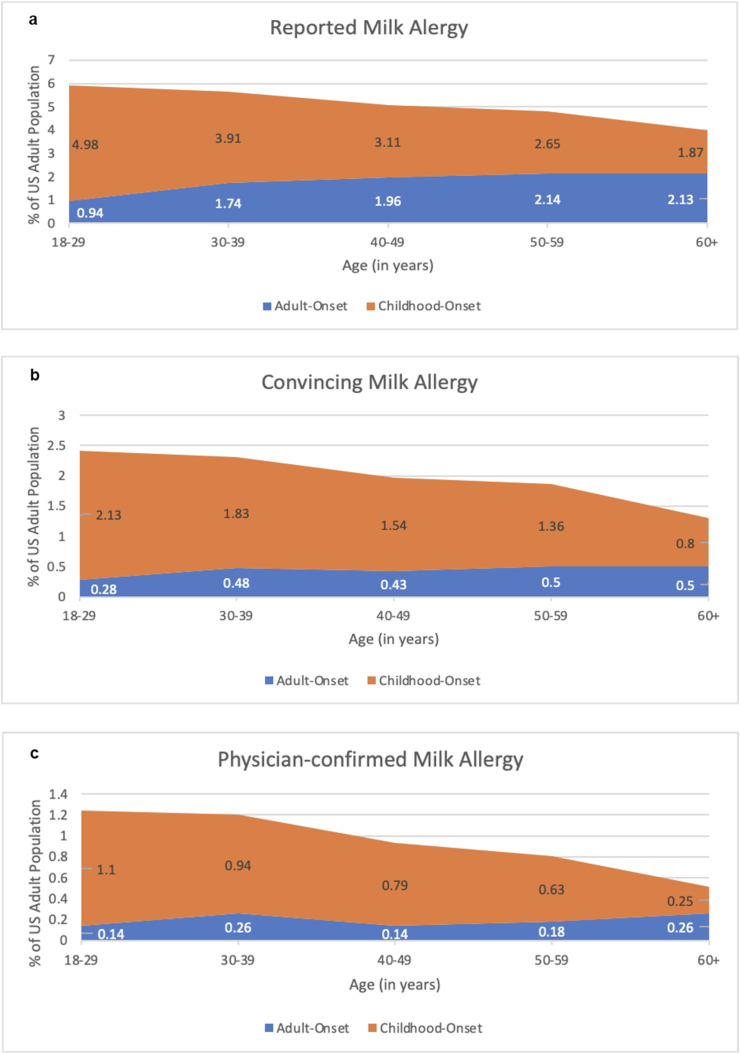
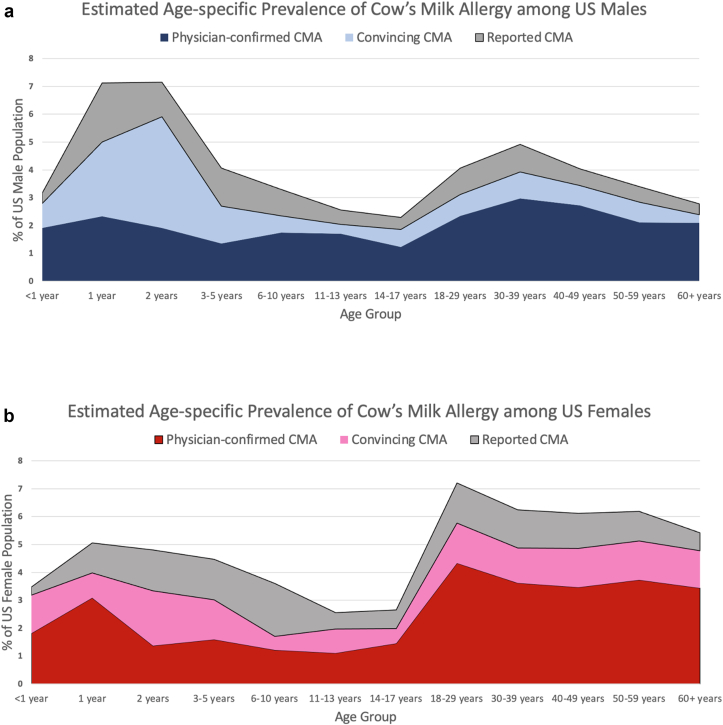
Analyzing survey responses from 78 851 individuals, an estimated 4.7% (95% CI, 4.4%-4.9%) of the US population reported current CMA, whereas 1.9% (95% CI, 1.8%-2.1%) met symptom-report criteria for convincing IgE-mediated allergy. An estimated 0.9% (95% CI, 0.8%-1.0%) had CMA that met convincing symptom-report criteria and was physician diagnosed. Female and White respondents were more likely to report outgrowing CMA relative to males and those reporting other races and ethnicities. Individuals with CMA who reported tolerance to baked milk products were less likely to report severe reaction histories (33.5% vs 42.7%; p = .03), a lifetime history of food allergy-related emergency department visits (43.4% vs. 55.8%; p = .005), and treating a milk-allergic reaction with epinephrine (10.6 vs. 18.9%; p = .003). These individuals also exhibited less psychosocial burden on the validated Food Allergy Independent Measure (FAIM) than their counterparts with CMA who were allergic to baked forms of milk.
These data indicate a discrepancy in reported rates of allergy to cow's milk among the US general population ranging from approximately 1 in 20 with reported CMA to fewer than 1 in 50 with physician-confirmed CMA. However, they suggest a substantial population-level burden of CMA, including substantial healthcare utilization, psychosocial burden and nutritional impacts-particularly among the approximately 30% of individuals with CMA who cannot tolerate baked forms of milk.
在美国和全球范围内,牛奶都是一种具有公共卫生重要性的食物过敏原。其自然病史和流行病学在婴幼儿中研究得最多,但它给成年人和大龄儿童群体带来的公共卫生负担仍不明确。本研究在美国具有全国代表性的大量家庭样本中,全面描述了牛奶过敏(CMA)在美国人群层面的负担,包括其患病率、严重程度、医疗保健利用情况、社会心理影响、自然病史以及其他相关因素,包括耐受深度加热奶制品的能力。
通过网络和电话进行横断面调查。人群层面的推断基于从芝加哥大学全国民意研究中心(NORC)基于概率的样本中招募的参与者收集的数据。采用既定的双样本复杂调查校准方法,通过国际调查抽样公司招募额外的参与者来扩充该样本,以提高所得估计值的精度。2015年10月1日至2016年9月31日期间,共对51819户美国家庭进行了具有全国代表性的抽样调查。分析了40453名成年人的自我报告和38408名儿童的家长代理报告。
分析78851人的调查回复,估计美国人群中有4.7%(95%CI,4.4%-4.9%)报告当前患有CMA,而1.9%(95%CI,1.8%-2.1%)符合令人信服的IgE介导过敏的症状报告标准。估计有0.9%(95%CI,0.8%-1.0%)患有符合令人信服的症状报告标准且经医生诊断的CMA。相对于男性以及报告其他种族和族裔的人,女性和白人受访者更有可能报告CMA已自愈。报告耐受烘焙奶制品的CMA患者报告严重反应史的可能性较小(33.5%对42.7%;p = 0.03),有食物过敏相关急诊就诊终身史的可能性较小(43.4%对55.8%;p = 0.005),用肾上腺素治疗牛奶过敏反应的可能性较小(10.6%对18.9%;p = 0.003)。与对烘焙形式牛奶过敏的CMA患者相比,这些人在经过验证的食物过敏独立测量量表(FAIM)上的社会心理负担也较小。
这些数据表明,美国普通人群中报告的牛奶过敏率存在差异,从约二十分之一报告患有CMA到不到五十分之一经医生确诊患有CMA。然而,这些数据表明CMA在人群层面负担巨大,包括大量的医疗保健利用、社会心理负担和营养影响,特别是在约30%无法耐受烘焙形式牛奶的CMA患者中。