Calcio Gaudino Emanuela, Manzoli Maela, Carnaroglio Diego, Wu Zhilin, Grillo Giorgio, Rotolo Laura, Medlock Jonathan, Bonrath Werner, Cravotto Giancarlo
Dipartimento di Scienza e Tecnologia del Farmaco, NIS - Centre for Nanostructured Interfaces and Surfaces, University of Turin Via P. Giuria 9 10125 Turin Italy
Milestone srl Via Fatebenefratelli, 1-5 Sorisole 24010 Italy.
RSC Adv. 2018 Feb 13;8(13):7029-7039. doi: 10.1039/c8ra00331a. eCollection 2018 Feb 9.
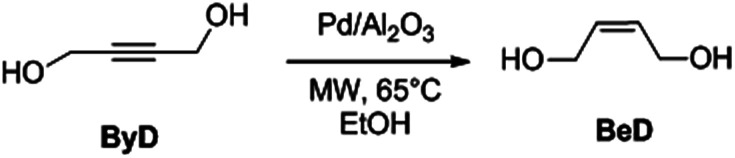
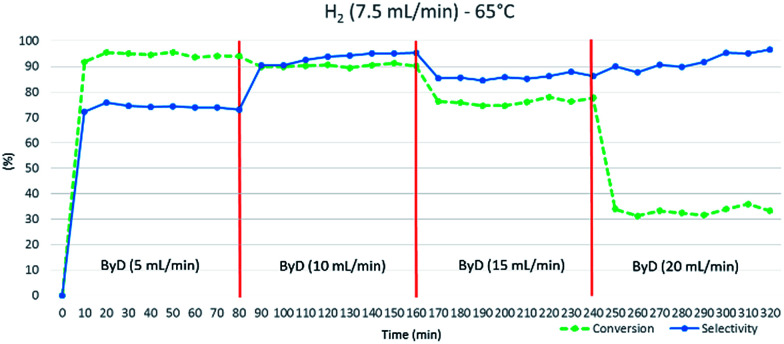
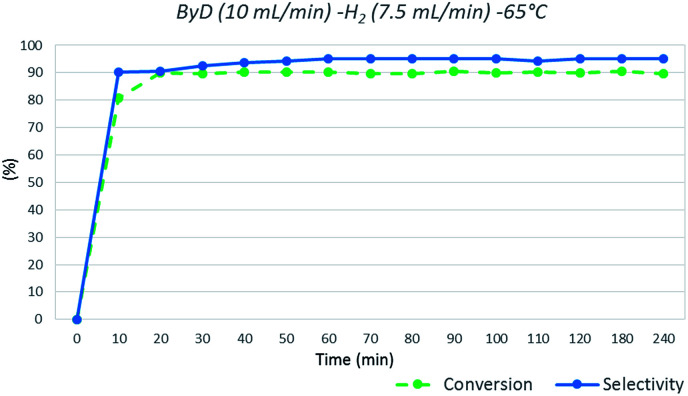
A novel protocol for microwave-assisted alkyne semi-hydrogenation under heterogeneous catalysis in a continuous flow reactor is reported herein. This challenging task has been accomplished using a multifaceted strategy which includes the ultrasound-assisted preparation of Pd nanoparticles (average 3.0 ± 0.5 nm) that were synthesized on the μ-metric pores of sintered alumina spheres ( 0.8 mm) and a continuous flow reaction under H (flow rate 7.5 mL min) in a microwave reactor (counter-pressure 4.5 bar). The semi-hydrogenation of 2-butyne-1,4-diol in ethanol was chosen as a model reaction for the purposes of optimization. The high catalyst efficiency of the process, in spite of the low Pd loading (Pd content 111.15 mg kg from ICP-MS), is due to the pivotal role of ultrasound in generating a regular distribution of Pd nanoparticles across the entire support surface. Ultrasound promotes the nucleation, rather than the growth, of crystalline Pd nanoparticles and does so within a particularly narrow Gaussian size distribution. High conversion (>90.5%) and selectivity to ()-2-butene-1,4-diol (95.20%) have been achieved at an alkyne solution flow rate of 10 mL min. The lead-free, alumina-stabilized Pd catalyst was fully characterized by TEM, HR-TEM, EDX, IR, XRPD and AAS. Highly dispersed Pd nanoparticles have proven themselves to be stable under the reaction conditions employed. The application of the method is subject to the dielectric properties of substrates and solvents, and is therefore hardly applicable to apolar alkynes. Considering the small volume of the reaction chamber, microwave-assisted flow hydrogenation has proven itself to be a safe procedure and one that is suitable for further scaling up to industrial application.
本文报道了一种在连续流动反应器中进行非均相催化微波辅助炔烃半氢化的新方法。这项具有挑战性的任务是通过多方面的策略完成的,该策略包括超声辅助制备负载在烧结氧化铝球(0.8毫米)微米级孔隙上的钯纳米颗粒(平均粒径3.0±0.5纳米),以及在微波反应器中于氢气(流速7.5毫升/分钟)下进行连续流动反应(反压4.5巴)。选择2-丁炔-1,4-二醇在乙醇中的半氢化反应作为模型反应进行优化。尽管钯负载量较低(通过电感耦合等离子体质谱法测得钯含量为111.15毫克/千克),但该工艺具有较高的催化剂效率,这归因于超声在使钯纳米颗粒在整个载体表面均匀分布方面所起的关键作用。超声促进结晶钯纳米颗粒的成核而非生长,并且是在特别窄的高斯尺寸分布范围内进行。在炔烃溶液流速为10毫升/分钟时,实现了高转化率(>90.5%)和对()-2-丁烯-1,4-二醇的选择性(95.20%)。通过透射电子显微镜(TEM)、高分辨率透射电子显微镜(HR-TEM)、能量散射X射线光谱(EDX)、红外光谱(IR)、X射线粉末衍射(XRPD)和原子吸收光谱(AAS)对无铅、氧化铝稳定的钯催化剂进行了全面表征。已证明高度分散的钯纳米颗粒在所采用的反应条件下是稳定的。该方法的应用取决于底物和溶剂的介电性质,因此几乎不适用于非极性炔烃。考虑到反应腔体积小,微波辅助流动氢化已证明是一种安全的方法,并且适合进一步扩大规模用于工业应用。