Biundo Antonino, Subagia Raditya, Maurer Michael, Ribitsch Doris, Syrén Per-Olof, Guebitz Georg M
Austrian Centre of Industrial Biotechnology (ACIB) Konrad Lorenz Strasse 20 3430 Tulln an der Donau Austria
Institute of Environmental Biotechnology, University of Natural Resources and Life Sciences (BOKU) Konrad Lorenz Strasse 20 3430 Tulln an der Donau Austria.
RSC Adv. 2019 Nov 7;9(62):36217-36226. doi: 10.1039/c9ra07519d. eCollection 2019 Nov 4.
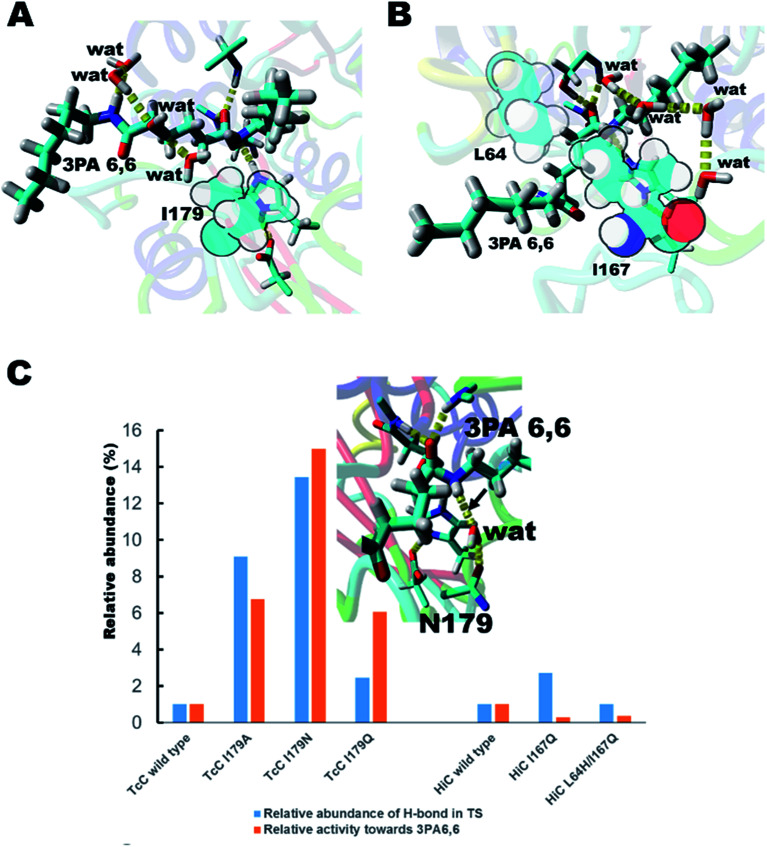
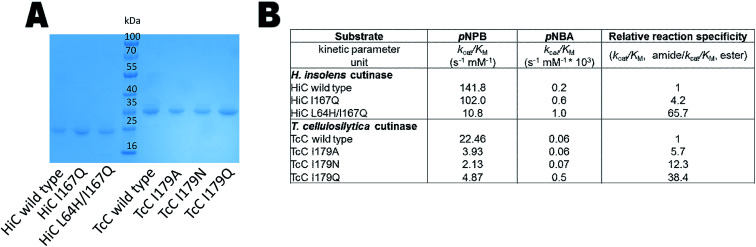
The recalcitrance of plastics like nylon and other polyamides contributes to environmental problems ( microplastics in oceans) and restricts possibilities for recycling. The fact that hitherto discovered amidases (EC 3.5.1. and 3.5.2.) only show no, or low, activity on polyamides currently obstructs biotechnological-assisted depolymerization of man-made materials. In this work, we capitalized on enzyme engineering to enhance the promiscuous amidase activity of polyesterases. Through enzyme design we created a reallocated water network adapted for hydrogen bond formation to synthetic amide backbones for enhanced transition state stabilization in the polyester-hydrolyzing biocatalysts cutinase and cutinase 1. This novel concept enabled increased catalytic efficiency towards amide-containing soluble substrates. The afforded enhanced hydrolysis of the amide bond-containing insoluble substrate 3PA 6,6 by designed variants was aligned with improved transition state stabilization identified by molecular dynamics (MD) simulations. Furthermore, the presence of a favorable water-molecule network that interacted with synthetic amides in the variants resulted in a reduced activity on polyethylene terephthalate (PET). Our data demonstrate the potential of using enzyme engineering to improve the amidase activity for polyesterases to act on synthetic amide-containing polymers.
尼龙等聚酰胺类塑料的难降解性导致了环境问题(海洋中的微塑料)并限制了回收利用的可能性。迄今为止发现的酰胺酶(EC 3.5.1. 和 3.5.2.)对聚酰胺仅表现出无活性或低活性,这一事实目前阻碍了人造材料的生物技术辅助解聚。在这项工作中,我们利用酶工程来增强聚酯酶的混杂酰胺酶活性。通过酶设计,我们创建了一个重新分配的水网络,该网络适合与合成酰胺主链形成氢键,以增强聚酯水解生物催化剂角质酶和角质酶1中的过渡态稳定性。这一新概念提高了对含酰胺可溶性底物的催化效率。通过分子动力学(MD)模拟确定,设计变体对含酰胺键的不溶性底物3PA 6,6的水解增强与过渡态稳定性的改善相一致。此外,变体中与合成酰胺相互作用的有利水分子网络的存在导致其对聚对苯二甲酸乙二酯(PET)的活性降低。我们的数据证明了利用酶工程提高聚酯酶对含合成酰胺聚合物的酰胺酶活性的潜力。