Department of Pharmacology, University of North Carolina at Chapel Hill, Chapel Hill, North Carolina 27599, USA.
Department of Mechanical and Aerospace Engineering, University of Alabama at Huntsville, Huntsville, Alabama 35899, USA.
Sci Rep. 2017 Mar 10;7:44072. doi: 10.1038/srep44072.
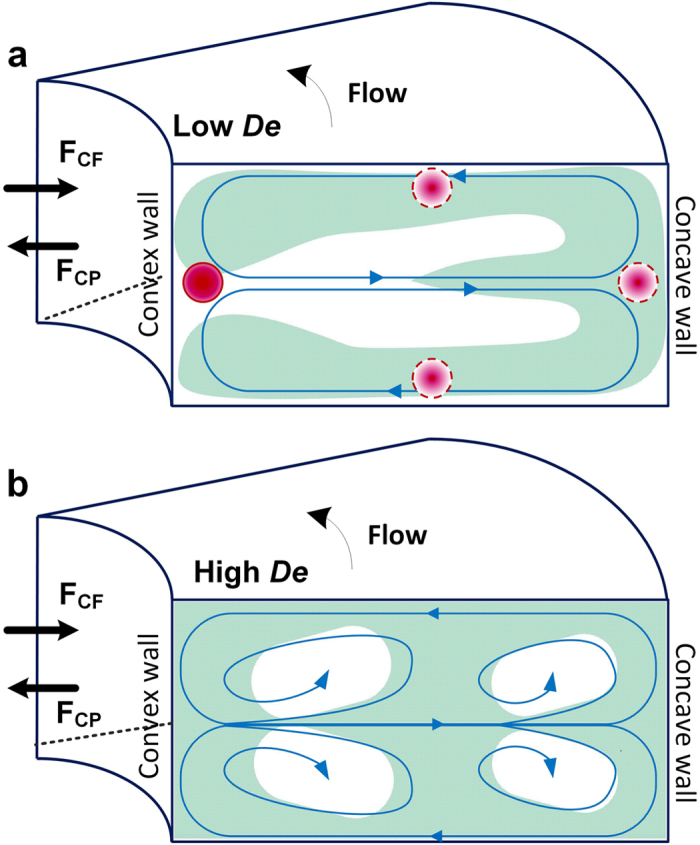
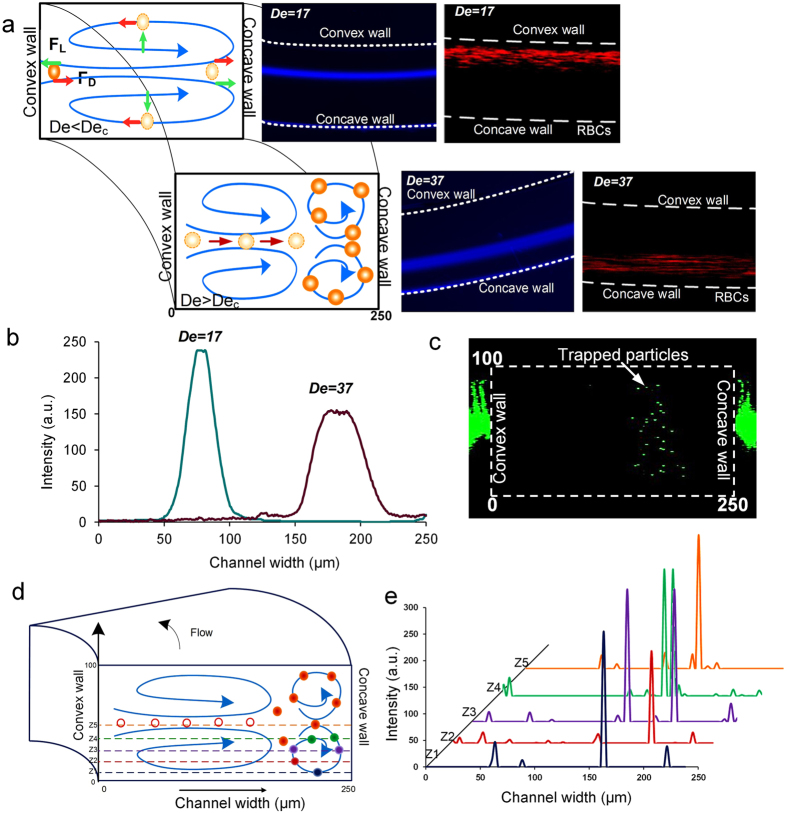
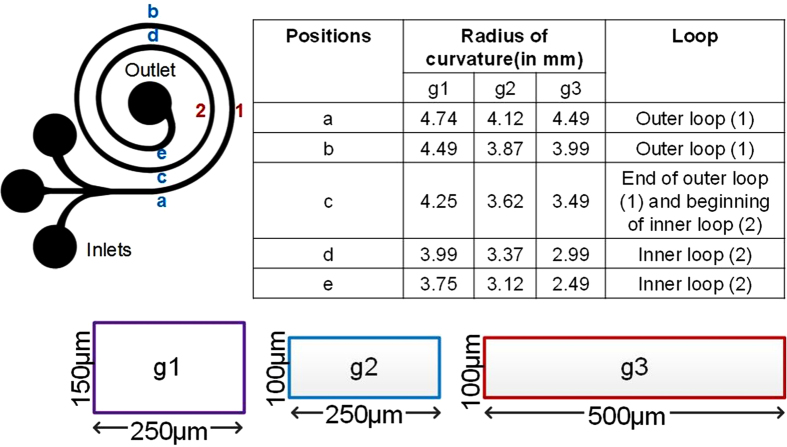
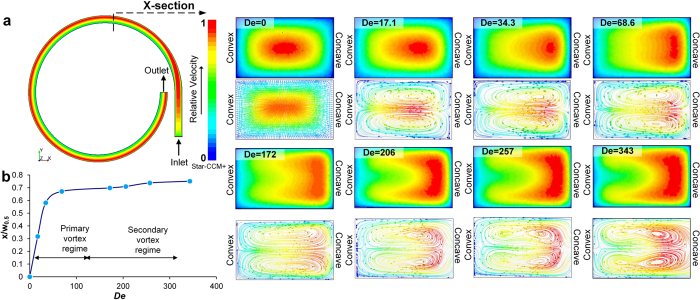
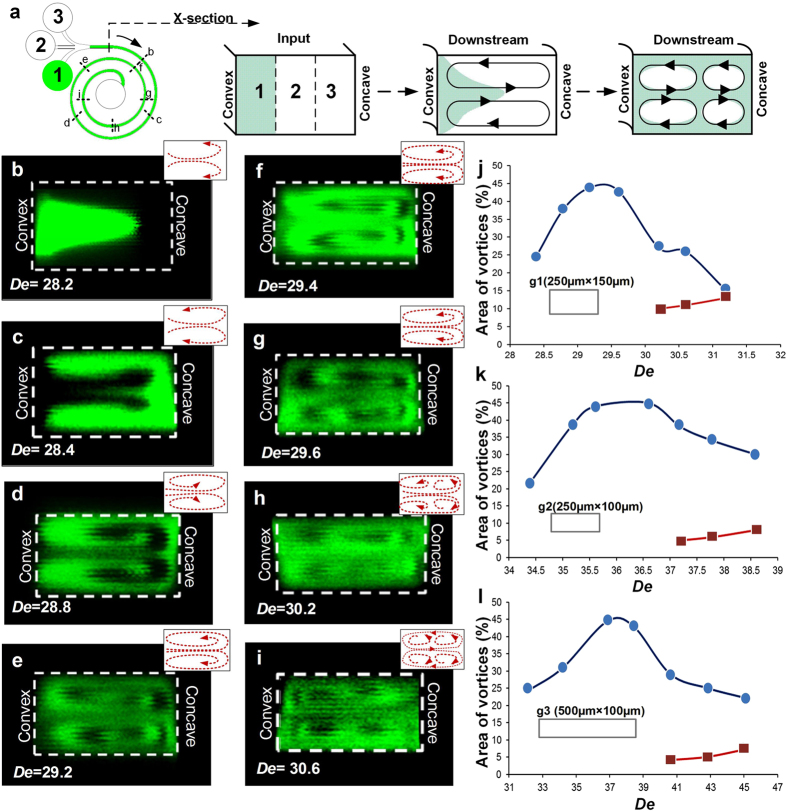
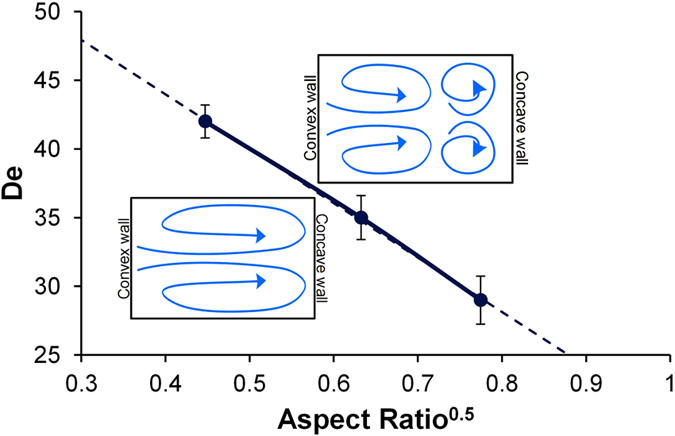
A wide range of microfluidic cell-sorting devices has emerged in recent years, based on both passive and active methods of separation. Curvilinear channel geometries are often used in these systems due to presence of secondary flows, which can provide high throughput and sorting efficiency. Most of these devices are designed on the assumption of two counter rotating Dean vortices present in the curved rectangular channels and existing in the state of steady rotation and amplitude. In this work, we investigate these secondary flows in low aspect ratio spiral rectangular microchannels and define their development with respect to the channel aspect ratio and Dean number. This work is the first to experimentally and numerically investigate Dean flows in microchannels for Re > 100, and show presence of secondary Dean vortices beyond a critical Dean number. We further demonstrate the impact of these multiple vortices on particle and cell focusing. Ultimately, this work offers new insights into secondary flow instabilities for low-aspect ratio, spiral microchannels, with improved flow models for design of more precise and efficient microfluidic devices for applications such as cell sorting and micromixing.
近年来,出现了多种基于被动和主动分离方法的微流控细胞分选装置。由于存在二次流,这些系统通常采用曲线通道几何形状,这可以提供高通量和高效率的分选。这些装置中的大多数都是基于在弯曲矩形通道中存在两个反向旋转的迪恩涡旋的假设设计的,这些涡旋处于稳定旋转和幅度的状态。在这项工作中,我们研究了低纵横比螺旋矩形微通道中的这些二次流,并根据通道纵横比和迪恩数定义了它们的发展。这项工作首次实验和数值研究了 Re>100 时微通道中的迪恩流,并显示出在临界迪恩数之后存在二次迪恩涡旋。我们进一步展示了这些多个涡旋对颗粒和细胞聚焦的影响。最终,这项工作为低纵横比、螺旋微通道中的二次流不稳定性提供了新的见解,为细胞分选和微混合等应用设计更精确、更高效的微流控装置提供了改进的流动模型。