Eze Fredrick Nwude, Tola Adesola Julius, Nwabor Ozioma Forstinus, Jayeoye Titilope John
Department of Chemical Sciences, Joseph Ayo Babalola University Ikeji-Arakeji Osun State Nigeria.
Department of Chemistry, Biochemistry and Physics, Université du Québec à Trois-Rivières (UQTR) Trois-Rivières Québec G9A 5H7 Canada.
RSC Adv. 2019 Nov 20;9(65):37957-37970. doi: 10.1039/c9ra08618h. eCollection 2019 Nov 19.
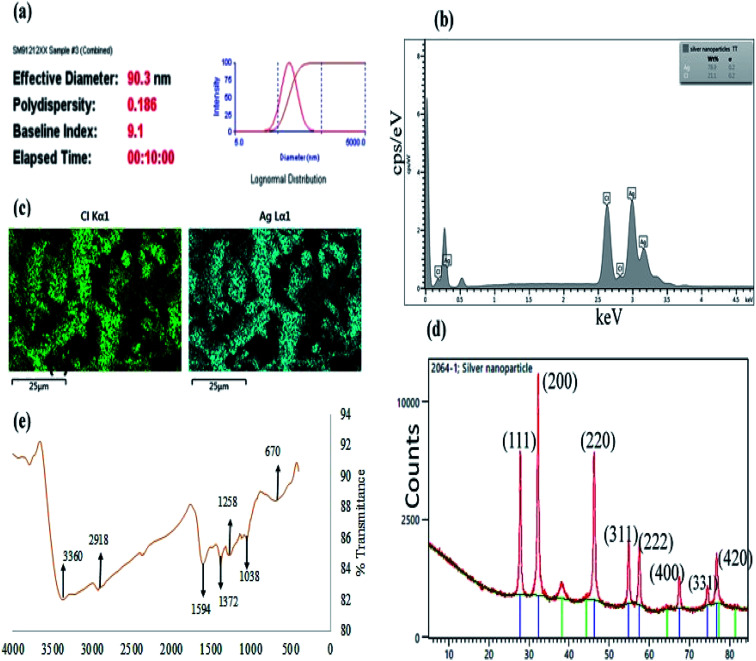
In this article, we have reported an environmentally benign and cost-effective method for the synthesis of monodispersed silver nanoparticles (AgNPs), based on phenolic extracts (CAPE). The presence of phenolics was confirmed by ultra high-performance liquid chromatography coupled with electrospray ionization quadrupole time of flight mass spectrometry (UHPLC-ESI-qTOF-MS). Colloidal AgNPs synthesized under different concentrations of silver nitrate were monitored with a UV-vis spectrophotometer. Maximum absorption spectra intensity was found to range between 430-440 nm, during a synthesis time of 90 minutes at room temperature. The as-synthesized CAPE-AgNPs, was subjected to various instrumental characterizations such as, transmission electron microscopy (TEM), X-ray powder diffraction (XRD), energy dispersive X-ray spectroscopy (EDS), Fourier transform infrared (FTIR) spectroscopy, dynamic light scattering (DLS) and zeta potential. At the optimized synthesis conditions, spherical and monodispersed CAPE-AgNPs were obtained, with an absorption maximum at 430 nm. The crystalline CAPE-AgNPs had a face-centered-cubic (fcc) crystallographic structure, possessing average sizes estimated from TEM, to be between 20-25 nm diameter, a hydrodynamic diameter from DLS of about 90 nm and a zeta potential value of -28.7 mV. FTIR results validated the presence of phenolics on the surfaces of CAPE-AgNPs. The anti-microbial capacity of CAPE-AgNPs was further demonstrated on different pathogenic bacterial strains with satisfactory performances. As a result of the high surface area to volume ratio of CAPE-AgNPs, it was investigated as a catalyst towards the reduction of prominent environmental pollutants, 4 nitrophenol (4 NP), Congo red (CR) and methylene blue (MB). Pseudo first order kinetics were obtained with rate constants of 3.9 × 10 s for 4 NP, 54.7 × 10 min for MB and 5.6 × 10 s for CR. The catalytic performance and antimicrobial activities of CAPE-AgNPs suggest its potential application in wastewater treatment and control of pathogenic microbes.
在本文中,我们报道了一种基于酚类提取物(CAPE)合成单分散银纳米颗粒(AgNPs)的环境友好且具有成本效益的方法。通过超高效液相色谱与电喷雾电离四极杆飞行时间质谱联用(UHPLC-ESI-qTOF-MS)确认了酚类物质的存在。用紫外可见分光光度计监测在不同浓度硝酸银下合成的胶体AgNPs。在室温下90分钟的合成时间内,发现最大吸收光谱强度在430 - 440nm之间。合成的CAPE-AgNPs进行了各种仪器表征,如透射电子显微镜(TEM)、X射线粉末衍射(XRD)、能量色散X射线光谱(EDS)、傅里叶变换红外(FTIR)光谱、动态光散射(DLS)和zeta电位。在优化的合成条件下,获得了球形且单分散的CAPE-AgNPs,其最大吸收峰在430nm处。结晶的CAPE-AgNPs具有面心立方(fcc)晶体结构,根据TEM估计其平均尺寸在直径20 - 25nm之间,DLS测得的流体动力学直径约为90nm,zeta电位值为-28.7mV。FTIR结果验证了CAPE-AgNPs表面存在酚类物质。CAPE-AgNPs对不同致病细菌菌株的抗菌能力进一步得到证实,表现令人满意。由于CAPE-AgNPs具有高的表面积与体积比,研究了其作为催化剂用于还原主要环境污染物4-硝基苯酚(4-NP)、刚果红(CR)和亚甲基蓝(MB)的性能。对于4-NP获得了伪一级动力学,速率常数为3.9×10⁻³s⁻¹,对于MB为54.7×10⁻³min⁻¹,对于CR为5.6×10⁻³s⁻¹。CAPE-AgNPs的催化性能和抗菌活性表明其在废水处理和致病微生物控制方面具有潜在应用。