Liu Yongzhi, Zheng Huaili, Wang Yili, Zheng Xinyu, Wang Moxi, Ren Jie, Zhao Chuanliang
Key Laboratory of the Three Gorges Reservoir Region's Eco-Environment, Ministry of Education, Chongqing University Campus B, 83 Shabei Street, Shapingba District Chongqing 400045 PR China
National Centre for International Research of Low-carbon and Green Buildings, Chongqing University Chongqing 400045 PR China.
RSC Adv. 2018 Aug 7;8(50):28329-28340. doi: 10.1039/c8ra05622f.
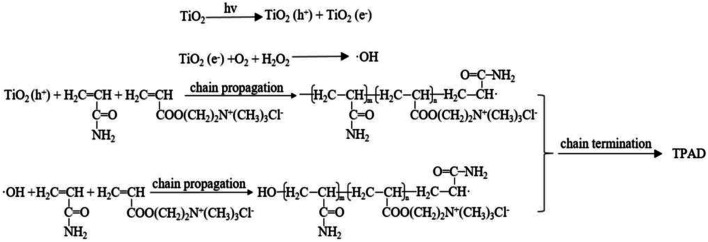
In the face of complex water quality changes, the application of existing cationic polyacrylamide has been largely limited. In this study, a series of cationic polyacrylamides (TPADs) with excellent flocculation/dewatering performance and low dosage were synthesized through photocatalytic surface initiation using acrylamide (AM) and acryloyloxyethyl trimethylammonium chloride (DAC) as monomers and nano-TiO as an initiator. Characterization using Fourier transform infrared (FTIR) spectroscopy, nuclear magnetic resonance (H NMR) spectroscopy, thermogravimetric/differential scanning calorimetry (TG/DSC) and scanning electron microscopy (SEM) was used to analyze the structural and morphological properties of TPADs. The initiation mechanism was described and the study on the properties of TPADs shows that the initiation method could obtain the copolymer with extra-high intrinsic viscosity. Furthermore, the flocculation and dewatering performance of TPADs and PADs were investigated in the micro-polluted low turbidity water flocculation test and sludge dewatering test. The application experimental results indicated that TPADs showed satisfactory turbidity removal and sludge dewatering performance by virtue of strong charge neutralization and a bridging effect. The excellent flocculation/dewatering performance was attributed to the photocatalytic surface-initiated method and the nano-TiO initiator. Therefore, it is expected to open up new initiation methods in the synthesis of polymeric flocculants for a broad variety of applications.
面对复杂的水质变化,现有阳离子聚丙烯酰胺的应用受到很大限制。在本研究中,以丙烯酰胺(AM)和丙烯酰氧乙基三甲基氯化铵(DAC)为单体,纳米TiO为引发剂,通过光催化表面引发合成了一系列具有优异絮凝/脱水性能且用量低的阳离子聚丙烯酰胺(TPADs)。利用傅里叶变换红外(FTIR)光谱、核磁共振(H NMR)光谱、热重/差示扫描量热法(TG/DSC)和扫描电子显微镜(SEM)进行表征,以分析TPADs的结构和形态特性。描述了引发机理,对TPADs性能的研究表明,该引发方法能够得到具有超高特性粘度的共聚物。此外,在微污染低浊水絮凝试验和污泥脱水试验中研究了TPADs和PADs的絮凝和脱水性能。应用实验结果表明,TPADs凭借强大的电荷中和作用和架桥效应,表现出令人满意的浊度去除和污泥脱水性能。优异的絮凝/脱水性能归因于光催化表面引发方法和纳米TiO引发剂。因此,有望在合成用于广泛应用的聚合物絮凝剂方面开辟新的引发方法。