Anjum Sumaira, Anjum Iram, Hano Christopher, Kousar Sidra
Department of Biotechnology, Kinnaird College for Women Lahore Pakistan
Laboratoire de Biologie des Ligneux et des Grandes Cultures, INRA USC1328, Université d'Orléans 28000 Chartres France.
RSC Adv. 2019 Dec 5;9(69):40404-40423. doi: 10.1039/c9ra08457f. eCollection 2019 Dec 3.
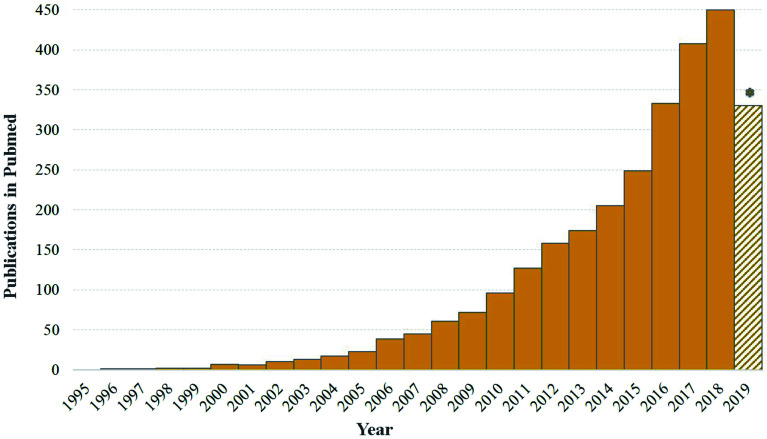
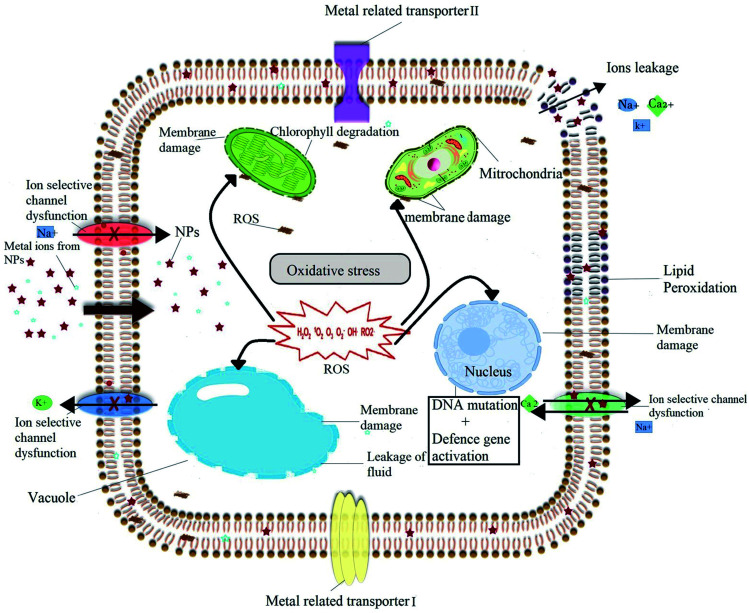
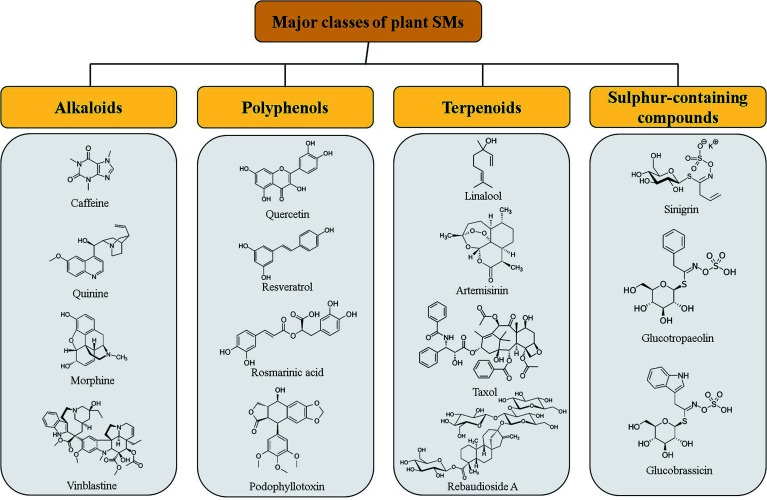
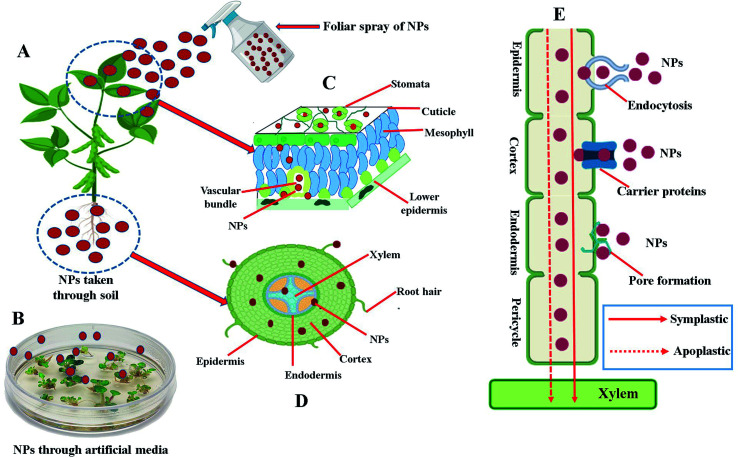
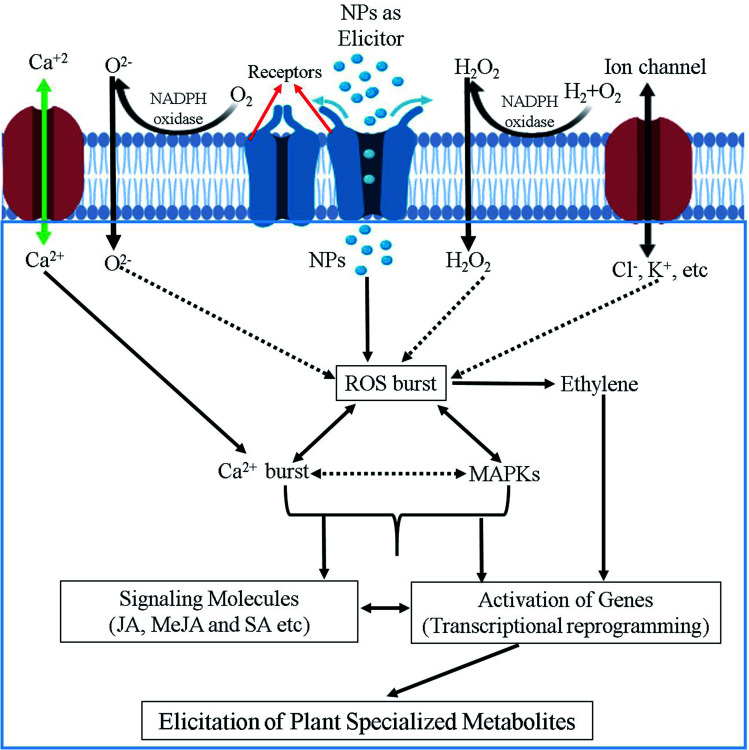
During the last few decades major advances have shed light on nanotechnology. Nanomaterials have been widely used in various fields such as medicine, energy, cosmetics, electronics, biotechnology and pharmaceuticals. Owing to their unique physicochemical characteristics and nanoscale structures, nanoparticles (NPs) have the capacity to enter into plant cells and interact with intracellular organelles and various metabolites. The effects of NPs on plant growth, development, physiology and biochemistry have been reported, but their impact on plant specialized metabolism (aka as secondary metabolism) still remains obscure. In reaction to environmental stress and elicitors, a common response in plants results in the production or activation of different types of specialized metabolites (, alkaloids, terpenoids, phenolics and flavonoids). These plant specialized metabolites (SMs) are important for plant adaptation to an adverse environment, but also a huge number of them are biologically active and used in various commercially-valued products (pharmacy, cosmetic, agriculture, food/feed). Due to their wide array of applications, SMs have attracted much attention to explore and develop new strategies to enhance their production in plants. In this context, NPs emerged as a novel class of effective elicitors to enhance the production of various plant SMs. In recent years, many reports have been published regarding the elicitation of SMs by different types of NPs. However, in order to achieve an enhanced and sustainable production of these SMs, in-depth studies are required to figure out the most suitable NP in terms of type, size and/or effective concentration, along with a more complete understanding about their uptake, translocation, internalization and elicitation mechanisms. Herein, we are presenting a comprehensive and critical account of the plant SMs elicitation capacities of the three main classes of nanomaterials (, metallic NPs (MNPs), metal oxide NPs (MONPs) and carbon related nanomaterials). Their different proposed uptake, translocation and internalization pathways as well as elicitation mechanism along with their possible deleterious effect on plant SMs and/or phytotoxic effects are summarized. We also identified and critically discussed the current research gaps existing in this field and requiring future investigation to further improve the use of these nanomaterials for an efficient production of plant SMs.
在过去几十年中,重大进展使人们对纳米技术有了更深入的了解。纳米材料已广泛应用于医学、能源、化妆品、电子、生物技术和制药等各个领域。由于其独特的物理化学特性和纳米级结构,纳米颗粒(NPs)有能力进入植物细胞并与细胞内细胞器和各种代谢物相互作用。已有报道称纳米颗粒对植物生长、发育、生理和生物化学有影响,但其对植物特殊代谢(又称次生代谢)的影响仍不清楚。作为对环境胁迫和诱导剂的反应,植物的常见反应是产生或激活不同类型的特殊代谢物(如生物碱、萜类、酚类和黄酮类)。这些植物特殊代谢物(SMs)对植物适应不利环境很重要,而且其中大量代谢物具有生物活性,可用于各种具有商业价值的产品(制药、化妆品、农业、食品/饲料)。由于其广泛的应用,特殊代谢物吸引了很多关注,人们探索并开发新策略以提高其在植物中的产量。在这种背景下,纳米颗粒成为一类新型的有效诱导剂,可提高各种植物特殊代谢物的产量。近年来,已发表了许多关于不同类型纳米颗粒诱导特殊代谢物的报道。然而,为了实现这些特殊代谢物的增产和可持续生产,需要进行深入研究,以确定在类型、尺寸和/或有效浓度方面最合适的纳米颗粒,并更全面地了解它们的吸收、转运、内化和诱导机制。在此,我们全面且批判性地阐述了三类主要纳米材料(即金属纳米颗粒(MNPs)、金属氧化物纳米颗粒(MONPs)和碳基纳米材料)对植物特殊代谢物的诱导能力。总结了它们不同的吸收、转运和内化途径以及诱导机制,以及它们对植物特殊代谢物可能产生的有害影响和/或植物毒性作用。我们还识别并批判性地讨论了该领域目前存在的研究空白,这些空白需要未来进一步研究,以进一步改进这些纳米材料在高效生产植物特殊代谢物方面的应用。