Su Minglei, Zhang Rong, Li Huairui, Jin Xiaobei, Li Jingpeng, Yue Xianfeng, Qin Daochun
International Centre for Bamboo and Rattan Beijing 100102 PR China
China National Bamboo Research Centre Hangzhou 310012 PR China.
RSC Adv. 2019 Dec 4;9(69):40277-40285. doi: 10.1039/c9ra07046j. eCollection 2019 Dec 3.
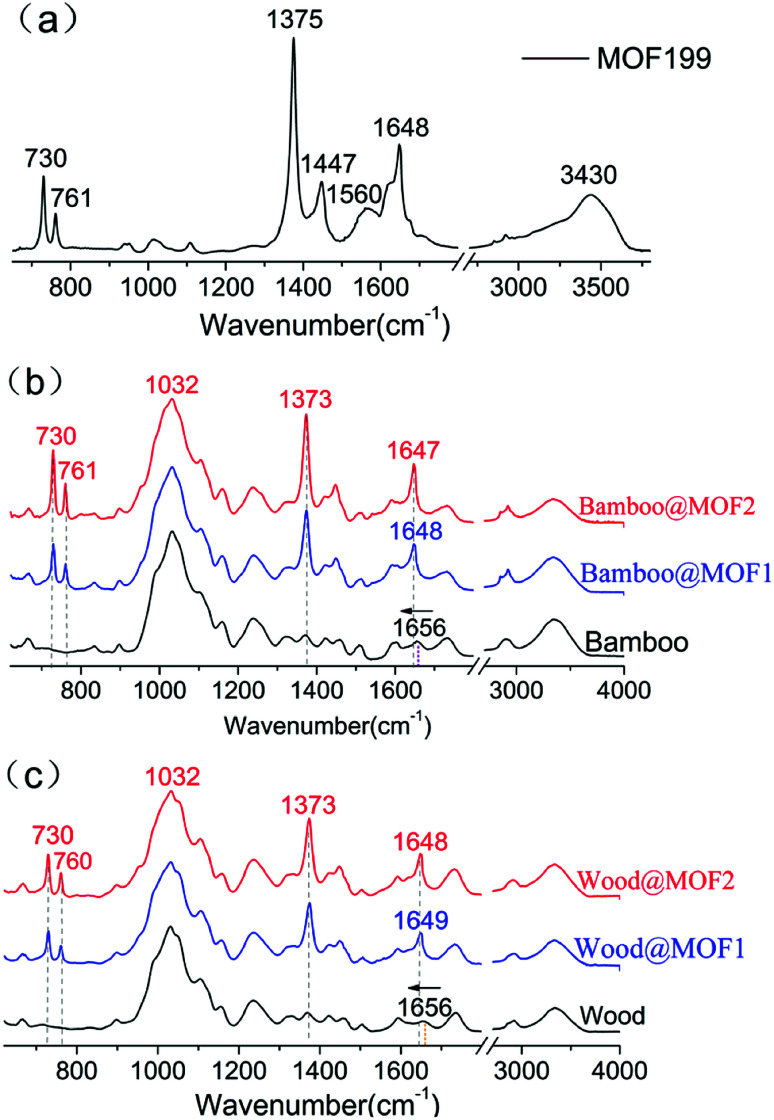
Tremendous efforts have been dedicated to developing functionalized cellulose materials by synthesis with copper-based metal-organic frameworks (MOF199), also known as HKUST-1. However, few studies have explored the deposition of MOFs on woody materials due to the complex chemical compositions of these materials (cellulose, hemicellulose, lignin) and their difficulty of bonding with MOF crystals. In this article, for the first time, MOF199 was successfully synthesized onto two different woody materials, moso bamboo and balsa wood, deposition at room temperature. The results show that the diverse surface roughness and the hierarchical structures of woody materials have significant effects on the size of MOF199 crystal. Additionally, bamboo and wood coated with MOF199 exhibited better antibacterial activities against () than (); they could minimize colony levels to 2.08 from 8.98 CFU cm. This study provides a facile method for the functionalization of woody materials with MOFs for antibacterial applications.
人们付出了巨大努力,通过与铜基金属有机框架(MOF199,也称为HKUST-1)合成来开发功能化纤维素材料。然而,由于这些木质材料(纤维素、半纤维素、木质素)复杂的化学成分以及它们与MOF晶体结合的困难,很少有研究探索MOF在木质材料上的沉积。在本文中,首次在室温下成功地将MOF199合成到两种不同的木质材料——毛竹和轻木上。结果表明,木质材料多样的表面粗糙度和分级结构对MOF199晶体的尺寸有显著影响。此外,涂有MOF199的竹子和木材对()表现出比()更好的抗菌活性;它们可以将菌落水平从8.98 CFU/cm²降至2.08。这项研究为用MOF对木质材料进行功能化以用于抗菌应用提供了一种简便方法。