Ramful Raviduth, Sunthar Thefye P M, Kamei Kaeko, Pezzotti Giuseppe
Graduate School of Science and Technology, Kyoto Institute of Technology (KIT), Kyoto 606-8585, Japan.
Mechanical and Production Engineering Department, Faculty of Engineering, University of Mauritius, Reduit 80837, Mauritius.
Antibiotics (Basel). 2022 Apr 24;11(5):569. doi: 10.3390/antibiotics11050569.
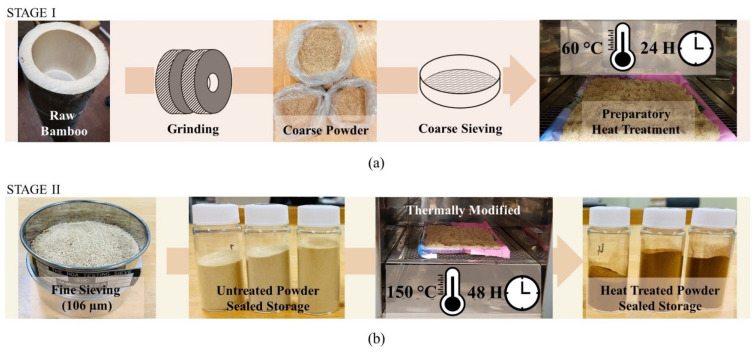
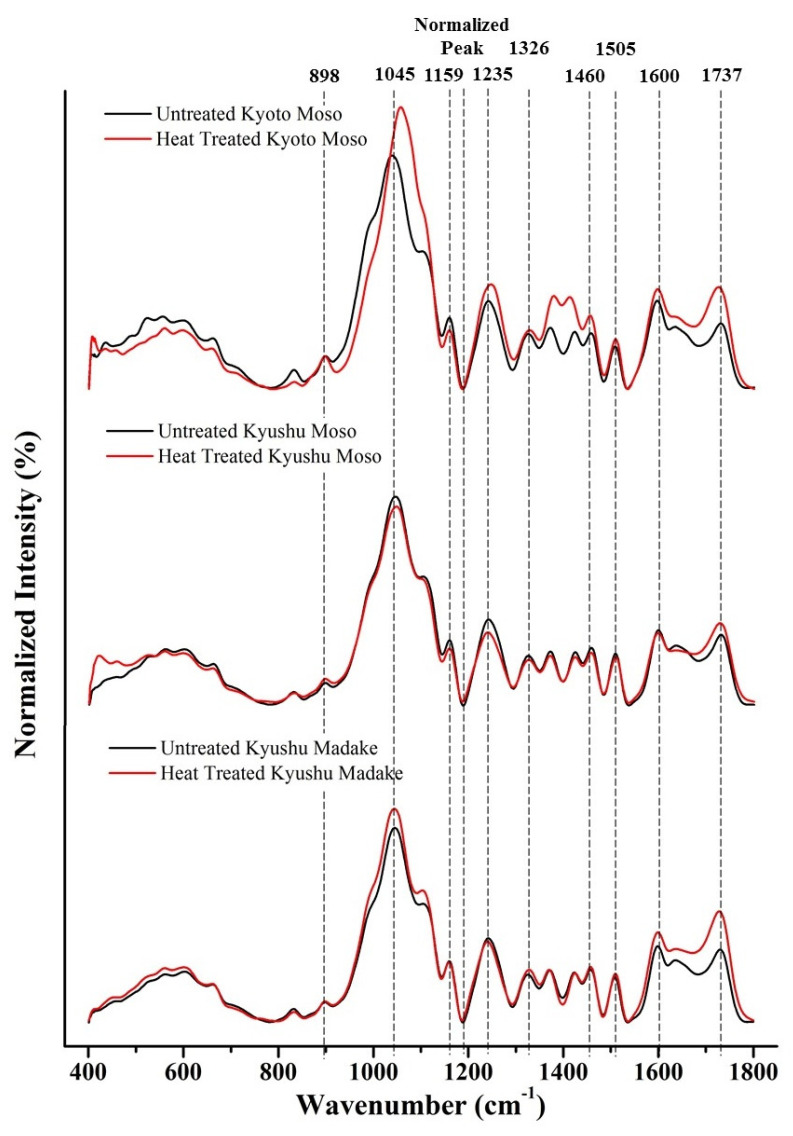
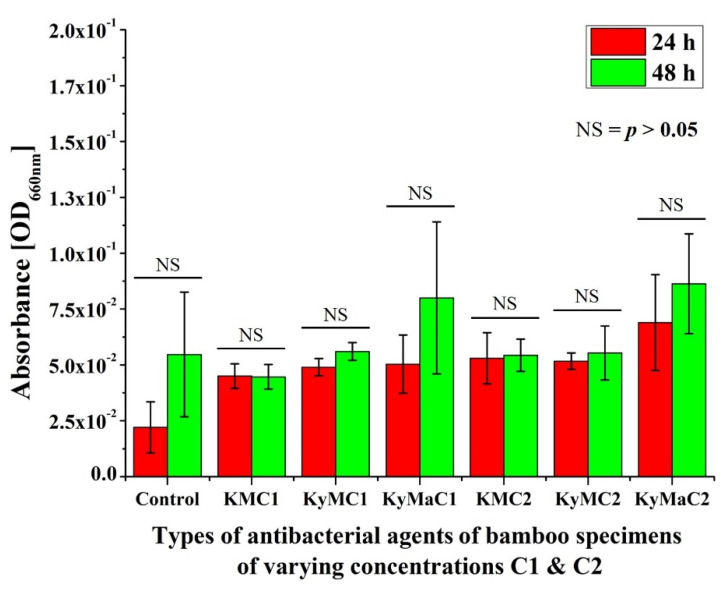
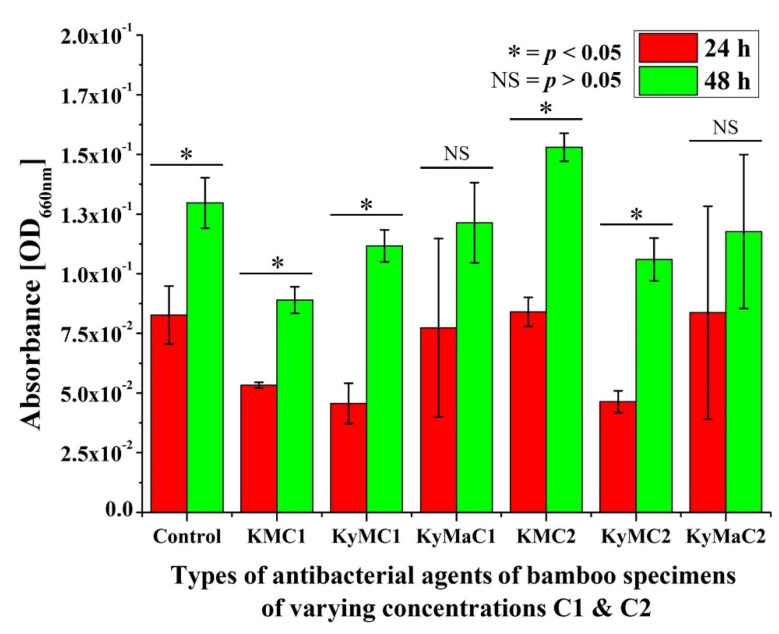
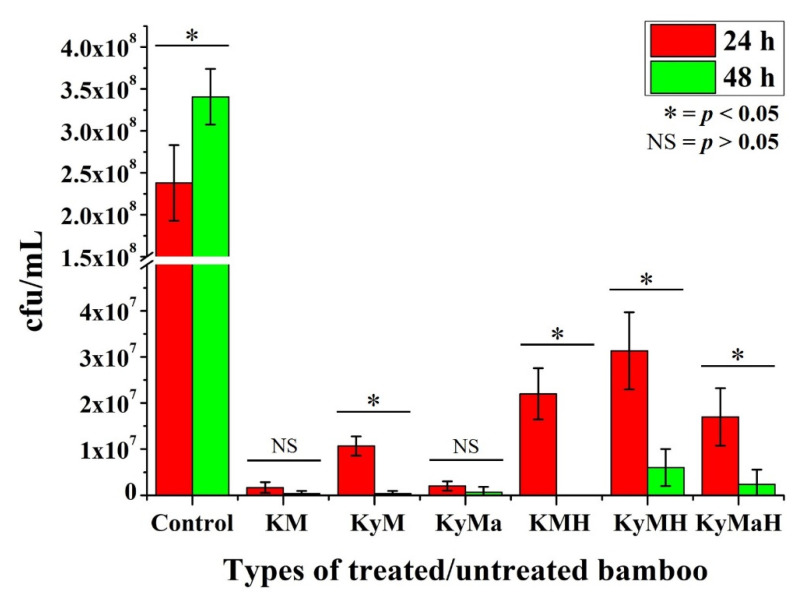
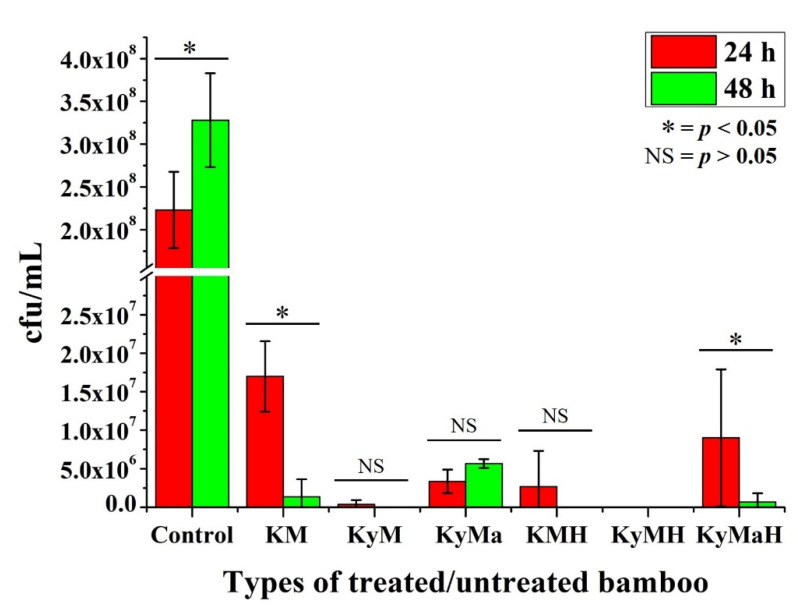
Natural materials, such as bamboo, is able to withstand the rough conditions posed by its environment, such as resistance to degradation by microorganisms, due to notable antibacterial characteristics. The methods of extraction exert a significant influence on the effectiveness of bamboo-derived antibacterial agents. In this study, the antibacterial characteristics of various types of Japanese bamboo, namely, Kyoto-Moso, Kyushu-Moso and Kyushu-Madake were investigated by considering an extraction and a non-extraction method. The characterization of the efficacy of antibacterial agents of various bamboo samples derived from both methods of extractions was conducted using an in vitro cultured bacteria technique consisting of and . Antibacterial test results based on colony-forming units showed that antibacterial agents derived from the non-extraction method yielded better efficacy when tested against and . Most specimens displayed maximum antibacterial efficacy following a 48-h period. The antibacterial agents derived from thermally modified bamboo powder via the non-extraction method showed improved antibacterial activity against specifically. In contrast, absorbance results indicated that antibacterial agents derived from the extraction method yielded poor efficacy when tested against both and . From FTIR analysis, characteristic bands assigned to the C-O and C-H functional groups in lignin were recognized as responsible for the antibacterial trait observed in both natural and thermally modified Japanese bamboo powder. Techniques to exploit the antibacterial characteristics present in bamboo by identification of antibacterial source and adoption of adequate methods of extraction are key steps in taking advantage of this attribute in numerous applications involving bamboo-derived products such as laminates and textile fabrics.
天然材料,如竹子,由于其显著的抗菌特性,能够承受其环境带来的恶劣条件,如抵抗微生物降解。提取方法对竹源抗菌剂的有效性有重大影响。在本研究中,通过考虑提取法和非提取法,研究了各种日本竹子,即京都毛竹、九州毛竹和九州真竹的抗菌特性。使用由……组成的体外培养细菌技术,对两种提取方法得到的各种竹子样品的抗菌剂功效进行了表征。基于菌落形成单位的抗菌测试结果表明,非提取法得到的抗菌剂在针对……和……进行测试时具有更好的功效。大多数标本在48小时后显示出最大抗菌功效。通过非提取法从热改性竹粉中得到的抗菌剂对……表现出增强的抗菌活性。相比之下,吸光度结果表明,提取法得到的抗菌剂在针对……和……进行测试时功效较差。从傅里叶变换红外光谱分析来看,木质素中归属于C-O和C-H官能团的特征谱带被认为是天然和热改性日本竹粉中观察到的抗菌特性的原因。通过识别抗菌源和采用适当的提取方法来利用竹子中存在的抗菌特性的技术,是在涉及竹基产品如层压板和织物的众多应用中利用这一特性的关键步骤。