Centre for Human Psychopharmacology, Swinburne University of Technology, Hawthorn, VIC, 3122, Australia.
Division of Pharmacology, Utrecht Institute for Pharmaceutical Sciences (UIPS), Utrecht University, Utrecht, 3584 CG, The Netherlands.
Psychopharmacology (Berl). 2022 Aug;239(8):2695-2704. doi: 10.1007/s00213-022-06150-4. Epub 2022 May 11.
Alcohol hangover (AH) is associated with impaired attention and memory performance. However, whether this effect is related to reduced attentional resources remains unclear.
A dual-attention paradigm was employed to assess the effects of AH on attentional resources, delayed memory recognition, and the interaction between attentional load and AH. Mental effort and perceived performance during AH and control conditions were also assessed.
A seminaturalistic, crossover design was used. In total, 25 healthy social drinkers aged 18-35 years, visited the laboratory following a typical night out drinking (Hangover condition) and after alcohol abstinence (control) between 8:30 am and 12:30 pm, with conditions counterbalanced. Attentional load was manipulated via the presence (dual attention) or absence of psychomotor tracking during verbal memory encoding. Perceived mental effort and performance were measured using the NASA-TLX. Participants' recollected alcohol consumption was used to compute estimated blood alcohol level (eBAC).
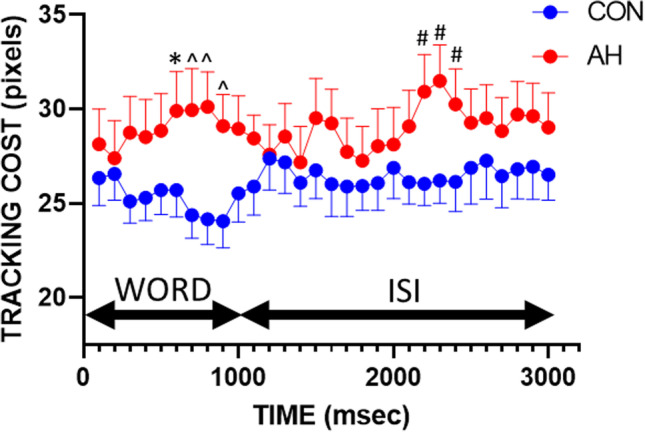
Compared with the control visit, AH was associated with reduced recognition accuracy (particularly more false negatives), higher "tracking costs" (poorer accuracy) in the dual attention condition, increased ratings of "mental demand," "effort," and "frustration," and lower ratings of task performance. There was also a significant main effect of attentional load with poorer recognition accuracy and response time in the dual attention condition. There were no significant interaction effects between hangover and attentional load.
These findings suggest that reduced attentional resources contribute to the cognitive deficits associated with AH including impaired memory consolidation. They further suggest that while hungover, participants are aware of these deficits but are unable to compensate.
酒精宿醉(AH)与注意力和记忆表现受损有关。然而,这种影响是否与注意力资源减少有关尚不清楚。
采用双重注意范式评估 AH 对注意力资源、延迟记忆识别以及注意力负荷与 AH 之间相互作用的影响。还评估了 AH 和对照条件下的心理努力和感知表现。
采用半自然主义、交叉设计。共有 25 名年龄在 18-35 岁之间的健康社交饮酒者,在典型的外出饮酒后(宿醉条件)和在上午 8:30 至下午 12:30 之间的酒精禁欲后(对照)访问实验室,条件均衡。通过在言语记忆编码期间存在(双重注意)或不存在精神运动跟踪来操纵注意力负荷。使用 NASA-TLX 测量感知的心理努力和表现。参与者回忆的饮酒量用于计算估计的血液酒精水平(eBAC)。
与对照访问相比,AH 与识别准确性降低(尤其是更多的假阴性)、双重注意条件下的“跟踪成本”(准确性更差)升高、“心理需求”、“努力”和“挫折”的评分升高以及任务绩效评分降低有关。注意力负荷也有显著的主效应,在双重注意条件下识别准确性和反应时间更差。宿醉和注意力负荷之间没有显著的交互作用。
这些发现表明,注意力资源减少导致与 AH 相关的认知缺陷,包括记忆巩固受损。它们进一步表明,在宿醉期间,参与者意识到这些缺陷,但无法弥补。