Department of Electrical Engineering, University of Notre Dame, Notre Dame, IN, 46556, USA.
Department of Cognitive Sciences, University of California Irvine, Irvine, CA, 92697, USA.
Nat Commun. 2022 May 11;13(1):2571. doi: 10.1038/s41467-022-30305-8.
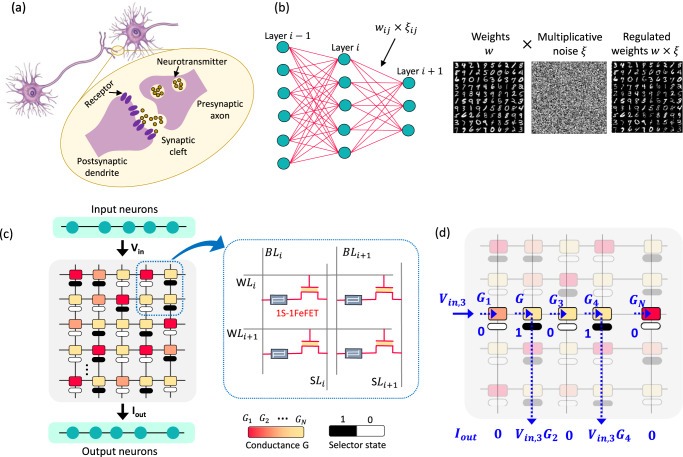
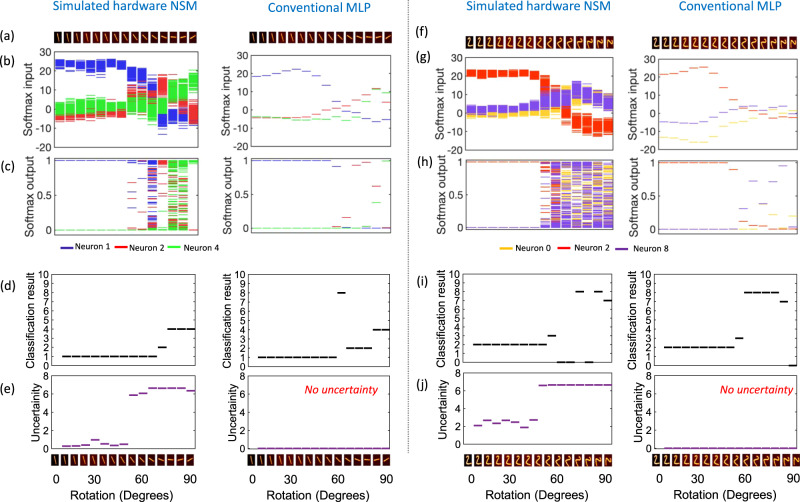
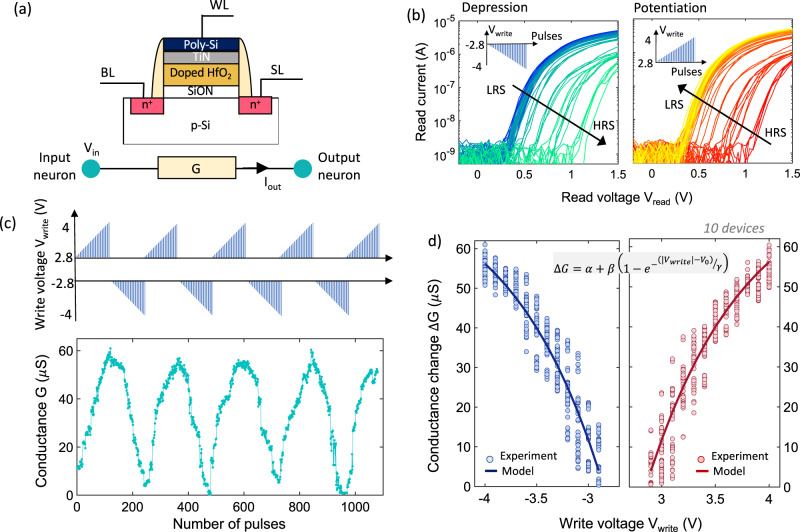
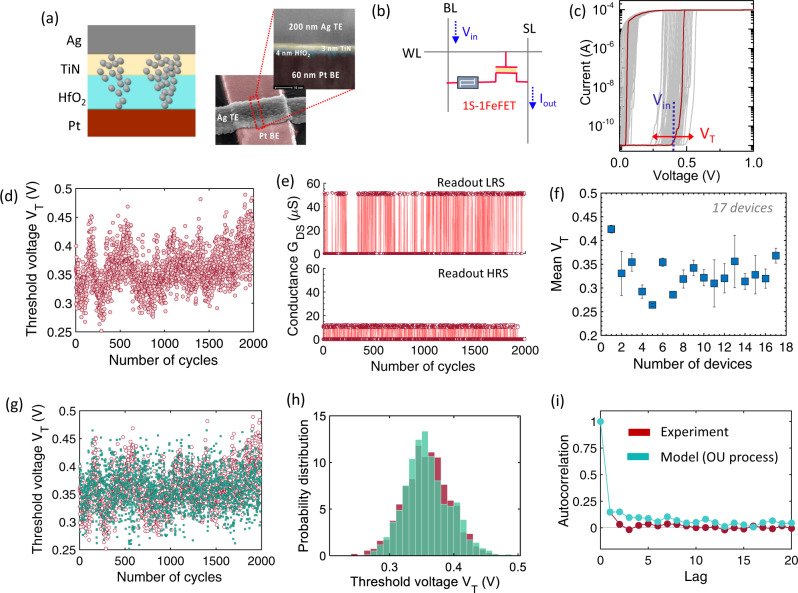
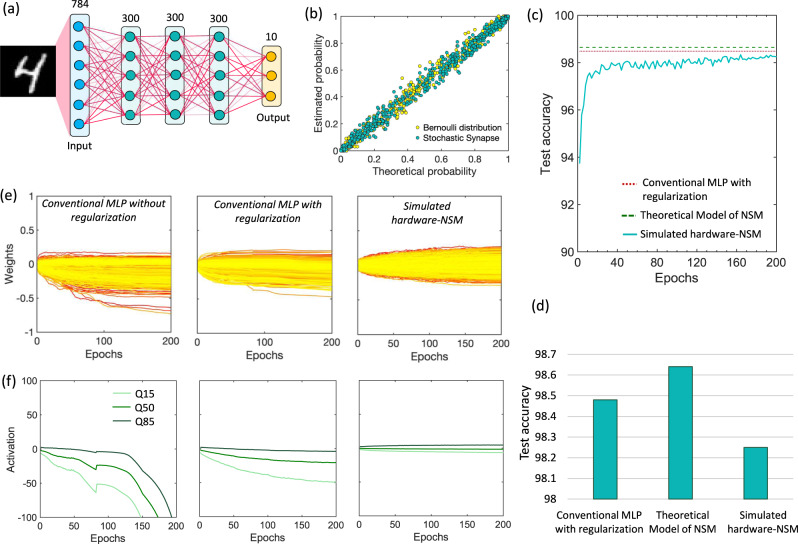
Many real-world mission-critical applications require continual online learning from noisy data and real-time decision making with a defined confidence level. Brain-inspired probabilistic models of neural network can explicitly handle the uncertainty in data and allow adaptive learning on the fly. However, their implementation in a compact, low-power hardware remains a challenge. In this work, we introduce a novel hardware fabric that can implement a new class of stochastic neural network called Neural Sampling Machine (NSM) by exploiting the stochasticity in the synaptic connections for approximate Bayesian inference. We experimentally demonstrate an in silico hybrid stochastic synapse by pairing a ferroelectric field-effect transistor (FeFET)-based analog weight cell with a two-terminal stochastic selector element. We show that the stochastic switching characteristic of the selector between the insulator and the metallic states resembles the multiplicative synaptic noise of the NSM. We perform network-level simulations to highlight the salient features offered by the stochastic NSM such as performing autonomous weight normalization for continual online learning and Bayesian inferencing. We show that the stochastic NSM can not only perform highly accurate image classification with 98.25% accuracy on standard MNIST dataset, but also estimate the uncertainty in prediction (measured in terms of the entropy of prediction) when the digits of the MNIST dataset are rotated. Building such a probabilistic hardware platform that can support neuroscience inspired models can enhance the learning and inference capability of the current artificial intelligence (AI).
许多现实世界中的关键任务应用程序需要从嘈杂的数据中持续在线学习,并在定义的置信水平下实时做出决策。受大脑启发的神经网络概率模型可以明确处理数据中的不确定性,并允许实时自适应学习。然而,将其在紧凑、低功耗的硬件中实现仍然是一个挑战。在这项工作中,我们引入了一种新型硬件结构,该结构可以通过利用突触连接中的随机性来实现一类称为神经采样机 (NSM) 的新型随机神经网络,从而进行近似贝叶斯推理。我们通过将基于铁电晶体管 (FeFET) 的模拟权重单元与双端随机选择器元件相结合,实验演示了一种混合模拟随机突触。我们表明,选择器在绝缘态和金属态之间的随机切换特性类似于 NSM 的乘法突触噪声。我们进行了网络级仿真,以突出随机 NSM 提供的显著特征,例如持续在线学习和贝叶斯推断的自主权重归一化。我们表明,随机 NSM 不仅可以在标准 MNIST 数据集上以 98.25%的准确率进行高度准确的图像分类,还可以在 MNIST 数据集的数字旋转时估计预测的不确定性(以预测熵的形式衡量)。构建这样一个能够支持神经科学启发模型的概率硬件平台可以提高当前人工智能 (AI) 的学习和推理能力。