Cheema Izzat Iqbal, Krewer Ulrike
Institute of Energy and Process Systems Engineering, TU Braunschweig Braunschweig 38106 Germany
International Max Planck Research School for Advanced Methods in Process and Systems Engineering Magdeburg 39106 Germany.
RSC Adv. 2018 Oct 11;8(61):34926-34936. doi: 10.1039/c8ra06821f. eCollection 2018 Oct 10.
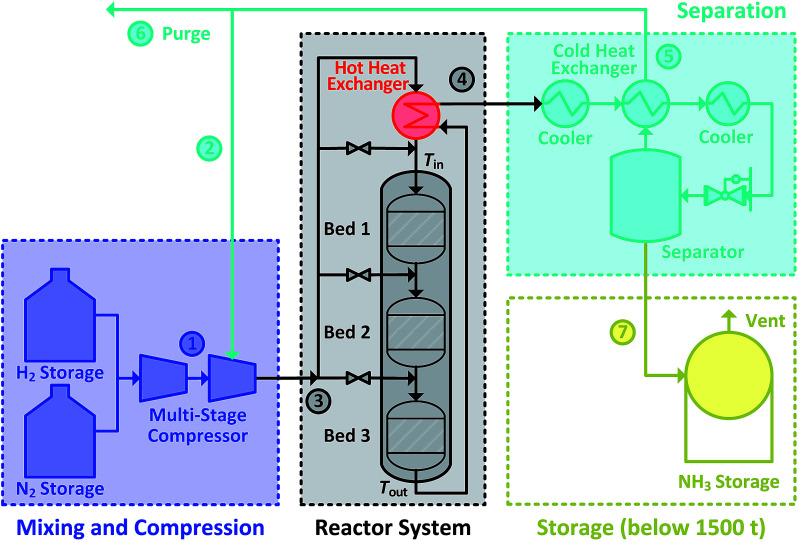
The power-to-ammonia concept allows for the production of ammonia, one of the most produced inorganic chemicals, from air, water and (renewable) electricity. However, power-to-ammonia requires flexible operation for use with a directly intermittent renewable energy supply. In this paper, we systematically analyse the operating envelope for steady-state operation of the three bed autothermic Haber-Bosch reactor system for power-to-ammonia by pseudo-homogeneous model. Operational flexibilities of process variables, hydrogen intake and ammonia production flexibilities are analysed, along with maximum and minimum possible changes in recycle load and recycle to feed ratio for the following process variables: reactor pressure, inert gas percentage in synthesis loop, NH concentration, H-to-N ratio, total flow rate and feed temperature. Among the six process variables, inert gas fraction and H-to-N ratio provided very high flexibilities, 255% operational flexibility for Ar, up to 51 to 67% flexibility in hydrogen intake, and up to 73% reduction and 24% enhancement in ammonia production. However, a decrease in ammonia production by H-to-N ratio significantly increases recycle load. Besides inert gas fraction and H-to-N ratio, the total mass feed flow rate is also significant for minimum hydrogen intake and ammonia production.
“电制氨”概念使得能够利用空气、水和(可再生)电力生产氨,氨是产量最高的无机化学品之一。然而,“电制氨”需要灵活运行,以便与间歇性的直接可再生能源供应配合使用。在本文中,我们通过拟均相模型系统地分析了用于“电制氨”的三床自热式哈伯-博施法反应器系统稳态运行的操作范围。分析了工艺变量的操作灵活性、氢气进料灵活性和氨生产灵活性,以及以下工艺变量在循环负荷和循环与进料比方面可能的最大和最小变化:反应器压力、合成回路中的惰性气体百分比、NH浓度、氢氮比、总流量和进料温度。在这六个工艺变量中,惰性气体分数和氢氮比具有很高的灵活性,氩气的操作灵活性为255%,氢气进料灵活性高达51%至67%,氨产量最多可降低73%,最多可提高24%。然而,氢氮比导致的氨产量下降会显著增加循环负荷。除了惰性气体分数和氢氮比外,总进料质量流量对于最小氢气进料量和氨产量也很重要。