
从出生到断奶期间,选择性的母体接种和饲养环境塑造了发育中的仔猪肠道微生物群。
Selective Maternal Seeding and Rearing Environment From Birth to Weaning Shape the Developing Piglet Gut Microbiome.
作者信息
Chen Wei, Ma Jingyun, Jiang Yiming, Deng Li, Lv Ning, Gao Jinming, Cheng Jian, Liang Juan Boo, Wang Yan, Lan Tian, Liao Xindi, Mi Jiandui
机构信息
College of Animal Science, National Engineering Research Center for Breeding Swine Industry, South China Agricultural University, Guangzhou, China.
Guangdong Provincial Key Lab of Agro-Animal Genomics and Molecular Breeding, Guangzhou, Chain.
出版信息
Front Microbiol. 2022 Apr 25;13:795101. doi: 10.3389/fmicb.2022.795101. eCollection 2022.
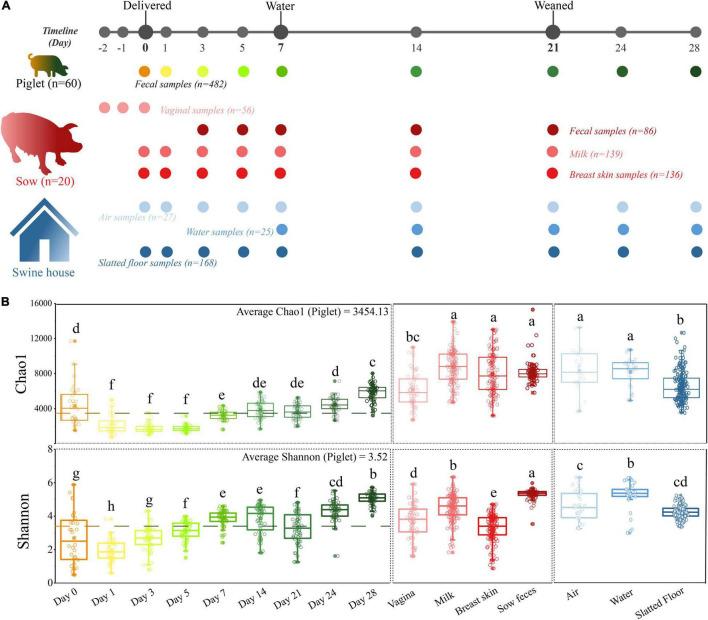
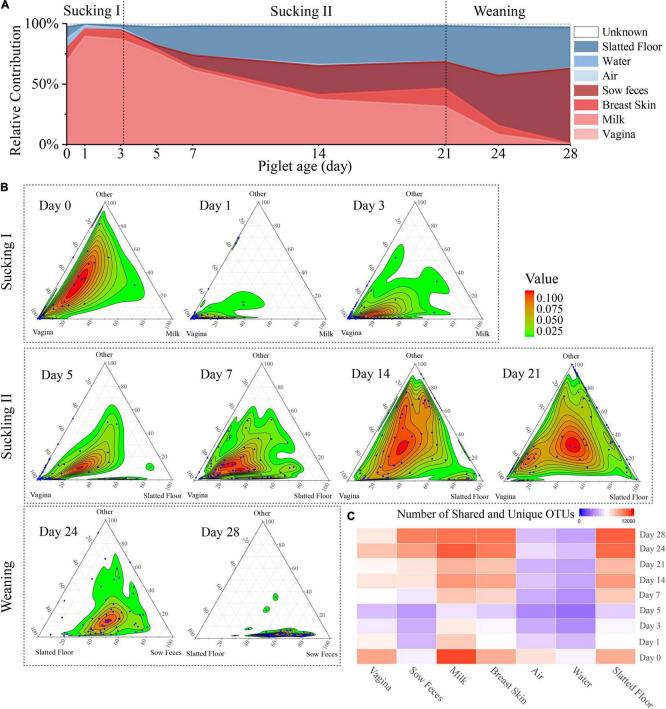
The acquisition and development of the mammalian microbiome early in life are critical to establish a healthy host-microbiome symbiosis. Despite recent advances in understanding microbial sources in infants, the relative contribution of various microbial sources to the colonization of the gut microbiota in pigs remains unclear. Here, we longitudinally sampled the microbiota of 20 sow-piglet pairs (three piglets per sow) reared under identical conditions from multiple body sites and the surrounding weaning environment from birth to 28 days postpartum (1,119 samples in total). Source-tracking analysis revealed that the contribution of various microbial sources to the piglet gut microbiome gradually changed over time. The neonatal microbiota was initially sparsely populated, and the predominant contribution was from the maternal vaginal microbiota that increased gradually from 69.0% at day 0 to 89.3% at day 3 and dropped to 0.28% at day 28. As the piglets aged, the major microbial community patterns were most strongly associated with the sow feces and slatted floor, with contributions increasing from 0.52 and 9.6% at day 0 to 62.1 and 33.8% at day 28, respectively. The intestinal microbial diversity, composition, and function significantly changed as the piglets aged, and 30 age-discriminatory bacterial taxa were identified with distinctive time-dependent shifts in their relative abundance, which likely reflected the effect of the maternal and environmental microbial sources on the selection and adaptation of the piglet gut microbiota. Overall, these data demonstrate that the vaginal microbiota is the primary source of the gut microbiota in piglets within 3 days after birth and are gradually replaced by the sow fecal and slatted floor microbiota over time. These findings may offer novel strategies to promote the establishment of exogenous symbiotic microbes to improve piglet gut health.
哺乳动物微生物群落在生命早期的获得与发育对于建立健康的宿主-微生物群共生关系至关重要。尽管近期在了解婴儿微生物来源方面取得了进展,但各种微生物来源对猪肠道微生物群定殖的相对贡献仍不清楚。在此,我们纵向采集了20对母猪-仔猪(每头母猪3头仔猪)在相同条件下从出生到产后28天多个身体部位及断奶周围环境中的微生物群样本(共1119个样本)。来源追踪分析显示,各种微生物来源对仔猪肠道微生物群的贡献随时间逐渐变化。新生仔猪的微生物群最初数量稀少,主要贡献来自母体阴道微生物群,其比例从第0天的69.0%逐渐增加到第3天的89.3%,并在第28天降至0.28%。随着仔猪长大,主要微生物群落模式与母猪粪便和板条地板的关联最为紧密,其贡献分别从第0天的0.52%和9.6%增加到第28天的62.1%和33.8%。随着仔猪年龄增长,肠道微生物的多样性、组成和功能发生了显著变化,鉴定出30个年龄区分细菌分类群,其相对丰度具有独特的时间依赖性变化,这可能反映了母体和环境微生物来源对仔猪肠道微生物群选择和适应的影响。总体而言,这些数据表明,阴道微生物群是出生后3天内仔猪肠道微生物群的主要来源,并随着时间的推移逐渐被母猪粪便和板条地板微生物群取代。这些发现可能为促进外源共生微生物的建立以改善仔猪肠道健康提供新策略。



 Zotero 插件