Zhang Feng, Luo Lianghui, Gong Hang, Chen Chunyan, Cai Changqun
College of Science, Hunan Agricultural University Changsha 410128 China.
Key Laboratory of Environmentally Friendly Chemistry and Applications of Ministry of Education, College of Chemistry, Xiangtan University Xiangtan Hunan 411105 China
RSC Adv. 2018 Sep 18;8(56):32262-32268. doi: 10.1039/c8ra06204h. eCollection 2018 Sep 12.
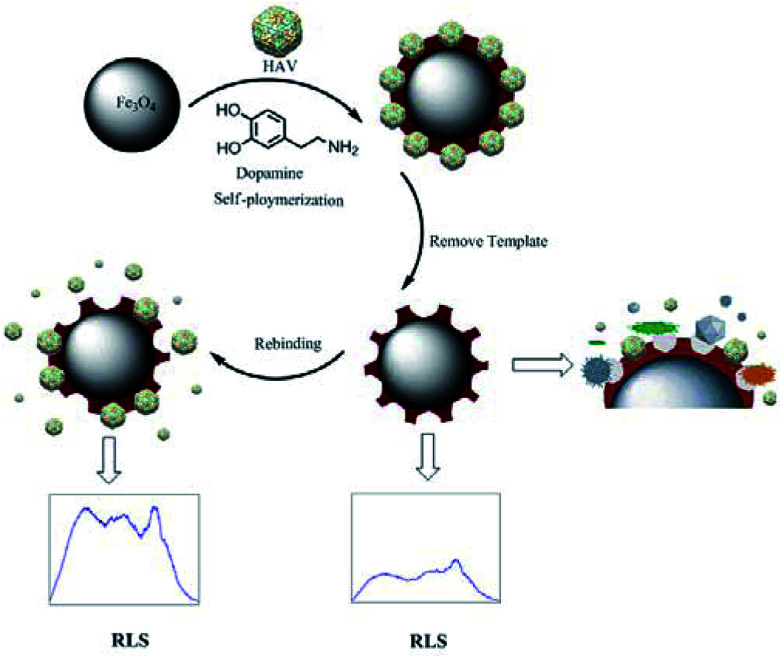
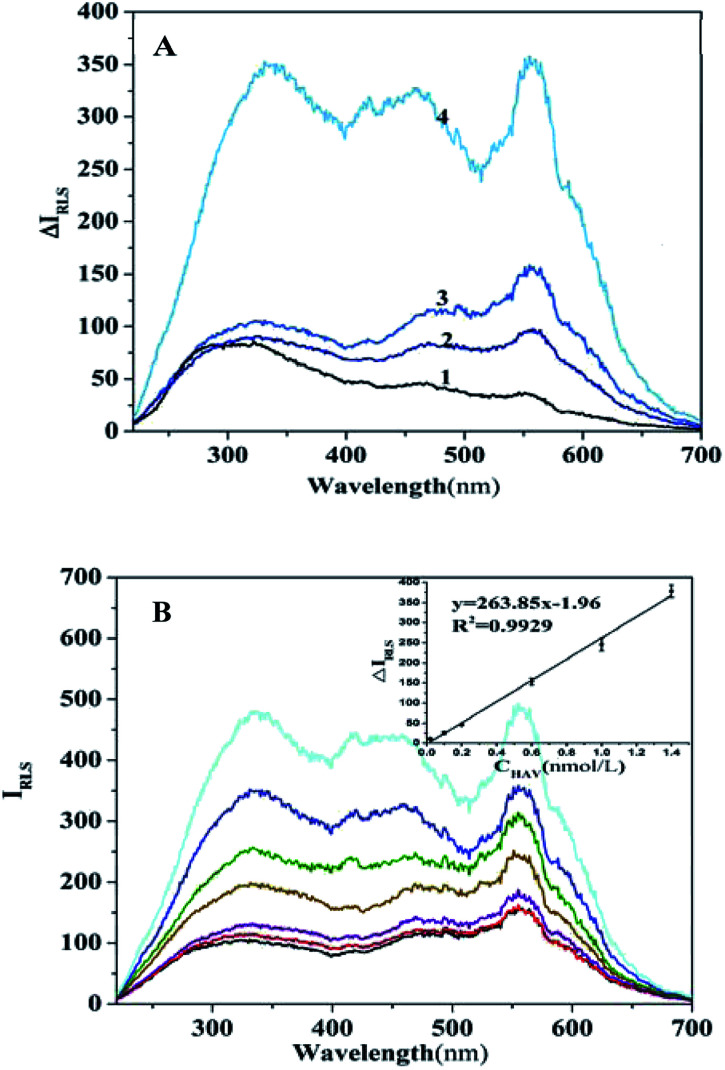
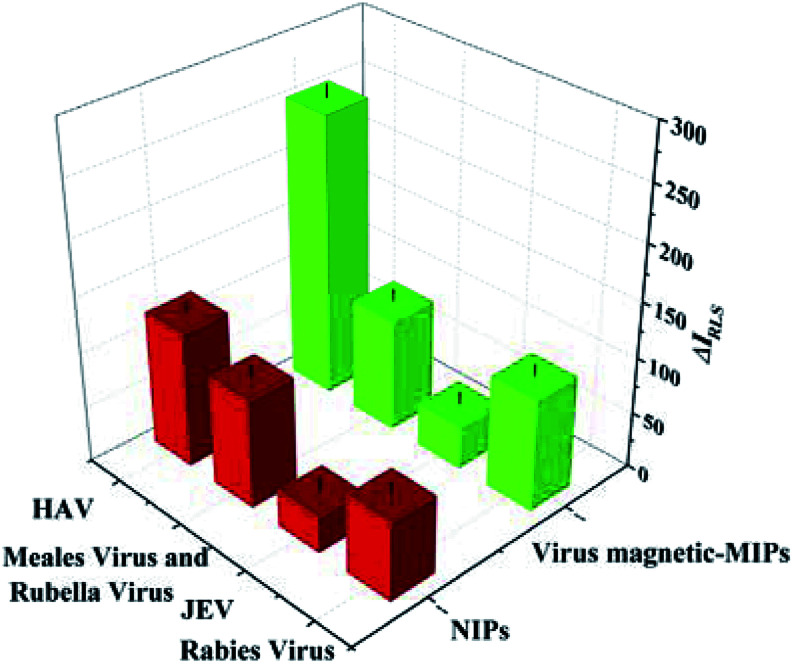
A magnetic resonance light scattering (RLS) sensor based on the molecularly imprinted polymer (MIP) technique was developed for specific recognition of trace quantities of hepatitis A virus (HAV). Through a surface imprinting technique, the virus-magnetic-MIPs (virus-MMIPs) were prepared as the specific identification element, which was based on the effective synthesis of biomimetic polydopamine (PDA) inspired by mussels on the surface of FeO magnetic nanoparticles. The preparation process of the virus-magnetic-MIPs was simple and rapid under an applied magnetic field. The surface of the magnetic-MIP captured viruses through specific recognition in water, which caused changes to the particle size and shape, and subsequently resulted in changes in the intensity of the RLS. The sensor was applied to determine the amount of HAV in the linear concentration range of 0.02-1.40 nmol L, with a low detection limit of 6.2 pmol L, and it was successfully applied for the immediate detection of added HAV from a 2000-fold dilution of human serum. More importantly, the proposed strategy addressed the difficulty of virus-MIP detection in the elution process and it is rapid, easy, sensitive, and eco-friendly.
基于分子印迹聚合物(MIP)技术开发了一种磁共振光散射(RLS)传感器,用于特异性识别痕量甲型肝炎病毒(HAV)。通过表面印迹技术,制备了病毒磁性分子印迹聚合物(病毒-MMIPs)作为特异性识别元件,其基于受贻贝启发在FeO磁性纳米颗粒表面有效合成仿生聚多巴胺(PDA)。在施加磁场的情况下,病毒磁性分子印迹聚合物的制备过程简单快速。磁性分子印迹聚合物的表面通过在水中的特异性识别捕获病毒,这会导致粒径和形状发生变化,进而导致共振光散射强度发生变化。该传感器用于在0.02 - 1.40 nmol/L的线性浓度范围内测定HAV的含量,检测限低至6.2 pmol/L,并成功应用于直接检测从2000倍稀释的人血清中添加的HAV。更重要的是,所提出的策略解决了洗脱过程中病毒分子印迹聚合物检测的难题,且快速、简便、灵敏且环保。