Liu Qiyu, Yu Yanqiao, Xi Ruixi, Li Jingen, Lai Runmin, Wang Tongxin, Fan Yixuan, Zhang Zihao, Xu Hao, Ju Jianqing
National Clinical Research Center for Chinese Medicine Cardiology, Xiyuan Hospital, China Academy of Chinese Medical Sciences, Beijing, China.
Graduate School, Beijing University of Chinese Medicine, Beijing, China.
Front Cardiovasc Med. 2022 Apr 25;9:877140. doi: 10.3389/fcvm.2022.877140. eCollection 2022.
Preliminary studies indicated that enhanced plasma levels of lipoprotein(a) [lp(a)] might link with the risk of calcific aortic valve disease (CAVD), but the clinical association between them remained inconclusive. This systematic review and meta-analysis were aimed to determine this association.
We comprehensively searched PubMed, Embase, Web of Science, and Scopus databases for studies reporting the incidence of CAVD and their plasma lp(a) concentrations. Pooled risk ratio (RR) and 95% confidence interval (95% CI) were calculated to evaluate the effect of lp(a) on CAVD using the random-effects model. Subgroup analyses by study types, countries, and the level of adjustment were also conducted. Funnel plots, Egger's test and Begg's test were conducted to evaluate the publication bias.
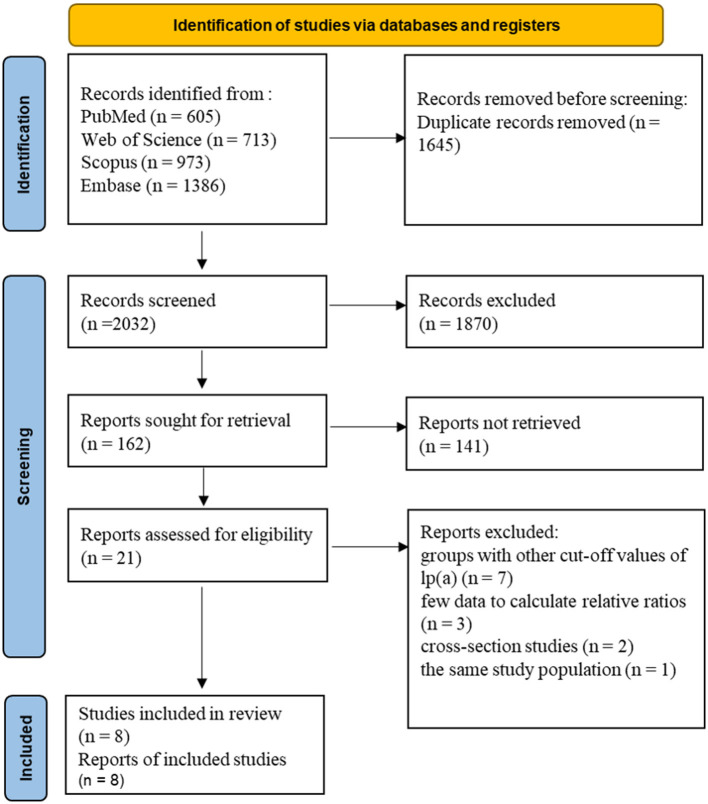
Eight eligible studies with 52,931 participants were included in this systematic review and meta-analysis. Of these, four were cohort studies and four were case-control studies. Five studies were rated as high quality, three as moderate quality. The pooled results showed that plasma lp(a) levels ≥50 mg/dL were associated with a 1.76-fold increased risk of CAVD (RR, 1.76; 95% CI, 1.47-2.11), but lp(a) levels ≥30 mg/dL were not observed to be significantly related with CAVD (RR, 1.28; 95% CI, 0.98-1.68). We performed subgroup analyses by study type, the RRs of cohort studies revealed lp(a) levels ≥50 mg/dL and lp(a) levels ≥30 mg/dL have positive association with CAVD (RR, 1.70; 95% CI, 1.39-2.07; RR 1.38; 95% CI, 1.19-1.61).
High plasma lp(a) levels (≥50 mg/dL) are significantly associated with increased risk of CAVD.
初步研究表明,脂蛋白(a)[Lp(a)]血浆水平升高可能与钙化性主动脉瓣疾病(CAVD)风险相关,但二者之间的临床关联仍无定论。本系统评价和荟萃分析旨在确定这种关联。
我们全面检索了PubMed、Embase、Web of Science和Scopus数据库,以查找报告CAVD发病率及其血浆Lp(a)浓度的研究。采用随机效应模型计算合并风险比(RR)和95%置信区间(95%CI),以评估Lp(a)对CAVD的影响。还按研究类型、国家和调整水平进行了亚组分析。采用漏斗图、Egger检验和Begg检验评估发表偏倚。
本系统评价和荟萃分析纳入了8项符合条件的研究,共52931名参与者。其中,4项为队列研究,4项为病例对照研究。5项研究被评为高质量,3项为中等质量。汇总结果显示,血浆Lp(a)水平≥50mg/dL与CAVD风险增加1.76倍相关(RR,1.76;95%CI,1.47-2.11),但未观察到Lp(a)水平≥30mg/dL与CAVD有显著相关性(RR,1.28;95%CI,0.98-1.68)。我们按研究类型进行了亚组分析,队列研究的RR显示,Lp(a)水平≥50mg/dL和Lp(a)水平≥30mg/dL与CAVD呈正相关(RR,1.70;95%CI,1.39-2.07;RR 1.38;95%CI,1.19-1.61)。
血浆Lp(a)高水平(≥50mg/dL)与CAVD风险增加显著相关。