Yu Yongjuan
School of Finance and Economics, Yangtze Normal University, Chongqing, China.
Front Psychol. 2022 Apr 25;13:848256. doi: 10.3389/fpsyg.2022.848256. eCollection 2022.
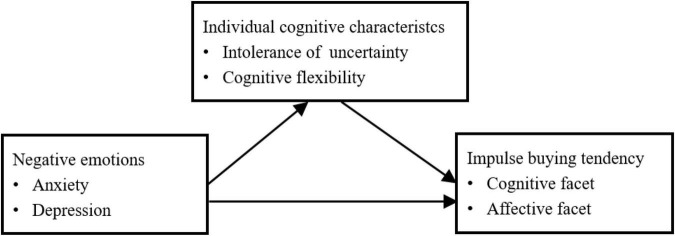
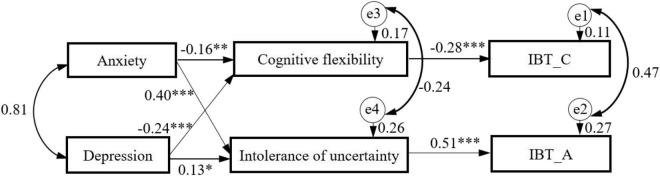
The COVID-19 pandemic has seriously disrupted the individual buying habits along with their consumption patterns. Previous studies indicated that anxiety and depression were related to impulse buying. However, no research has explored the mechanism possibly underlying the association between anxiety, depression, and impulse buying. Based on the regulatory focus theory and the emotion-cognition-behavior loop, this study aimed to examine the impacts of negative emotions on impulse buying and the mediating role of cognitive characteristics during the COVID-19 pandemic. In April 2021, 734 Chinese undergraduates were recruited by cluster sampling and they completed self-report measures of anxiety, depression, intolerance of uncertainty, cognitive flexibility, and impulse buying. Results showed that impulse buying was positively associated with anxiety, depression, and intolerance of uncertainty, while it was negatively associated with cognitive flexibility. Cognitive flexibility fully mediated the effects of anxiety and depression on cognitive facet of impulse buying. Meanwhile, intolerance of uncertainty fully mediated the effects of anxiety and depression on affective facet of impulse buying. Overall, this study shows that different pathways can explain how anxiety and depression exacerbate two aspects of impulse buying, and it highlights the importance of cognitive characteristics for the link between negative emotions and impulse buying. Intervention programs should focus on increasing cognitive flexibility and tolerance to uncertainty of high-risk individuals, so as to strengthen their adaptive purchase behaviors.
新冠疫情严重扰乱了个人的购买习惯及其消费模式。以往研究表明,焦虑和抑郁与冲动购买有关。然而,尚无研究探讨焦虑、抑郁与冲动购买之间关联可能潜在的机制。基于调节焦点理论和情绪-认知-行为循环,本研究旨在考察新冠疫情期间负面情绪对冲动购买的影响以及认知特征的中介作用。2021年4月,通过整群抽样招募了734名中国大学生,他们完成了焦虑、抑郁、不确定性不耐受、认知灵活性和冲动购买的自我报告测量。结果显示,冲动购买与焦虑、抑郁和不确定性不耐受呈正相关,而与认知灵活性呈负相关。认知灵活性完全中介了焦虑和抑郁对冲动购买认知方面的影响。同时,不确定性不耐受完全中介了焦虑和抑郁对冲动购买情感方面的影响。总体而言,本研究表明不同途径可以解释焦虑和抑郁如何加剧冲动购买的两个方面,并且突出了认知特征在负面情绪与冲动购买之间联系中的重要性。干预项目应侧重于提高高风险个体的认知灵活性和对不确定性的耐受性,以强化其适应性购买行为。