Vilageliu-Jordà E, Enseñat-Cantallops A, García-Molina A
Universitat Autònoma de Barcelona, Bellaterra, España.
Institut Universitari de Neurorehabilitació Guttmann-UAB, Badalona, España.
Rev Neurol. 2022 May 16;74(10):331-339. doi: 10.33588/rn.7410.2022034.
Virtual reality (VR) is a therapeutic tool that is widely used in the cognitive rehabilitation of brain-damaged patients. Depending on the degree of immersiveness, a distinction can be made between non-immersive, semi-immersive and immersive VR. Studies assessing the utility of VR have focused on the non-immersive and semi-immersive modes. Little evidence is available on the effectiveness of immersive VR.
To describe the characteristics, methodological quality and main results of studies that have applied immersive VR programmes in the cognitive rehabilitation of brain-damaged patients.
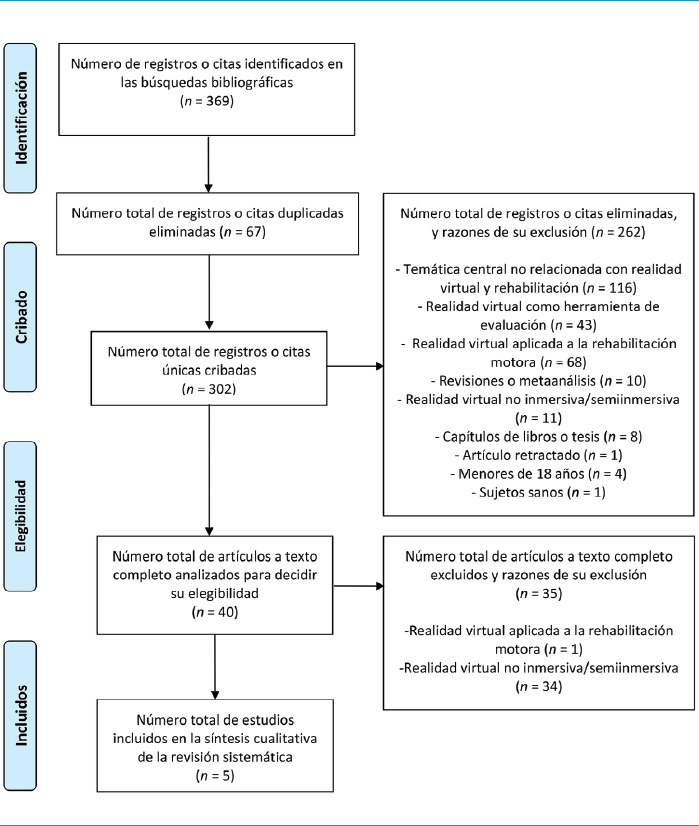
Following the PRISMA guidelines, a bibliographic search was conducted for studies published in the PubMed and PsycINFO databases. The methodological quality of the articles that met the selection criteria was assessed using the PEDro scale.
After applying the inclusion and exclusion criteria, of the 369 articles of potential interest, five met the eligibility criteria. One of them was a randomised clinical trial (with acceptable/good methodological quality). Three were studies with pre- and post-treatment measures and one was a single case study, all four of them displaying poor methodological quality.
According to the results obtained, there is no evidence of the effectiveness or utility of immersive VR in cognitive rehabilitation in brain-damaged patients. This finding is explained by the lack of studies with a methodological design that allows for the generation of quality evidence rather than because the results obtained in the articles analysed are negative or inconclusive.
虚拟现实(VR)是一种治疗工具,广泛应用于脑损伤患者的认知康复。根据沉浸程度的不同,可将虚拟现实分为非沉浸式、半沉浸式和沉浸式VR。评估VR效用的研究主要集中在非沉浸式和半沉浸式模式。关于沉浸式VR有效性的证据很少。
描述在脑损伤患者认知康复中应用沉浸式VR程序的研究的特征、方法学质量和主要结果。
按照PRISMA指南,在PubMed和PsycINFO数据库中检索相关研究。使用PEDro量表评估符合选择标准的文章的方法学质量。
应用纳入和排除标准后,在369篇可能感兴趣的文章中,有5篇符合纳入标准。其中1篇为随机临床试验(方法学质量可接受/良好)。3篇为有治疗前和治疗后测量的研究,1篇为单病例研究,这4篇研究的方法学质量均较差。
根据所得结果,没有证据表明沉浸式VR在脑损伤患者认知康复中具有有效性或效用。这一发现的原因是缺乏具有能够产生高质量证据的方法学设计的研究,而非因为所分析文章的结果为阴性或不确定。