Department of Physiology, College of Korean Medicine, Gachon University, Seongnam, 13120, Korea.
Department of Life Science, College of Bio-Nano Technology, Gachon University, Seongnam, 13120, Korea.
BMC Complement Med Ther. 2022 May 12;22(1):132. doi: 10.1186/s12906-022-03608-y.
Cordyceps species have been used as tonics to enhance energy, stamina, and libido in traditional Asian medicine for more than 1600 years, indicating their potential for improving reproductive hormone disorders and energy metabolic diseases. Among Cordyceps, Cordyceps militaris has been reported to prevent metabolic syndromes including obesity and benefit the reproductive hormone system, suggesting that Cordyceps militaris can also regulate obesity induced by the menopause. We investigated the effectiveness of Cordyceps militaris extraction (CME) on menopausal obesity and its mechanisms.
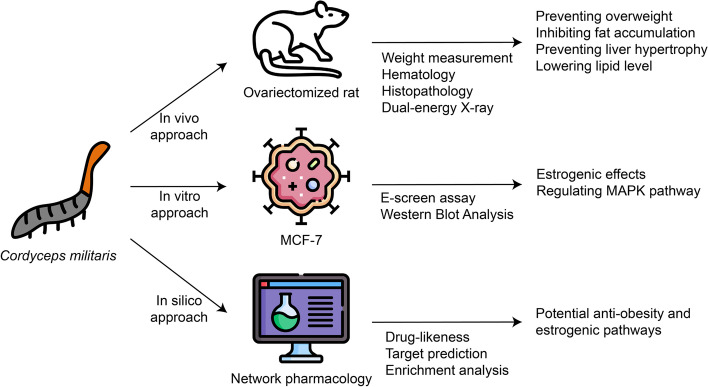
We applied an approach combining in vivo, in vitro, and in silico methods. Ovariectomized rats were administrated CME, and their body weight, area of adipocytes, liver and uterus weight, and lipid levels were measured. Next, after the exposure of MCF-7 human breast cancer cells to CME, cell proliferation and the phosphorylation of estrogen receptor and mitogen-activated protein kinases (MAPK) were measured. Finally, network pharmacological methods were applied to predict the anti-obesity mechanisms of CME.
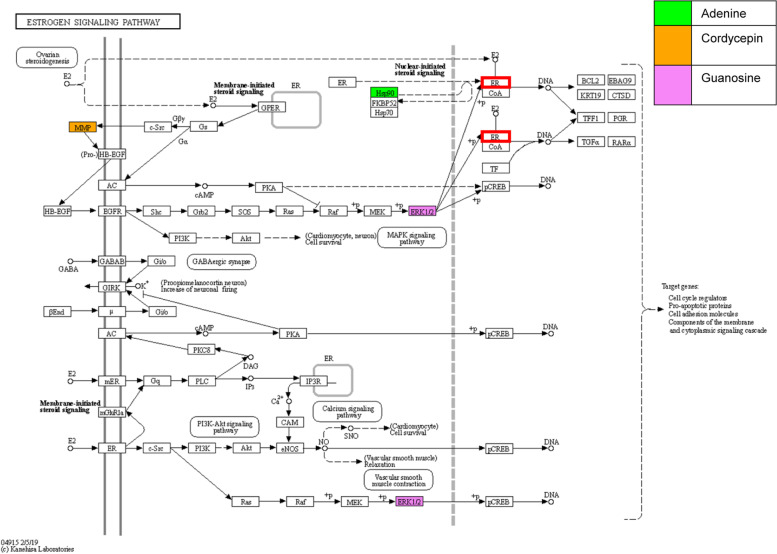
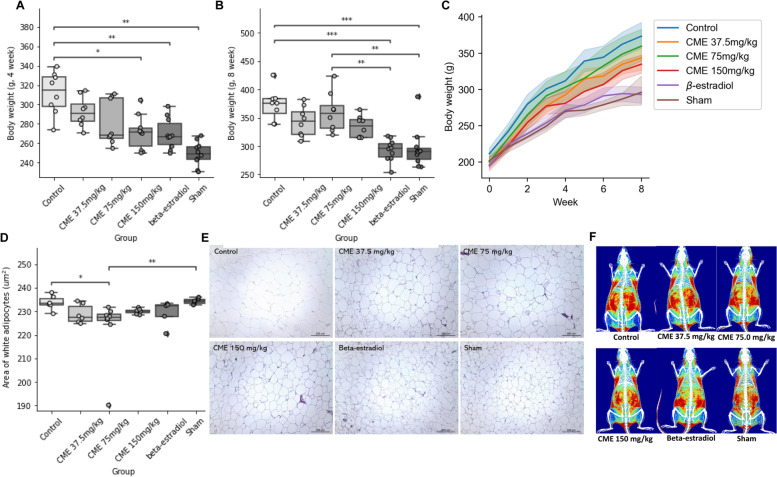
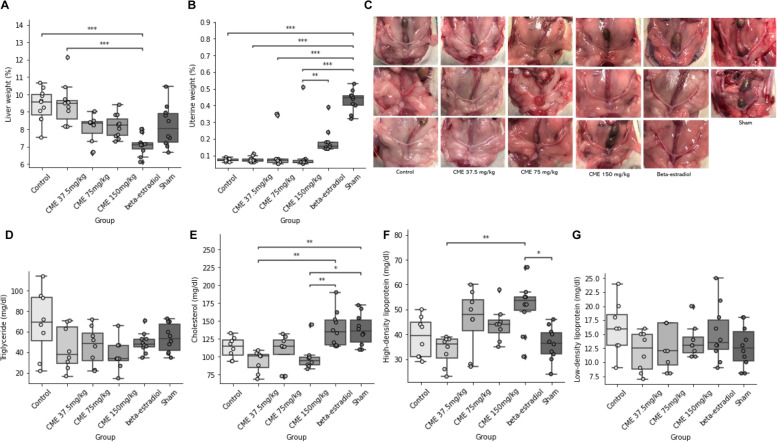
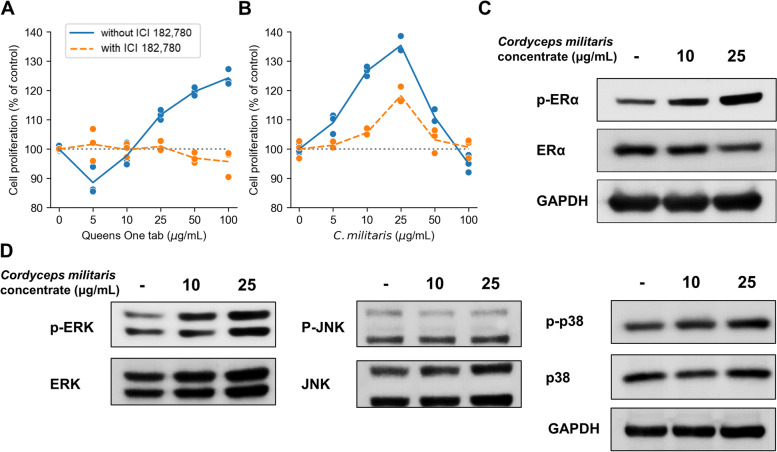
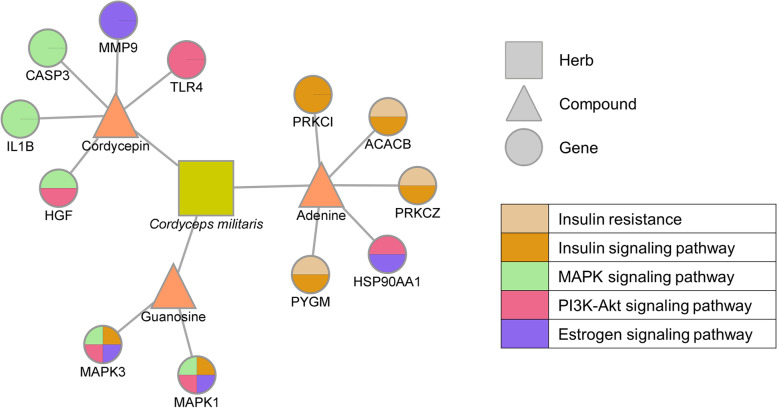
CME prevented overweight, fat accumulation, liver hypertrophy, and lowered triglyceride levels, some of which were improved in a dose-dependent manner. In MCF-7 cell lines, CME showed not only estrogen receptor agonistic activity through an increase in cell proliferation and the phosphorylation of estrogen receptors, but also phosphorylation of extracellular-signal-regulated kinase and p38. In the network pharmacological analysis, bioactive compounds of CME such as cordycepin, adenine, and guanosine were predicted to interact with non-overlapping genes. The targeted genes were related to the insulin signaling pathway, insulin resistance, the MARK signaling pathway, the PI3K-Akt signaling pathway, and the estrogen signaling pathway.
These results suggest that CME has anti-obesity effects in menopause and estrogenic agonistic activity. Compounds in CME have the potential to regulate obesity-related and menopause-related pathways. This study will contribute to developing the understanding of anti-obesity effects and mechanisms of Cordyceps militaris.
虫草属真菌在传统亚洲医学中已被用作补品超过 1600 年,以增强能量、耐力和性欲,这表明它们有可能改善生殖激素紊乱和能量代谢疾病。在虫草属中,蛹虫草已被报道可预防包括肥胖症在内的代谢综合征,并有益于生殖激素系统,这表明蛹虫草也可以调节绝经引起的肥胖症。我们研究了蛹虫草提取物(CME)对绝经后肥胖症的有效性及其机制。
我们应用了一种结合体内、体外和计算方法的方法。对去卵巢大鼠给予 CME,并测量其体重、脂肪细胞面积、肝脏和子宫重量以及血脂水平。然后,在 MCF-7 人乳腺癌细胞暴露于 CME 后,测量细胞增殖和雌激素受体和丝裂原激活蛋白激酶(MAPK)的磷酸化。最后,应用网络药理学方法预测 CME 的抗肥胖机制。
CME 可预防超重、脂肪堆积、肝脏肥大和降低甘油三酯水平,其中一些作用呈剂量依赖性。在 MCF-7 细胞系中,CME 不仅通过增加细胞增殖和雌激素受体的磷酸化表现出雌激素受体激动活性,而且还表现出细胞外信号调节激酶和 p38 的磷酸化。在网络药理学分析中,预测 CME 的生物活性化合物,如蛹虫草素、腺嘌呤和鸟苷,与非重叠基因相互作用。靶基因与胰岛素信号通路、胰岛素抵抗、MARK 信号通路、PI3K-Akt 信号通路和雌激素信号通路有关。
这些结果表明 CME 具有绝经后和雌激素激动活性的抗肥胖作用。CME 中的化合物具有调节肥胖相关和绝经相关途径的潜力。本研究将有助于加深对蛹虫草抗肥胖作用和机制的理解。