Koris Andrea, Steven Shadrack, Akika Veronica, Puls Cassondra, Okoro Charles, Bitrus David, Seff Ilana, Deitch Julianne, Stark Lindsay
Women's Refugee Commission, 15 W. 37th St, New York, NY, 10018, USA.
Mercy Corps Nigeria, 35 Patrick Bokkor Crescent, Jabi, Utako District, Abuja, Nigeria.
Confl Health. 2022 May 12;16(1):26. doi: 10.1186/s13031-022-00458-w.
Household violence is one of the most prevalent forms of gender-based violence faced by adolescent girls in humanitarian settings. A growing evidence base demonstrates the extent to which multiple forms of familial violence, including intimate partner violence, violence against children, and sibling violence overlap in the same households. However, existing evidence of family support programming that effectively reduces violence against girls by addressing intersecting forms of household violence are limited, particularly in the Global South. Through a qualitative implementation evaluation informed by a grounded theoretical approach, we explored the perceived impact of a gender transformative, whole-family support intervention aimed at building adolescent girls' protective assets against violence, among program participants in two communities of internally displaced people Maiduguri, Borno State, Northeast Nigeria.
We conducted six in-depth interviews and six focus group discussions with adult caregivers; six participatory activities and four paired interviews with adolescent girls and boys; and 12 key informant interviews with program staff. Criterion sampling was used to recruit 21 male caregivers, 21 female caregivers, 23 adolescent boys, and 21 adolescent girls; purposive sampling was used to recruit 12 program staff to participate in qualitative research activities. We audio recorded, translated, and transcribed all interviews. In a collaborative coding process, a multi-stakeholder team used applied thematic analysis in Dedoose to identify emergent themes in the data.
Participants reported a decreased tolerance for and perpetration of violence against girls at the household level, and endorsed their right to protection from violence at the community level. However, alongside these self-reported changes in attitude and behavior, aspects of normative, patriarchal norms governing the treatment of adolescent girls were maintained by participants.
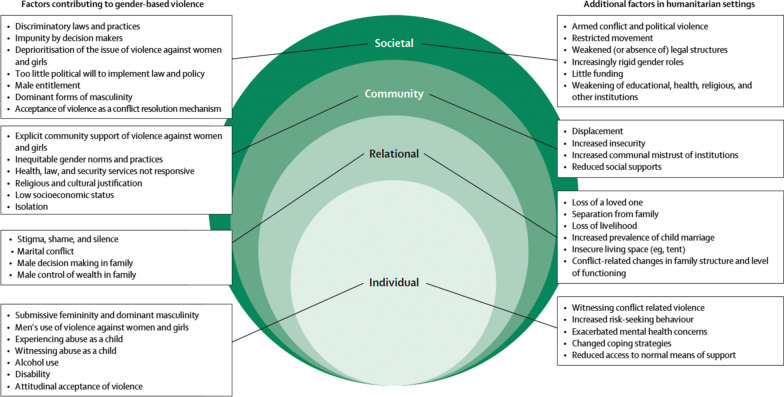
This study builds the evidence base for gender transformative, whole-family support programming and its impact on preventing violence against adolescent girls in humanitarian emergencies. Situating our findings in a feminist analysis of violence, this study calls attention to the complexity of gender norms change programming amongst families in conflict-affected settings, and highlights the need for programming which holistically addresses the relational, community, and structural drivers of violence against girls in emergencies.
家庭暴力是人道主义环境中少女面临的最普遍的性别暴力形式之一。越来越多的证据表明,多种形式的家庭内暴力,包括亲密伴侣暴力、侵害儿童暴力和兄弟姐妹间暴力,在同一家庭中相互交织的程度。然而,现有的关于通过解决家庭内暴力的交叉形式有效减少针对女童暴力的家庭支持项目的证据有限,尤其是在全球南方地区。通过基于扎根理论方法的定性实施评估,我们在尼日利亚东北部博尔诺州迈杜古里的两个境内流离失所者社区的项目参与者中,探讨了一项旨在增强少女抵御暴力的保护资产的性别变革性全家庭支持干预措施的感知影响。
我们对成年照料者进行了6次深入访谈和6次焦点小组讨论;对青少年女孩和男孩进行了6次参与式活动和4次配对访谈;对项目工作人员进行了12次关键 informant 访谈。采用标准抽样法招募了21名男性照料者、21名女性照料者、23名青少年男孩和21名青少年女孩;采用目的抽样法招募了12名项目工作人员参与定性研究活动。我们对所有访谈进行了录音、翻译和转录。在一个协作编码过程中,一个多利益相关者团队使用Dedoose中的应用主题分析来识别数据中出现的主题。
参与者报告称,家庭层面针对女孩的暴力行为的容忍度和发生率有所下降,并认可她们在社区层面免受暴力侵害的权利。然而,除了这些自我报告的态度和行为变化外,参与者还维持了规范青少年女孩待遇的父权制规范的某些方面。
本研究为性别变革性全家庭支持项目及其在预防人道主义紧急情况下针对青少年女孩的暴力行为方面的影响建立了证据基础。将我们的研究结果置于对暴力的女性主义分析中,本研究提请注意受冲突影响环境中家庭间性别规范变化项目的复杂性,并强调需要全面解决紧急情况下针对女孩暴力行为的关系、社区和结构驱动因素的项目。