MRC Centre for Global Infectious Disease Analysis, Imperial College London, London, United Kingdom.
Departamento de Sistemas y Procesos Naturales, Escuela Nacional de Estudios Superiores unidad Mérida, Universidad Nacional Autónoma de México, Mérida, México.
PLoS Negl Trop Dis. 2022 May 12;16(5):e0009867. doi: 10.1371/journal.pntd.0009867. eCollection 2022 May.
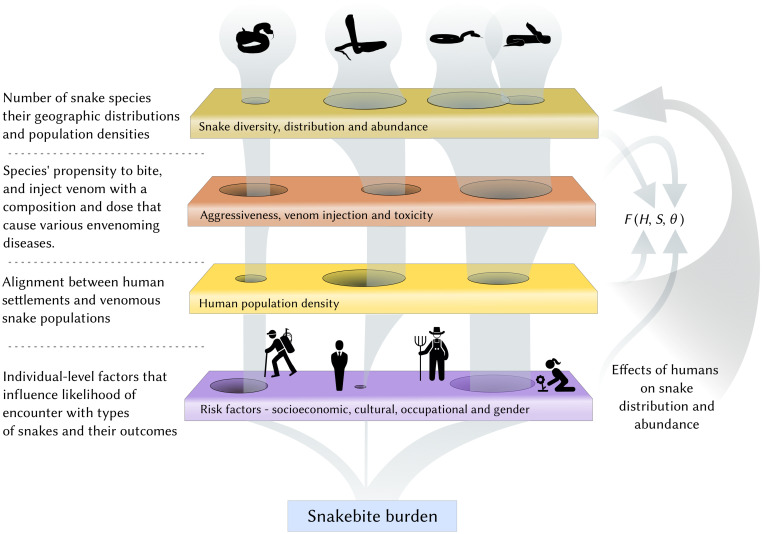
Snakebite is the only WHO-listed, not infectious neglected tropical disease (NTD), although its eco-epidemiology is similar to that of zoonotic infections: envenoming occurs after a vertebrate host contacts a human. Accordingly, snakebite risk represents the interaction between snake and human factors, but their quantification has been limited by data availability. Models of infectious disease transmission are instrumental for the mitigation of NTDs and zoonoses. Here, we represented snake-human interactions with disease transmission models to approximate geospatial estimates of snakebite incidence in Sri Lanka, a global hotspot. Snakebites and envenomings are described by the product of snake and human abundance, mirroring directly transmitted zoonoses. We found that human-snake contact rates vary according to land cover (surrogate of occupation and socioeconomic status), the impacts of humans and climate on snake abundance, and by snake species. Our findings show that modelling snakebite as zoonosis provides a mechanistic eco-epidemiological basis to understand snakebites, and the possible implications of global environmental and demographic change for the burden of snakebite.
蛇伤是世界卫生组织(WHO)唯一列出的、非传染性被忽视热带病(NTD),尽管其生态流行病学与动物源性传染病相似:脊椎动物宿主接触人类后会发生中毒。因此,蛇伤风险代表了蛇类和人类因素之间的相互作用,但由于数据的可用性,其量化受到限制。传染病传播模型对于减轻 NTD 和动物源性传染病非常重要。在这里,我们用疾病传播模型来表示蛇与人的相互作用,以近似估计斯里兰卡(一个全球热点地区)的蛇伤发病率的地理空间分布。蛇伤和中毒的发生情况由蛇和人类丰度的乘积来描述,这直接反映了直接传播的动物源性传染病。我们发现,人类与蛇的接触率因土地覆盖(职业和社会经济地位的替代物)、人类和气候对蛇丰度的影响以及蛇的种类而有所不同。我们的研究结果表明,将蛇伤建模为动物源性传染病为了解蛇伤以及全球环境和人口变化对蛇伤负担的可能影响提供了一个基于机制的生态流行病学基础。