Division Cardiothoracic Anesthesiology: Department of Anesthesiology and Intensive Care, Isala Heart Centre, Isala Zwolle, Netherlands.
ICON, Early development services, Groningen, Netherlands.
Interact Cardiovasc Thorac Surg. 2022 Jun 15;35(1). doi: 10.1093/icvts/ivac134.
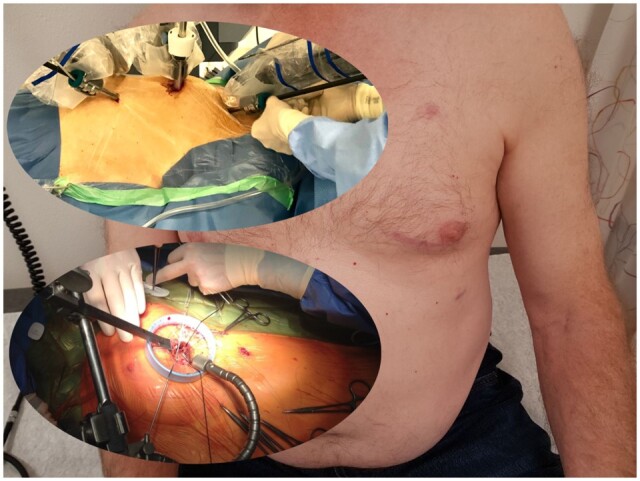
Robot-assisted coronary artery bypass grafting (CABG) has been developed as a less invasive alternative for conventional CABG to enhance postoperative recovery, patient satisfaction and early discharge to home. Furthermore, it may provide a basis for hybrid coronary revascularization. To determine the feasibility of this procedure, we compared robot-assisted with conventional off-pump CABG.
All consecutive patients undergoing a robot-assisted left internal mammary artery-to-left anterior descending coronary artery procedure were compared to consecutive patients undergoing conventional off-pump CABG for single-vessel disease from October 2016 to July 2019. The primary outcome was discharge to home within 5 days after the operation. Secondary outcomes were total hospital stay, reoperations within 48 h, transfusions, atrial fibrillation, 30-day mortality and quality of life 1 month postoperatively. A propensity matched cohort was assembled to correct for possible confounders.
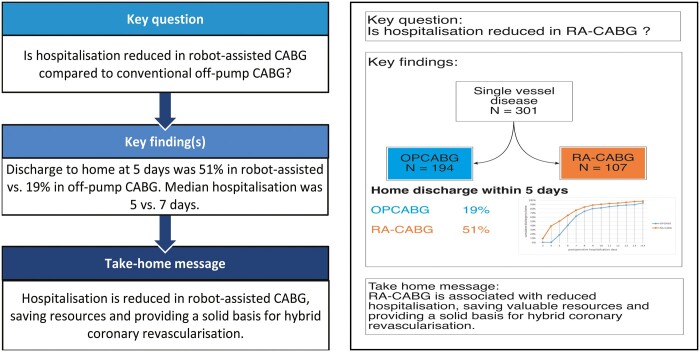
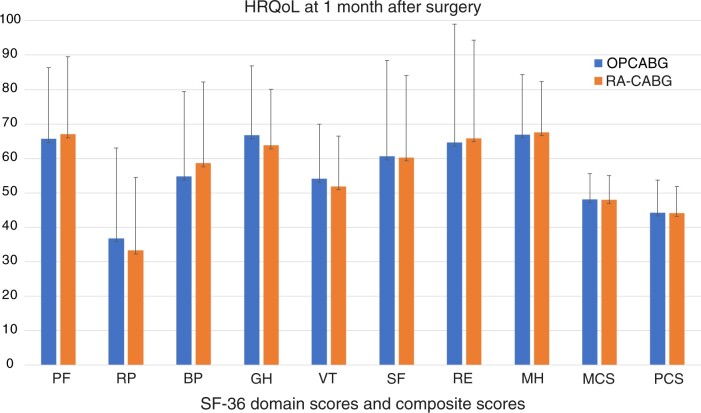
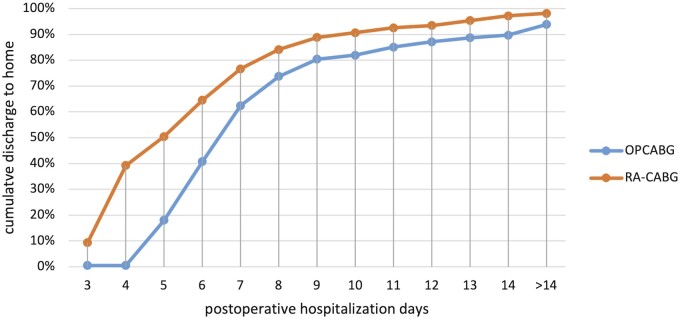
A total of 107 patients who had robot-assisted CABG were compared to 194 patients who had conventional off-pump CABG. The primary outcome was reached in 51% of the robot-assisted group versus 19% of the conventional off-pump group (P < 0.01). The median postoperative hospital stay was 5 days for the robot-assisted group versus 7 days in the conventional off-pump group (P < 0.01). Other secondary outcomes did not differ significantly between the groups, and the quality of life 1 month after the operation was equal. The results after propensity matching were similar.
Early discharge to home is more frequent for patients who have robot-assisted CABG than in those who have conventional off-pump CABG, with no difference in health-related quality of life. Therefore, this approach may reduce healthcare resources and provide a solid basis for hybrid coronary revascularization.
机器人辅助冠状动脉旁路移植术(CABG)作为一种微创替代传统 CABG 的方法,旨在促进术后恢复、提高患者满意度和尽早出院回家。此外,它还可能为杂交冠状动脉血运重建提供基础。为了确定该方法的可行性,我们将机器人辅助 CABG 与传统非体外循环 CABG 进行了比较。
将 2016 年 10 月至 2019 年 7 月期间连续接受机器人辅助左内乳动脉至左前降支 CABG 术的患者与连续接受传统非体外循环 CABG 治疗单支血管疾病的患者进行比较。主要转归为术后 5 天内出院回家。次要转归包括总住院时间、48 小时内再次手术、输血、心房颤动、30 天死亡率和术后 1 个月生活质量。通过倾向评分匹配建立队列以纠正可能的混杂因素。
共比较了 107 例机器人辅助 CABG 患者和 194 例传统非体外循环 CABG 患者。机器人辅助组中 51%的患者达到主要转归,而传统非体外循环组中为 19%(P < 0.01)。机器人辅助组的术后中位住院时间为 5 天,而传统非体外循环组为 7 天(P < 0.01)。其他次要转归两组之间无显著差异,术后 1 个月的生活质量相当。倾向评分匹配后的结果也相似。
与传统非体外循环 CABG 相比,机器人辅助 CABG 患者出院更早,且健康相关生活质量无差异。因此,这种方法可能会减少医疗资源的消耗,并为杂交冠状动脉血运重建提供坚实的基础。