Álvarez-Martín Claudia, Ribera Aida, Marsal Josep Ramon, Ariza-Solé Albert, Pérez-Hoyos Santiago, Oristrell Gerard, Soriano-Colomé Toni, Romaguera Rafael, Pijoan Jose Ignacio, Lidón Rosa M, Mauri Josepa, Ferreira-González Ignacio
Cardiovascular Research and Epidemiology Unit, Cardiology Department, University Hospital Vall d'Hebron and Vall d'Hebron Research Institute, Barcelona, Spain.
Centro de Investigación Biomédica en Red de Epidemiología y Salud Pública (CIBERESP), Madrid, Spain.
Front Cardiovasc Med. 2022 Apr 26;9:827212. doi: 10.3389/fcvm.2022.827212. eCollection 2022.
This study aimed to evaluate the decline in urgent cardiovascular hospital admissions and in-hospital mortality during the COVID pandemic in two successive waves, and to evaluate differences by sex, age, and deprivation index subgroups.
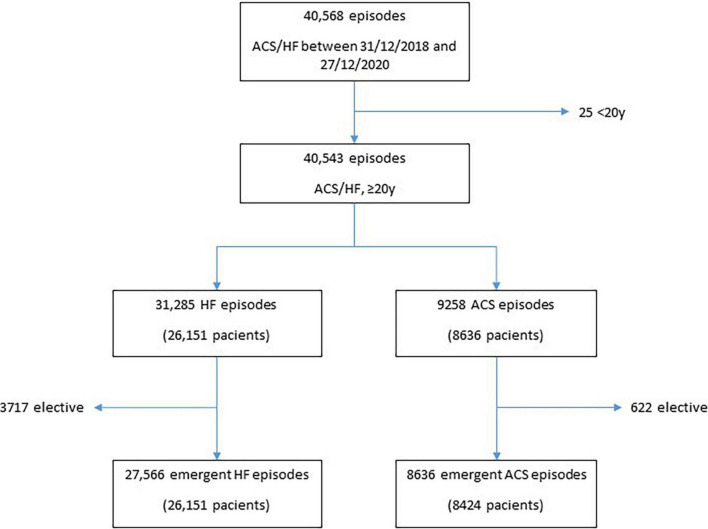
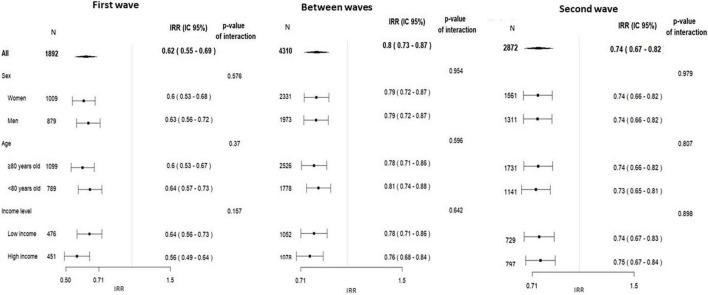
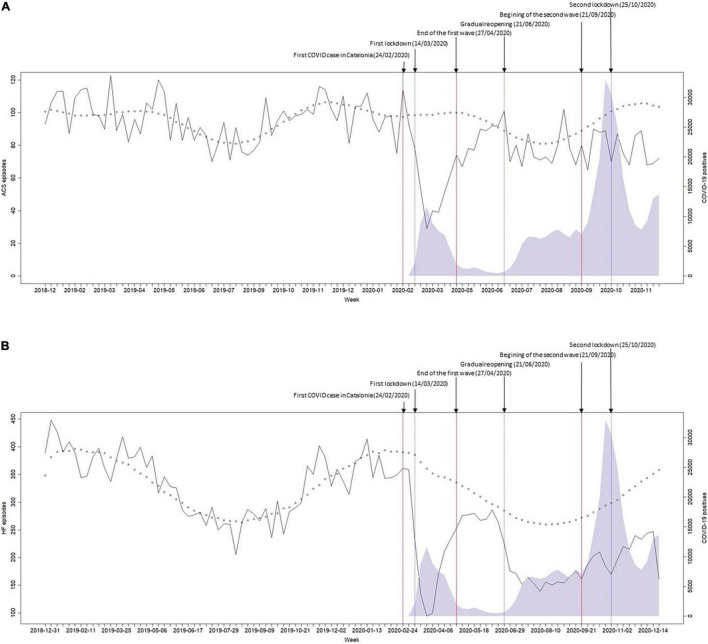
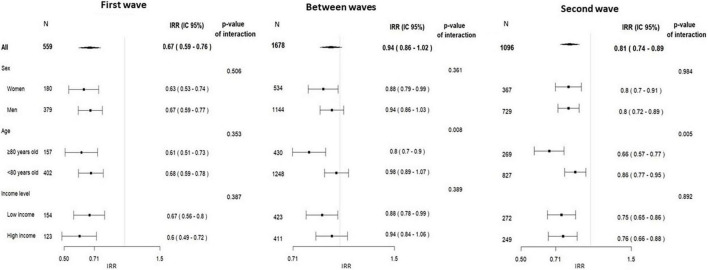
We obtained acute cardiovascular hospital episodes during the years 2019-2020 from region-wide data on public healthcare usage for the population of Catalonia (North-East Spain). We fitted time models to estimate the incidence rate ratios (IRRs) of the acute coronary syndrome (ACS) and acute heart failure (HF) admissions during the first pandemic wave, the between-waves period, and the second wave compared with the corresponding pre-COVID-19 periods and to test for the interaction with sex, age, and area-based socioeconomic level. We evaluated the effect of COVID-19 period on in-hospital mortality. ACS ( = 8,636) and HF ( = 27,566) episodes were defined using primary diagnostic ICD-10 codes. ACS and HF admissions decreased during the first wave (IRR = 0.66, 95%CI: 0.58-0.76 and IRR = 0.61, 95% CI: 0.55-0.68, respectively) and during the second wave (IRR = 0.80, 95%CI: 0.72-0.88 and IRR = 0.76, 95%CI: 0.69-0.84, respectively); acute HF admissions also decreased in the period between waves (IRR: 0.81, 95%CI: 0.74-0.89). The impact was similar in all sex and socioeconomic subgroups and was higher in older patients with ACS. In-hospital mortality was higher than expected only during the first wave.
During the first wave of the COVID-19 pandemic, there was a marked decline in urgent cardiovascular hospital admissions that were attenuated during the second wave. Both the decline and the attenuation of the effect have been similar in all subgroups regardless of age, sex, or socioeconomic status. In-hospital mortality for ACS and HF episodes increased during the first wave, but not during the second wave.
本研究旨在评估新冠疫情期间连续两波紧急心血管疾病住院人数的下降情况以及住院死亡率,并评估不同性别、年龄和贫困指数亚组之间的差异。
我们从加泰罗尼亚地区(西班牙东北部)全体居民的公共医疗使用区域数据中获取了2019 - 2020年期间的急性心血管疾病住院病例。我们拟合时间模型,以估计第一波疫情、两波疫情之间以及第二波疫情期间急性冠状动脉综合征(ACS)和急性心力衰竭(HF)住院人数与相应的新冠疫情前时期相比的发病率比值(IRR),并检验与性别、年龄和基于地区的社会经济水平的相互作用。我们评估了新冠疫情时期对住院死亡率的影响。ACS(n = 8636)和HF(n = 27566)病例使用国际疾病分类第十版(ICD - 10)初级诊断代码进行定义。第一波疫情期间ACS和HF住院人数下降(IRR分别为0.66,95%置信区间:0.58 - 0.76和IRR = 0.61,95%置信区间:0.55 - 0.68),第二波疫情期间也下降(IRR分别为0.80,95%置信区间:0.72 - 0.88和IRR = 0.76,95%置信区间:0.69 - 0.84);两波疫情之间急性HF住院人数也下降(IRR:0.81,95%置信区间:0.74 - 0.89)。所有性别和社会经济亚组的影响相似,且ACS老年患者的影响更高。仅在第一波疫情期间住院死亡率高于预期。
在新冠疫情的第一波期间,紧急心血管疾病住院人数显著下降,第二波疫情期间下降幅度有所减弱。无论年龄、性别或社会经济地位如何,所有亚组的下降和影响减弱情况都相似。ACS和HF病例的住院死亡率在第一波疫情期间有所上升,但在第二波疫情期间没有上升。