Tsigkas Grigorios, Koufou Eleni-Evangelia, Katsanos Konstantinos, Patrinos Panagiotis, Moulias Athanasios, Miliordos Ioannis, Almpanis Georgios, Christodoulou Ioannis, Papanikolaou Fotini, Dimitroula Theodora, Kivetos Andreas, Vardas Panagiotis, Davlouros Periklis
Department of Cardiology, Patras University Hospital, Patras, Greece.
Department of Radiology, Patras University Hospital, Patras, Greece.
Front Cardiovasc Med. 2021 Feb 11;8:604374. doi: 10.3389/fcvm.2021.604374. eCollection 2021.
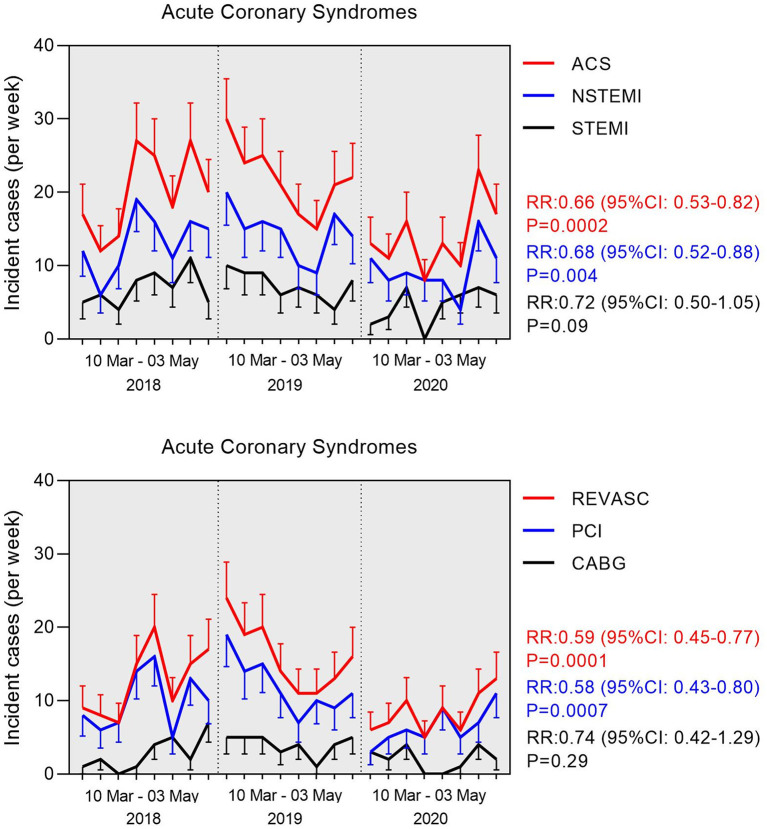
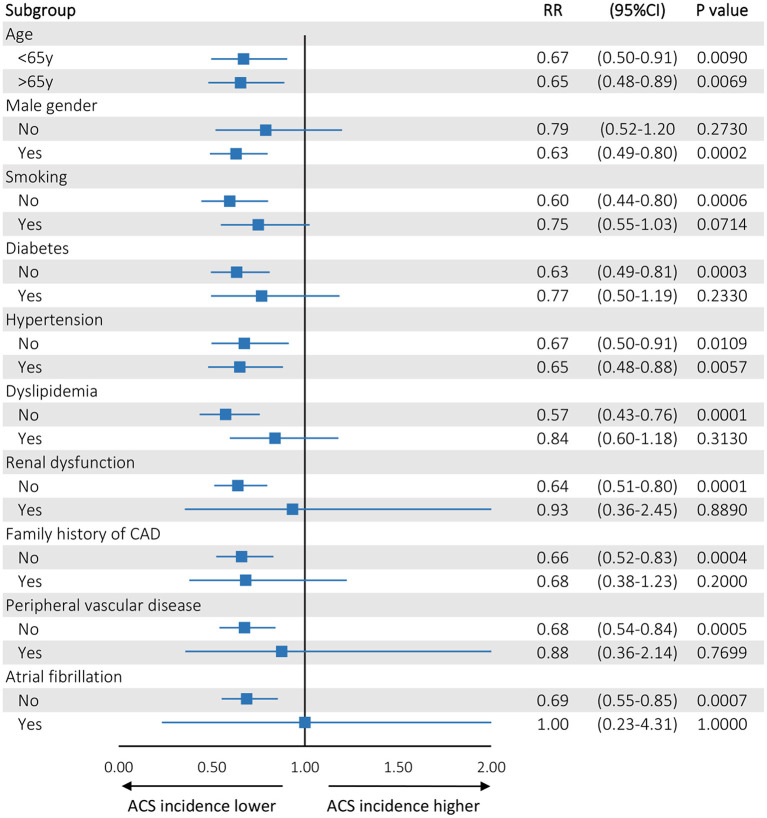
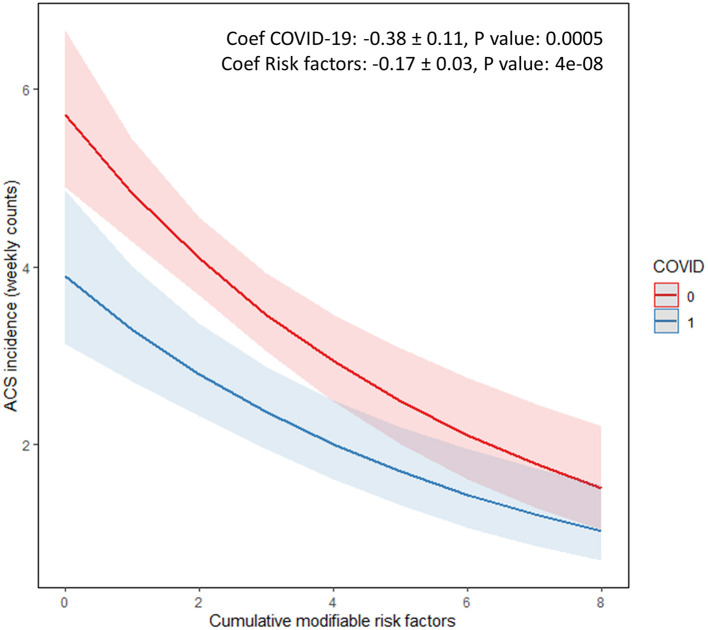
To evaluate the impact of lockdown during the COVID-19 pandemic on lifestyle changes of the general population, and on admissions for acute coronary syndrome (ACS). All ACS admissions during the COVID-19 lockdown (10 March to 4 May, 2020), in 3 municipalities (3 spoke, and 1 hub hospital), in Southwestern Greece (411,576 inhabitants), were prospectively recorded and compared to the equivalent periods during 2018, and 2019. A telephone survey of 1014 participants was conducted to explore the lifestyle habits of citizens aged ≥35-years-old before and during lockdown. The median ACS incidence rate decreased from 19.0 cases per week in 2018 and 21.5 in 2019 down to 13.0 in 2020 (RR: 0.66 during the Covid-19 lockdown; 95%CI: 0.53-0.82; = 0.0002). This was driven by a significant reduction of admissions for Non-ST elevation myocardial infarction (NSTEMI) (RR: 0.68; 95%CI: 0.52-0.88; = 0.0037), mainly in patients with a lower burden of cardiovascular risk factors, as we noticed an inverse association between the reduction of the incidence of ACS during the Covid-19 lockdown period and the number of registered patient risk factors. There was no difference in the rates of STEMI and population-based all-cause mortality across the examined time periods. The telephone survey demonstrated reduction of passive smoking, working hours, alcohol, junk food and salt consumption, and an increase in sleeping hours, mainly in participants with a lower burden of cardiovascular risk factors. A significant decline in ACS admissions during the COVID-19 lockdown was noted, affecting mainly NSTEMI patients with a lower burden of cardiovascular risk factors. This was accompanied by significant lifestyle changes. Thus, it is tempting to speculate that to some extend the latter might be associated with the observed decline in ACS admissions.
为评估新冠疫情期间封锁措施对普通人群生活方式变化以及急性冠状动脉综合征(ACS)入院情况的影响。前瞻性记录了希腊西南部3个市(3个分支及1个中心医院,共411,576名居民)在新冠疫情封锁期间(2020年3月10日至5月4日)的所有ACS入院病例,并与2018年和2019年的同期数据进行比较。对1014名参与者进行了电话调查,以探究≥35岁公民在封锁前及封锁期间的生活习惯。ACS的中位发病率从2018年的每周19.0例和2019年的每周21.5例降至2020年的每周13.0例(相对危险度:新冠疫情封锁期间为0.66;95%置信区间:0.53 - 0.82;P = 0.0002)。这主要是由于非ST段抬高型心肌梗死(NSTEMI)入院人数显著减少(相对危险度:0.68;95%置信区间:0.52 - 0.88;P = 0.0037),主要发生在心血管危险因素负担较低的患者中,因为我们注意到新冠疫情封锁期间ACS发病率的降低与登记的患者危险因素数量呈负相关。在所研究的时间段内,ST段抬高型心肌梗死(STEMI)发病率和基于人群的全因死亡率没有差异。电话调查显示,被动吸烟、工作时长、酒精、垃圾食品和盐的摄入量减少,睡眠时间增加,主要发生在心血管危险因素负担较低的参与者中。新冠疫情封锁期间ACS入院人数显著下降,主要影响心血管危险因素负担较低的NSTEMI患者。同时伴有显著的生活方式变化。因此,很容易推测,在某种程度上,后者可能与观察到的ACS入院人数下降有关。