Lora Jorge, Garcia-Lor Andres, Aleza Pablo
Department of Subtropical Fruit Crops, Instituto de Hortofruticultura Subtropical y Mediterránea La Mayora (IHSM la Mayora-UMA-CSIC), Málaga, Spain.
Centro de Citricultura y Producción Vegetal, Instituto Valenciano de Investigaciones Agrarias, Valencia, Spain.
Front Plant Sci. 2022 Apr 25;13:862813. doi: 10.3389/fpls.2022.862813. eCollection 2022.
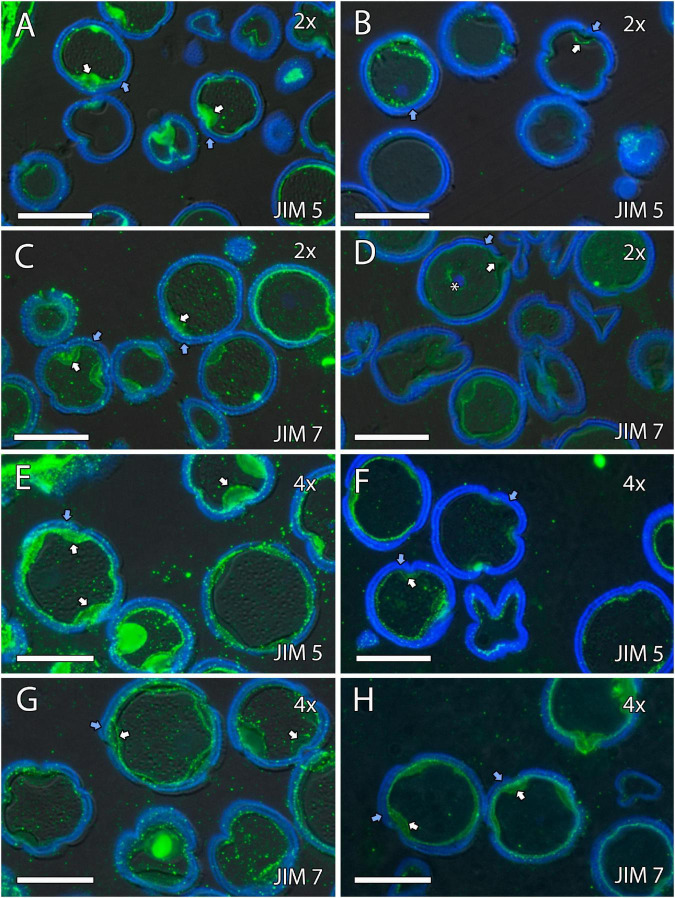
Seedlessness is one of the most important agronomic traits in mandarins on the fresh fruit market. Creation of triploid plants is an important breeding strategy for development of new commercial varieties of seedless citrus. To this end, one strategy is to perform sexual hybridizations, with tetraploid genotypes as male parents. However, while seed development has been widely studied in citrus, knowledge of key steps such as microsporogenesis and microgametogenesis, is scarce, especially in polyploids. Therefore, we performed a study on the effect of ploidy level on pollen development by including diploid and tetraploid (double diploid) genotypes with different degrees of pollen performance. A comprehensive study on the pollen ontogeny of diploid and doubled diploid "Sanguinelli" blood orange and "Clemenules" clementine was performed, with focus on pollen grain germination and , morphology of mature pollen grains by scanning electron microscopy (SEM), cytochemical characterization of carbohydrates by periodic acid-Shiff staining, and specific cell wall components revealed by immunolocalization. During microsporogenesis, the main difference between diploid and doubled diploid genotypes was cell area, which was larger in doubled diploid genotypes. However, after increase in size and vacuolization of microspores, but before mitosis I, doubled diploid "Clemenules" clementine showed drastic differences in shape, cell area, and starch hydrolysis, which resulted in shrinkage of pollen grains. The loss of fertility in doubled diploid "Clemenules" clementine is mainly due to lack of carbohydrate accumulation in pollen during microgametogenesis, especially starch content, which led to pollen grain abortion. All these changes make the pollen of this genotype unviable and very difficult to use as a male parent in sexual hybridization with the objective of recovering large progenies of triploid hybrids.
无核是鲜食柑橘市场上最重要的农艺性状之一。培育三倍体植株是开发无核柑橘新商业品种的重要育种策略。为此,一种策略是进行有性杂交,以四倍体基因型作为父本。然而,虽然柑橘种子发育已得到广泛研究,但对于小孢子发生和雄配子发生等关键步骤的了解却很少,尤其是在多倍体中。因此,我们通过纳入具有不同花粉表现程度的二倍体和四倍体(双二倍体)基因型,开展了一项关于倍性水平对花粉发育影响的研究。对二倍体和双二倍体“桑吉内利”血橙以及“克莱门氏”柑的花粉个体发育进行了全面研究,重点关注花粉粒萌发、通过扫描电子显微镜(SEM)观察成熟花粉粒的形态、用高碘酸 - 希夫染色对碳水化合物进行细胞化学表征以及通过免疫定位揭示特定细胞壁成分。在小孢子发生过程中,二倍体和双二倍体基因型之间的主要差异在于细胞面积,双二倍体基因型的细胞面积更大。然而,在小孢子体积增大和液泡化之后,但在有丝分裂I之前,双二倍体“克莱门氏”柑在形状、细胞面积和淀粉水解方面表现出巨大差异,这导致花粉粒萎缩。双二倍体“克莱门氏”柑育性丧失主要是由于在雄配子发生过程中花粉中碳水化合物积累不足,尤其是淀粉含量,这导致花粉粒败育。所有这些变化使得该基因型的花粉无法存活,并且很难用作有性杂交的父本以获得大量三倍体杂种后代。