Martens Marvin, Kreidl Franziska, Ehrhart Friederike, Jean Didier, Mei Merlin, Mortensen Holly M, Nash Alistair, Nymark Penny, Evelo Chris T, Cerciello Ferdinando
Department of Bioinformatics - BiGCaT, NUTRIM, Maastricht University, Maastricht, Netherlands.
Department of Bioinformatics - BiGCaT, MHeNs, Maastricht University, Maastricht, Netherlands.
Front Oncol. 2022 Apr 26;12:849640. doi: 10.3389/fonc.2022.849640. eCollection 2022.
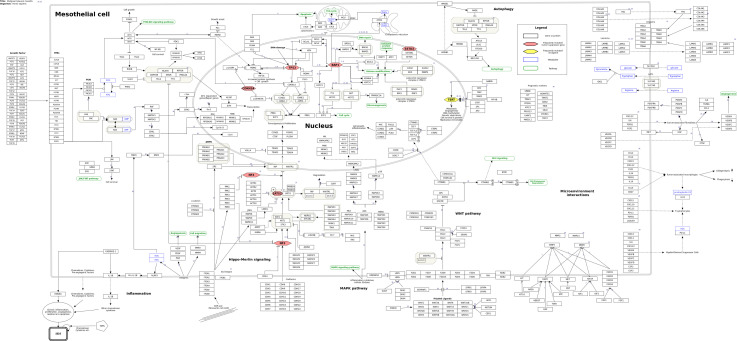
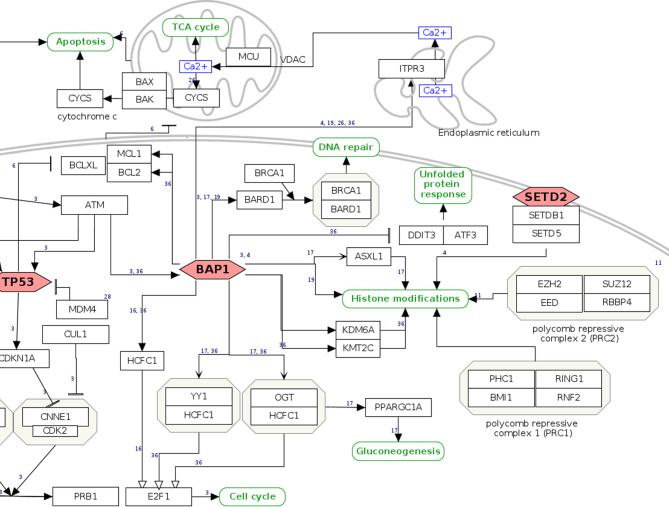
Malignant pleural mesothelioma (MPM) is a highly aggressive malignancy mainly triggered by exposure to asbestos and characterized by complex biology. A significant body of knowledge has been generated over the decades by the research community which has improved our understanding of the disease toward prevention, diagnostic opportunities and new treatments. Omics technologies are opening for additional levels of information and hypotheses. Given the growing complexity and technological spread of biological knowledge in MPM, there is an increasing need for an integrating tool that may allow scientists to access the information and analyze data in a simple and interactive way. We envisioned that a platform to capture this widespread and fast-growing body of knowledge in a machine-readable and simple visual format together with tools for automated large-scale data analysis could be an important support for the work of the general scientist in MPM and for the community to share, critically discuss, distribute and eventually advance scientific results. Toward this goal, with the support of experts in the field and informed by existing literature, we have developed the first version of a molecular pathway model of MPM in the biological pathway database WikiPathways. This provides a visual and interactive overview of interactions and connections between the most central genes, proteins and molecular pathways known to be involved or altered in MPM. Currently, 455 unique genes and 247 interactions are included, derived after stringent manual curation of an initial 39 literature references. The pathway model provides a directly employable research tool with links to common databases and repositories for the exploration and the analysis of omics data. The resource is publicly available in the WikiPathways database (Wikipathways : WP5087) and continues to be under development and curation by the community, enabling the scientists in MPM to actively participate in the prioritization of shared biological knowledge.
恶性胸膜间皮瘤(MPM)是一种侵袭性很强的恶性肿瘤,主要由接触石棉引发,具有复杂的生物学特性。几十年来,研究界积累了大量知识,增进了我们对该疾病在预防、诊断机会和新治疗方法方面的理解。组学技术为获取更多信息层次和假设开辟了道路。鉴于MPM生物学知识的复杂性不断增加且技术广泛传播,越来越需要一种整合工具,使科学家能够以简单且交互式的方式获取信息并分析数据。我们设想,一个以机器可读且简单直观的格式捕获这一广泛且快速增长的知识体系的平台,再加上用于自动化大规模数据分析的工具,可能会对MPM领域的普通科学家的工作以及科学界共享、批判性讨论、传播并最终推动科学成果提供重要支持。为实现这一目标,在该领域专家的支持下并参考现有文献,我们在生物通路数据库WikiPathways中开发了MPM分子通路模型的首个版本。这提供了一个直观且交互式的概述,展示了已知参与MPM或在MPM中发生改变的最核心基因、蛋白质和分子通路之间的相互作用和联系。目前,经过对最初39篇文献参考进行严格的人工编目后,该通路模型包含455个独特基因和247个相互作用。该通路模型提供了一个可直接使用的研究工具,带有指向常见数据库和储存库的链接,用于探索和分析组学数据。该资源在WikiPathways数据库(Wikipathways : WP5087)中公开可用,并将继续由社区进行开发和编目,使MPM领域的科学家能够积极参与共享生物学知识的优先级排序。