Cutroneo Sara, Angelino Donato, Tedeschi Tullia, Pellegrini Nicoletta, Martini Daniela
Food and Drug Department, University of Parma, Parma, Italy.
Faculty of Bioscience and Agro-Food and Environmental Technology, University of Teramo, Teramo, Italy.
Front Nutr. 2022 Apr 26;9:852831. doi: 10.3389/fnut.2022.852831. eCollection 2022.
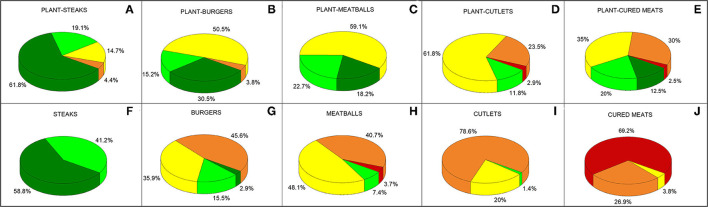
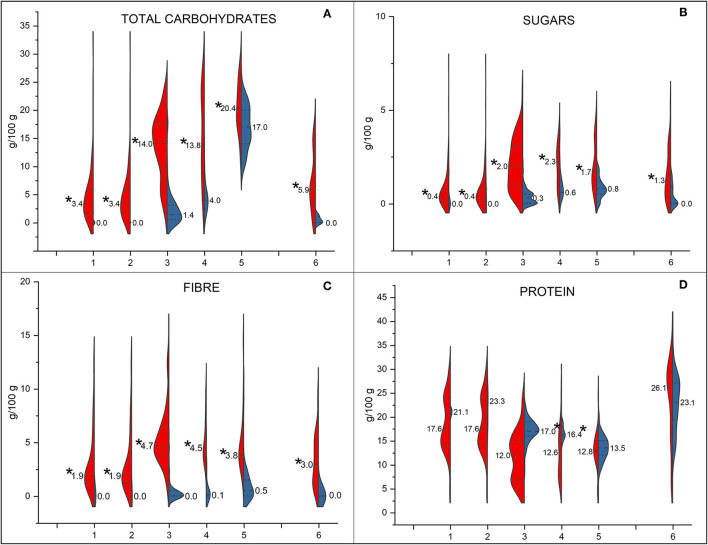
Nowadays, the interest in meat substitutes is increasing, and consumers perceive their nutritional quality better than that of the animal products they intend to resemble. Therefore, this work aimed to investigate the overall nutritional quality of these new products. Regulated information [Regulation (EU) 1169/2011], the presence/absence of nutrition or health claim and organic declarations, the gluten-free indication, and the number of ingredients were collected from the food labels of 269 commercial meat analogues currently sold on the Italian market. Nutritional information of reference animal meat products was used to compare the nutrition profile. As an indicator of the nutritional quality, the Nutri-Score of meat analogues and counterparts was also determined. Plant-based steaks showed significantly higher protein, lower energy, fats and salt contents, and better Nutri-Scores than the other analogues. All the meat analogues showed a higher fibre content than meat products, while plant-based burgers and meatballs had lower protein contents than meat counterparts. Ready-sliced meat analogues showed a lower salt content than cured meats. Overall, all these plant-based products showed a longer list of ingredients than animal meat products. Results from this survey highlighted that plant-based steaks, cutlets, and cured meats have some favourable nutritional aspects compared to animal-based products. However, they cannot be considered a "" alternative to meat products from a nutritional point of view.
如今,人们对肉类替代品的兴趣日益增加,消费者认为它们的营养质量优于其想要模仿的动物产品。因此,这项工作旨在研究这些新产品的整体营养质量。从目前在意大利市场上销售的269种商业肉类替代品的食品标签中收集了规范性信息[欧盟法规(EU)1169/2011]、营养或健康声明的有无以及有机声明、无麸质标识和成分数量。使用参考动物肉类产品的营养信息来比较营养概况。作为营养质量的指标,还测定了肉类替代品及其对照品的营养评分。植物性牛排的蛋白质含量显著更高,能量、脂肪和盐含量更低,且营养评分优于其他替代品。所有肉类替代品的纤维含量均高于肉类产品,而植物性汉堡和肉丸的蛋白质含量低于肉类对照品。即食切片肉类替代品的盐含量低于腌肉。总体而言,所有这些植物性产品的成分列表都比动物肉类产品更长。本次调查结果突出表明,与动物性产品相比,植物性牛排、肉片和腌肉具有一些有利的营养方面。然而,从营养角度来看,它们不能被视为肉类产品的“替代品”。