Shefler Alanna, Patrick Matthew T, Wasikowski Rachael, Chen Jiahan, Sarkar Mrinal K, Gudjonsson Johann E, Tsoi Lam C
Department of Dermatology, University of Michigan Medical School, Ann Arbor, MI, United States.
Department of Biostatistics, University of Michigan, Ann Arbor, MI, United States.
Front Genet. 2022 Apr 26;13:835740. doi: 10.3389/fgene.2022.835740. eCollection 2022.
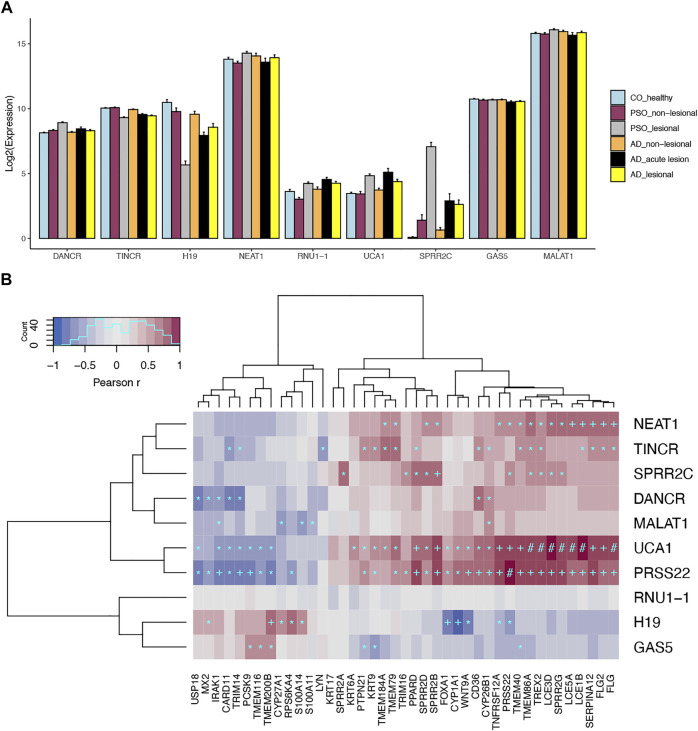
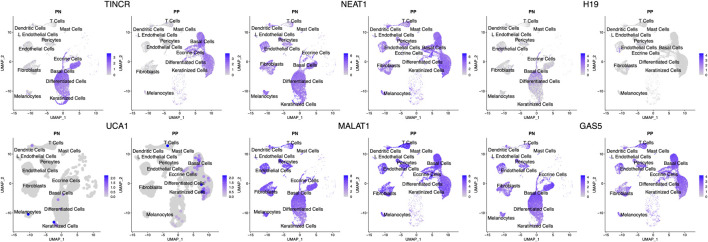
Long non-coding RNAs (lncRNAs) have attracted attention for their potential roles in modulating keratinocyte differentiation and inflammatory response; however, for many identified skin-expressing lncRNAs, there is no comprehensive characterization regarding their biological roles. In addition, the reported expression profiles for lncRNAs can be ambiguous due to their low-expressing nature. The objective of this review is to utilize large scale genomic data to characterize the prominent skin-expressing lncRNAs, aiming to provide additional insights for their potential roles in the pathology of inflammatory skin of psoriasis and atopic dermatitis by integrating and data. We highlighted the different skin-expressing lncRNAs, including , which is significantly down-regulated in lesional skin of AD/psoriasis and upon cytokine stimulation in keratinocytes; it is also negatively correlated with ( = -0.75, = 8 × 10), a gene involved in drug metabolism and skin barrier homeostasis, in keratinocytes. In addition, , a potential regulator that modulates IL-22 stimulation, was upregulated in both atopic dermatitis and psoriasis lesional skin and was also downstream of the IL-17A and IL-17 + TNF signaling in keratinocytes. Using scRNAseq, we further revealed the cell type specificity of lncRNAs, including basal-expressing nature of in the epidermis. Interestingly, instead of having cell type specific expression profile, we found few lncRNAs that are express across different cell types in skin, including , , and . While lncRNAs in general have lower expression, our results combining and experimental data demonstrate how some of these lncRNAs can play mediator roles in the cytokine-stimulated pathway.
长链非编码RNA(lncRNAs)因其在调节角质形成细胞分化和炎症反应中的潜在作用而受到关注;然而,对于许多已鉴定出的皮肤表达lncRNAs,其生物学作用尚无全面的表征。此外,由于lncRNAs的低表达特性,其报道的表达谱可能存在歧义。本综述的目的是利用大规模基因组数据来表征突出的皮肤表达lncRNAs,旨在通过整合和数据,为其在银屑病和特应性皮炎等炎症性皮肤病病理学中的潜在作用提供更多见解。我们强调了不同的皮肤表达lncRNAs,包括,其在AD/银屑病的皮损皮肤以及角质形成细胞受到细胞因子刺激时显著下调;在角质形成细胞中,它还与(= -0.75,= 8×10)呈负相关,是一个参与药物代谢和皮肤屏障稳态的基因。此外,作为调节IL-22刺激的潜在调节因子,在特应性皮炎和银屑病皮损皮肤中均上调,并且在角质形成细胞中也是IL-17A和IL-17 + TNF信号的下游。使用单细胞RNA测序,我们进一步揭示了lncRNAs的细胞类型特异性,包括在表皮中的基础表达性质。有趣的是,我们发现很少有lncRNAs在皮肤的不同细胞类型中表达,而不是具有细胞类型特异性表达谱,包括,和。虽然lncRNAs总体表达较低,但我们结合和实验数据的结果表明,这些lncRNAs中的一些如何在细胞因子刺激途径中发挥介导作用。