Volkova Kseniia, Heupel Julia, Trofimov Sergei, Betz Fridtjof, Colom Rémi, MacQueen Rowan W, Akhundzada Sapida, Reginka Meike, Ehresmann Arno, Reithmaier Johann Peter, Burger Sven, Popov Cyril, Naydenov Boris
Department Spins in Energy Conversion and Quantum Information Science (ASPIN), Helmholtz-Zentrum Berlin für Materialien und Energie GmbH, Hahn-Meitner-Platz 1, 14109 Berlin, Germany.
Institute of Nanostructure Technologies and Analytics (INA), Center for Interdisciplinary Nanostructure Science and Technology (CINSaT), University of Kassel, Heinrich-Plett-Str. 40, 34132 Kassel, Germany.
Nanomaterials (Basel). 2022 Apr 29;12(9):1516. doi: 10.3390/nano12091516.
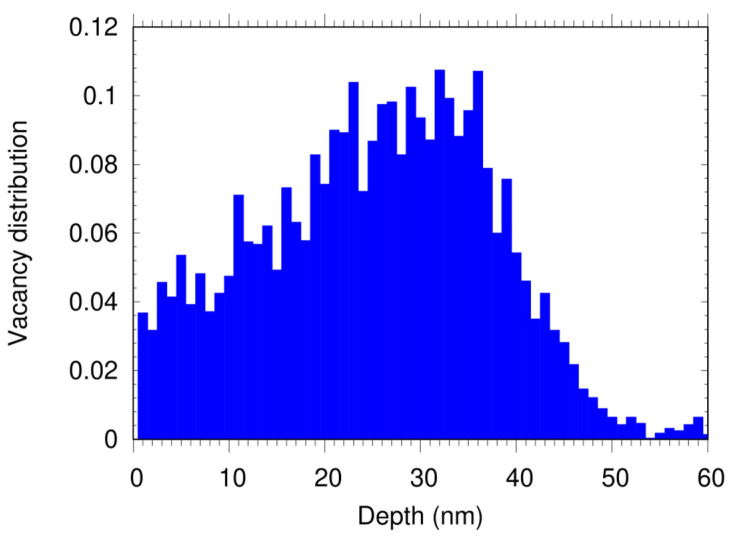
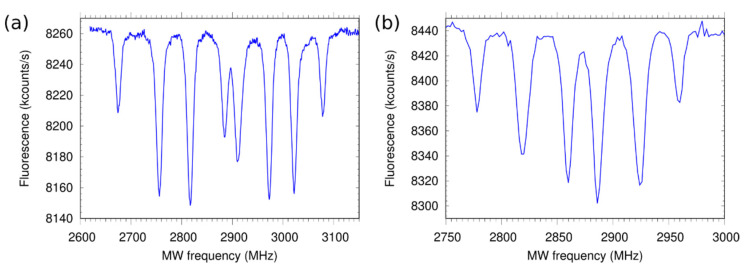
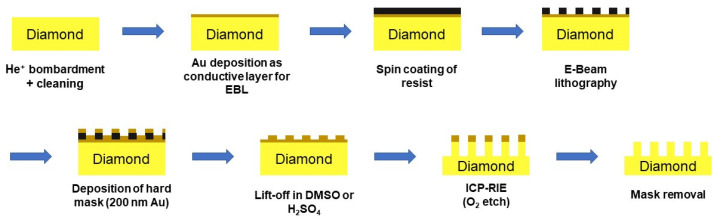
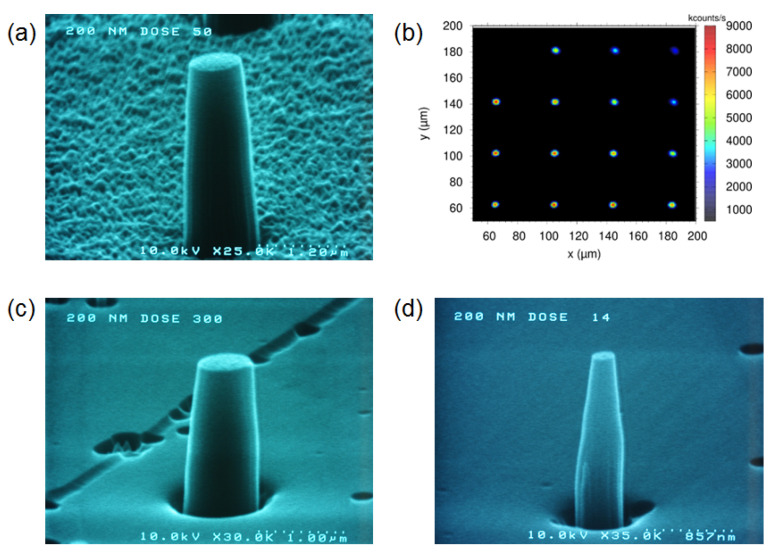
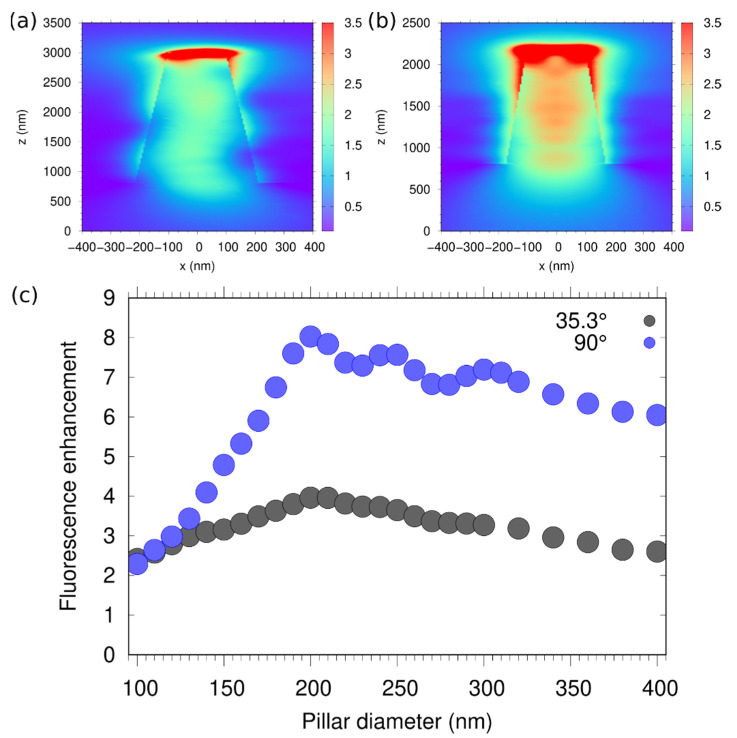
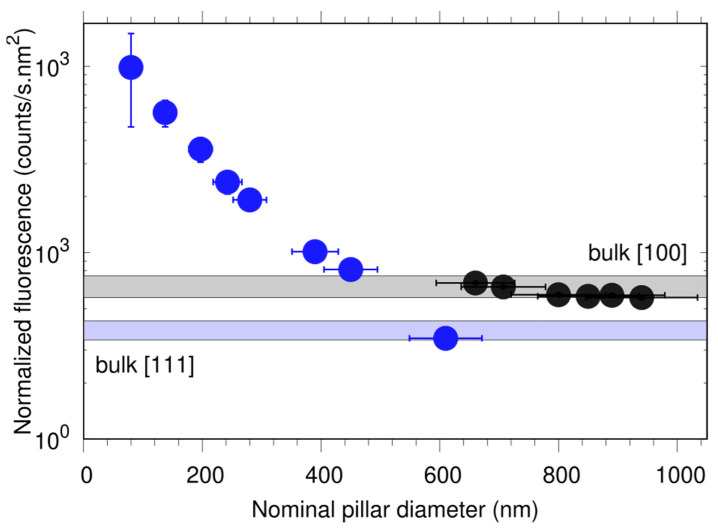
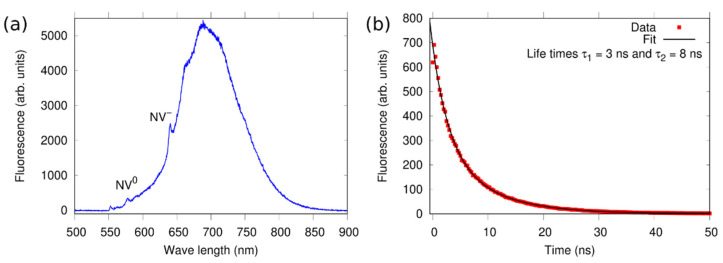
Nitrogen-vacancy (NV) color centers in diamond are excellent quantum sensors possessing high sensitivity and nano-scale spatial resolution. Their integration in photonic structures is often desired, since it leads to an increased photon emission and also allows the realization of solid-state quantum technology architectures. Here, we report the fabrication of diamond nano-pillars with diameters up to 1000 nm by electron beam lithography and inductively coupled plasma reactive ion etching in nitrogen-rich diamonds (type Ib) with [100] and [111] crystal orientations. The NV centers were created by keV-He ion bombardment and subsequent annealing, and we estimate an average number of NVs per pillar to be 4300 ± 300 and 520 ± 120 for the [100] and [111] samples, respectively. Lifetime measurements of the NVs' excited state showed two time constants with average values of τ ≈ 2 ns and τ ≈ 8 ns, which are shorter as compared to a single color center in a bulk crystal (τ ≈ 10 ns). This is probably due to a coupling between the NVs as well as due to interaction with bombardment-induced defects and substitutional nitrogen (P1 centers). Optically detected magnetic resonance measurements revealed a contrast of about 5% and average coherence and relaxation times of T [100] = 420 ± 40 ns, T [111] = 560 ± 50 ns, and T [100] = 162 ± 11 μs, T [111] = 174 ± 24 μs. These pillars could find an application for scanning probe magnetic field imaging.
金刚石中的氮空位(NV)色心是具有高灵敏度和纳米级空间分辨率的优秀量子传感器。人们常常希望将它们集成到光子结构中,因为这会增加光子发射,还能实现固态量子技术架构。在此,我们报告了通过电子束光刻和电感耦合等离子体反应离子刻蚀,在具有[100]和[111]晶体取向的富氮金刚石(Ib型)中制备直径达1000 nm的金刚石纳米柱。通过keV-He离子轰击和后续退火产生NV色心,我们估计[100]和[111]样品中每个纳米柱的NV平均数量分别为4300±300和520±120。对NV激发态的寿命测量显示出两个时间常数,平均值分别为τ≈2 ns和τ≈8 ns,与块状晶体中的单个色心(τ≈10 ns)相比更短。这可能是由于NV之间的耦合以及与轰击诱导的缺陷和替代氮(P1中心)的相互作用。光探测磁共振测量显示对比度约为5%,[100]的平均相干时间和弛豫时间为T[100]=420±40 ns,T[111]=560±50 ns,T[100]=162±11 μs,T[111]=174±24 μs。这些纳米柱可用于扫描探针磁场成像。